

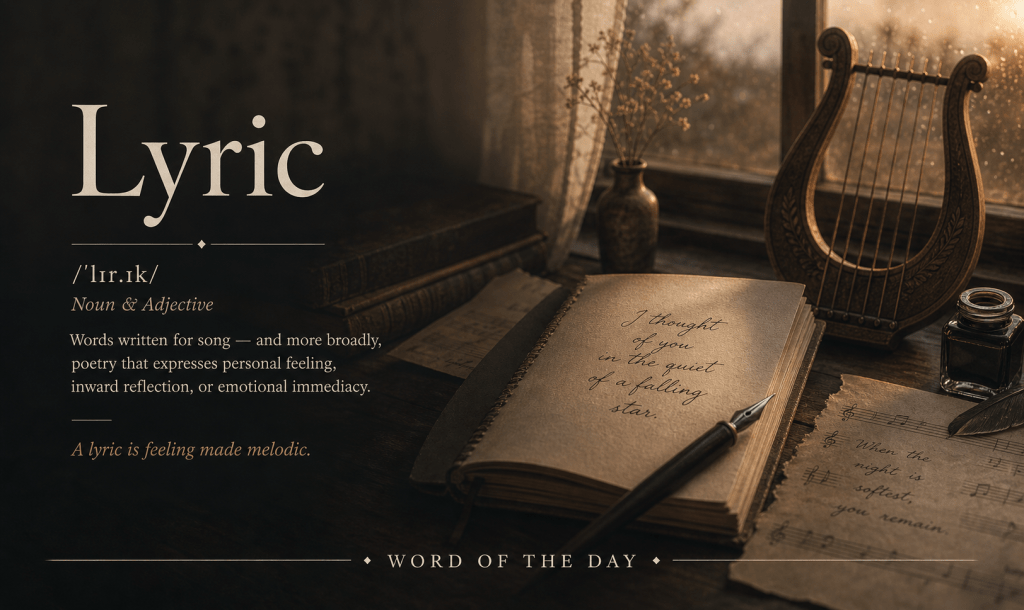
Lyric
IPA Pronunciation: /ˈlɪr.ɪk/
Part of Speech: Noun & Adjective
Origin
Lyric belongs to the vocabularies of poetry, music, and intimate expression. It refers to words written for song — and more broadly, to poetry that expresses personal feeling, inward reflection, or emotional immediacy.
It suggests language shaped not only by meaning, but by music and emotional concentration.
A lyric is feeling made melodic.
Etymology
From Greek: lyrikos — singing to the lyre
From lyra — lyre, the stringed instrument associated with song and poetry
The word preserves its origin in music: poetry meant to be sung.
Core Definitions
Words of a Song
The verbal component of music.
“She memorized the lyrics.”
Short Emotional Poem
A poem expressing personal feeling or reflection.
“He wrote a lyric about loss.”
(Adjective) Expressive and Musical
Describing language marked by emotional intensity and musical quality.
Explanation & Nuance
Lyric differs from narrative or dramatic forms.
It emphasizes:
Emotion
Subjectivity
Musicality
Condensed expression
Rather than telling a story, lyric often captures:
A moment
A feeling
A perception
An inward state
It is less concerned with events than with experience.
Poetic Dimension
Lyric poetry often includes:
Rhythm
Repetition
Imagery
Musical sound patterns
It may be:
Formal — with meter and rhyme
Free — guided by cadence and voice
Its power lies in intensity rather than scale.
Musical Context
In music, lyrics:
Carry voice and meaning
Shape emotional resonance
Transform melody into speech with memory
A lyric may outlive the song itself because language becomes memorable through rhythm.
Poetic & Literary Use
Lyric is central to poetry because it gives language emotional immediacy.
It often appears in writing about:
Love
Loss
Longing
Nature
Memory
Solitude
Desire
Wonder
Unlike epic or dramatic verse, lyric turns inward.
It is poetry of the self in relation to feeling.
Symbolic Dimensions
Voice — personal expression
String — resonance and vibration
Breath — speech made musical
Mirror — reflection of inner life
Song — emotion carried through sound
Lyric symbolizes the meeting of feeling and form.
Synonyms & Near-Relations
Verse — poetic line or composition
Song text — literal musical words
Elegy — lyric poem of mourning
Ode — formal lyric address
Ballad — narrative song (contrast)
Only lyric fully joins poetry, music, and intimate emotional expression.
Conceptual Relations
Emotion — central content
Music — shaping force
Voice — personal expression
Memory — strengthened through rhythm
Intimacy — closeness of feeling
Cultural & Intellectual Resonance
Poetry
Lyric is one of the oldest and most enduring poetic forms.
Music
Lyrics give songs identity and emotional precision.
Philosophy
Lyric raises questions about selfhood and expression.
Psychology
It reflects how emotion seeks form through language.
Takeaway
Lyric names the moment when feeling becomes singable —
when language moves close enough to music
that emotion begins to resonate.
It reminds us that not all truth is argumentative,
that some understanding arrives through rhythm and voice,
and that the smallest poem
can hold the largest feeling.
In poetry, lyric is the inward voice made audible —
a brief chamber of emotion,
where thought becomes music,
and feeling
finds its exact shape in sound.
Some words are written to be understood. Others are written to be felt.

 Word Nook
Leave a comment