
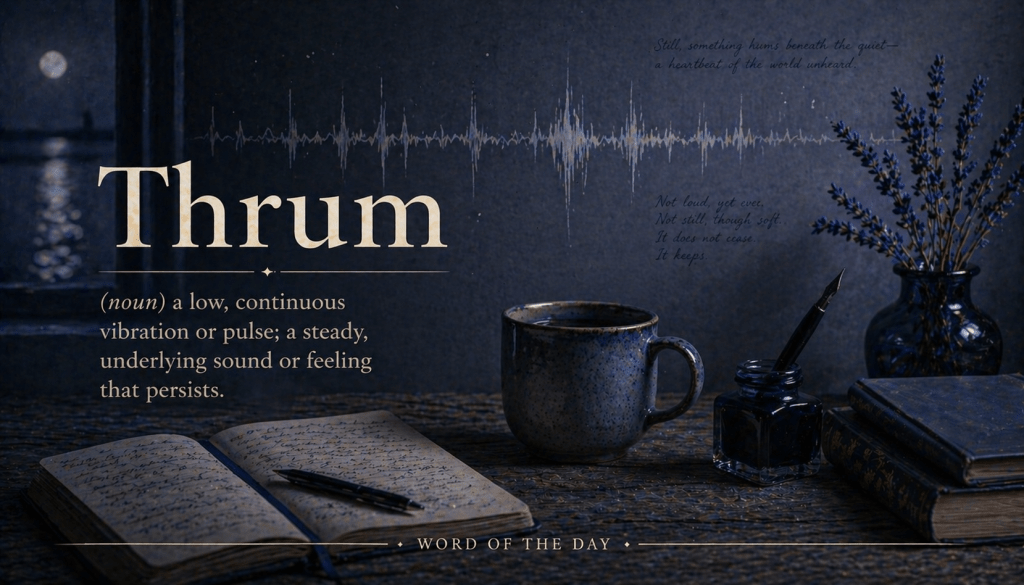
Thrum
IPA Pronunciation: /θrʌm/
Part of Speech: Noun & Verb
Origin
Thrum belongs to the vocabularies of sound, vibration, and quiet persistence. It refers to a continuous low, rhythmic humming or vibrating sound — often soft, steady, and felt as much as heard.
It suggests an underlying pulse rather than a sharp noise.
A thrum is sound that hums beneath attention.
Etymology
From Middle English: thrumme — the end of a thread, tuft
Later associated with the repetitive plucking of strings, creating a low, resonant vibration.
The word carries both tactile and acoustic texture.
Core Definitions
Low Continuous Hum
A steady, vibrating sound.
“The engine gave a quiet thrum.”
Rhythmic Vibration
A persistent pulse felt through sound or motion.
(Verb) To Hum or Vibrate Softly
“To thrum beneath the floorboards.”
Explanation & Nuance
Thrum differs from louder sounds like roar or clang.
It is:
Low
Continuous
Textured
Often backgrounded
It may come from:
Machines — engines, wires, distant motors
Nature — insects, wind, hidden movement
Emotion — metaphorical inner tension or anticipation
It is often perceived more as atmosphere than event.
Acoustic Dimension
A thrum is characterized by:
Low frequency
Steady repetition
Soft resonance
It often creates:
Ambient presence
Physical vibration
Subtle tension
Unlike a murmur, which is airy and diffuse, thrum feels grounded and pulsing.
Experiential Dimension
A thrum can evoke:
Anticipation — something building beneath calm
Comfort — steady familiar sound
Unease — hidden persistent pressure
Vitality — quiet life beneath stillness
It suggests something ongoing, rarely fully absent.
Symbolic Dimensions
Pulse — steady hidden life
String — vibration under tension
Engine — sustained unseen force
Undercurrent — movement beneath the surface
Heartbeat — internal rhythm
Thrum symbolizes continuity sustained below conscious focus.
Synonyms & Near-Relations
Hum — steady low sound
Drone — continuous monotone sound
Vibration — physical oscillation
Murmur — softer, less rhythmic sound
Buzz — sharper continuous sound
(Only thrum strongly conveys a low, rhythmic, almost tactile vibration.)
Conceptual Relations
Rhythm — repeated pulse
Sound — continuous low presence
Tension — held energy
Atmosphere — background sensation
Persistence — ongoing subtle force
Cultural & Intellectual Resonance
Literature
Thrum evokes hidden life, suspense, and atmospheric depth.
Music
It suggests bass resonance and sustained tonal presence.
Technology
Used for engines, electrical systems, and mechanical hum.
Psychology
It mirrors low-level emotional tension or anticipation.
Takeaway
Thrum names the quiet pulse beneath the surface —
a sound that does not demand attention,
yet shapes the feeling of a place.
It reminds us that presence is not always loud,
that energy often moves in low frequencies,
and that what persists softly
can define the whole atmosphere.
A thrum is the hidden rhythm of things —
a steady vibration,
felt in the floor,
the chest,
the silence between louder sounds.
A thrum isn’t heard—it’s felt beneath everything.


 Word Nook
Leave a comment