
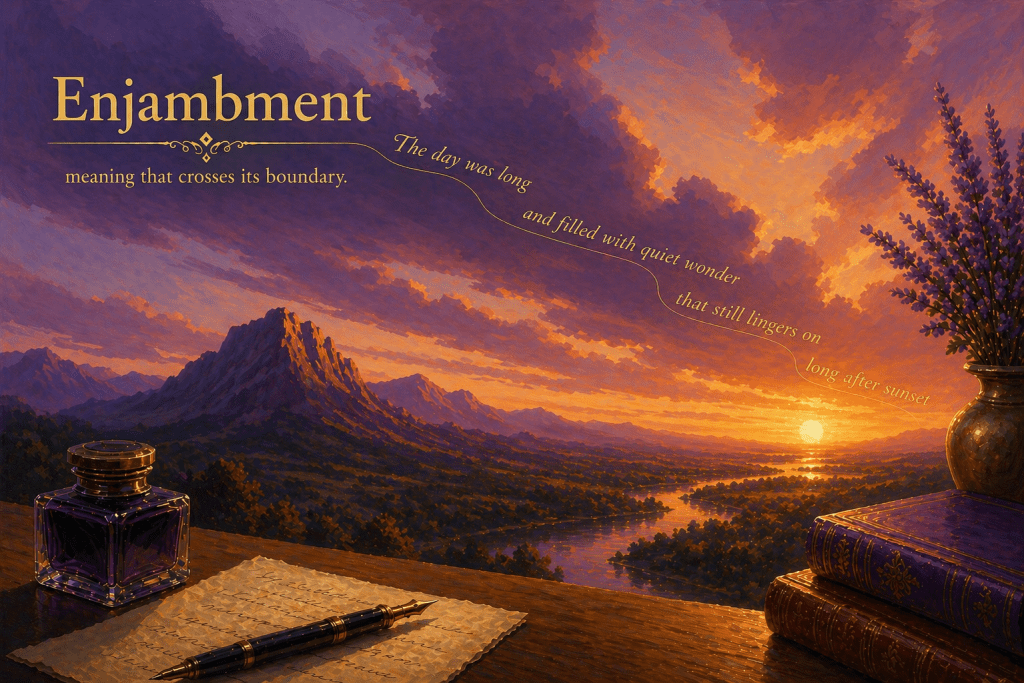
Enjambment
IPA Pronunciation: /ɪnˈdʒæmb.mənt/
Part of Speech: Noun
Origin
Enjambment belongs to the vocabularies of poetry, form, and movement. It refers to the continuation of a sentence or phrase beyond the end of a line, without a pause or terminal punctuation.
It is language refusing to stop where the line ends.
Enjambment is meaning that crosses its boundary.
Etymology
From French: enjambement — a striding over
From enjamber — to step across, to stride
The word preserves the image of movement that passes over a limit.
Core Definitions
Line Continuation
The carrying of a sentence over from one line to the next without pause.
“The poem uses enjambment.”
Poetic Device
A technique that breaks alignment between line and syntax.
Flow Across Boundaries
A movement of meaning beyond structural limits.
Explanation & Nuance
Enjambment disrupts the expectation that a line contains a complete thought.
It creates:
Forward motion
Tension between line and sentence
Delay in resolution
Unlike end-stopped lines, enjambment:
Pushes the reader onward
Suspends meaning
Links lines into a continuous flow
It allows syntax to exceed structure.
Structural Dimension
In enjambment:
The line break occurs mid-thought
The sentence continues into the next line
Meaning unfolds across boundaries
This produces:
Momentum
Surprise
Layered reading (line vs. sentence)
The reader experiences both pause and continuation simultaneously.
Experiential Dimension
Enjambment can evoke:
Urgency — movement without stopping
Fluidity — seamless progression
Ambiguity — temporary uncertainty
Emphasis — meaning shaped by placement
It alters how time and rhythm are felt in reading.
Symbolic Dimensions
Stride — crossing over
Line Break — boundary challenged
Current — uninterrupted flow
Gap — space between units
Continuation — refusal to end
Enjambment symbolizes movement that resists containment.
Synonyms & Near-Relations
Run-on line — descriptive term
Line break — structural division
Caesura — pause within a line (contrast)
End-stop — line with complete thought (contrast)
Flow — continuous movement
(Only enjambment specifically denotes the continuation of syntax across line breaks.)
Conceptual Relations
Form — structure of the poem
Syntax — arrangement of language
Rhythm — pacing of reading
Boundary — limit of the line
Movement — progression of meaning
Cultural & Intellectual Resonance
Poetry
Enjambment is a key device in modern and classical verse.
Literary Theory
It illustrates tension between structure and meaning.
Reading Experience
It shapes how a poem is perceived in time.
Artistic Expression
It reflects the idea that meaning can exceed imposed limits.
Takeaway
Enjambment names the moment when language crosses its line —
when structure pauses,
but meaning continues.
It reminds us that boundaries are not always endpoints,
that thought can exceed form,
and that movement can persist through interruption.
Enjambment is a step beyond the edge —
a continuation that carries sense forward,
line into line,
without stopping
where it is told to stop.
Enjambment is where the line ends—but the thought keeps going.

 Word Nook
Leave a comment