
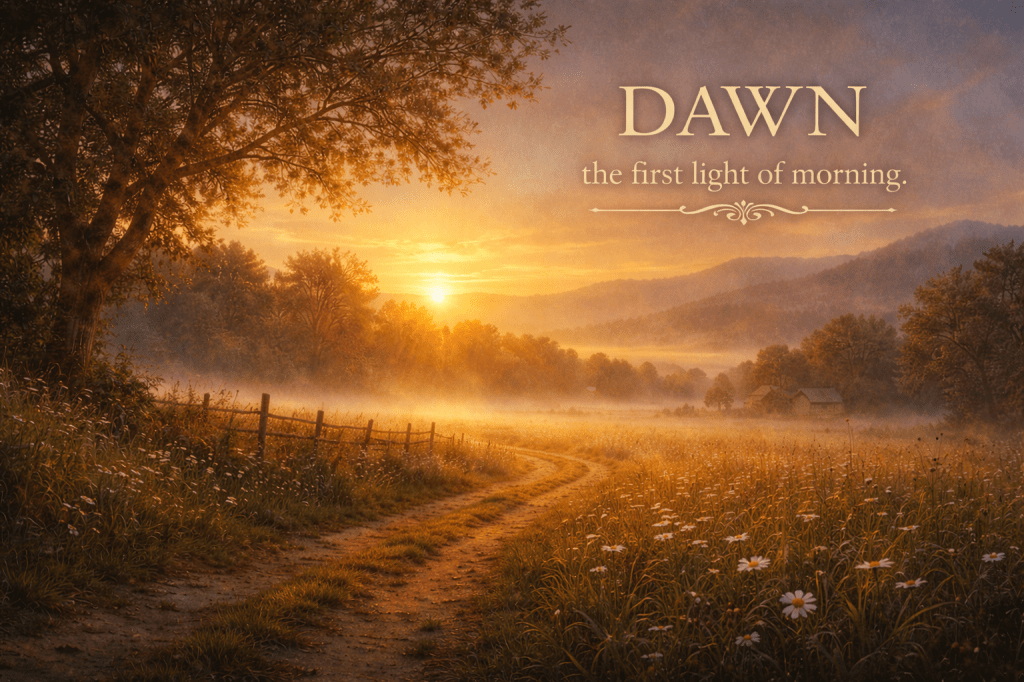
Dawn
IPA Pronunciation: /dɔːn/
Part of Speech: Noun (also Verb)
Origin
Dawn belongs to the vocabularies of time, light, and transition. It refers to the first appearance of light in the sky before sunrise — the moment when night begins to give way to day.
Beyond its literal sense, it also marks beginnings: the emergence of awareness, clarity, or change.
Dawn is the arrival of light before the sun.
Etymology
From Old English: dagian — to become day
Related to dæg — day
The word carries the sense of gradual becoming — not sudden, but unfolding.
Core Definitions
First Light of Day
The time when the sky begins to brighten before sunrise.
“They set out at dawn.”
Beginning or Emergence
The start of something new or the realization of understanding.
“A new era dawned.”
(Verb) To Begin to Appear
To start to become visible or understood.
“It dawned on her.”
Explanation & Nuance
Dawn is not a single instant, but a process.
It unfolds in stages:
Faint light
Color in the sky
Gradual illumination
It is characterized by:
Softness rather than brightness
Transition rather than completion
Anticipation rather than fulfillment
Dawn exists between states — no longer night, not yet day.
Natural & Scientific Context
Dawn corresponds to phases of twilight:
Astronomical twilight — first faint light
Nautical twilight — horizon becomes visible
Civil twilight — sufficient light for daily activity
These stages reflect the sun’s position below the horizon and the gradual scattering of light in the atmosphere.
Sensory Qualities
Dawn often carries:
Cool air
Muted colors shifting to warmth
Quiet or first sounds of activity
Stillness before movement
It is a time when the world feels suspended between rest and motion.
Symbolic Dimensions
Light — emergence of clarity
Horizon — threshold of change
Gradient — gradual transformation
Silence — anticipation
First Step — beginning of action
Dawn symbolizes renewal, awakening, and possibility.
Synonyms & Near-Relations
Sunrise — moment the sun appears (later than dawn)
Daybreak — early morning light
Morning — broader time period
Aurora — poetic term for dawn
First light — descriptive phrase
(Only dawn fully captures the gradual emergence before sunrise.)
Conceptual Relations
Time — cyclical progression
Change — movement between states
Awakening — shift into awareness
Hope — expectation of what comes next
Continuity — recurring daily renewal
Cultural & Intellectual Resonance
Literature
Dawn often symbolizes new beginnings or revelation.
Religion
It can represent renewal, resurrection, or spiritual awakening.
Philosophy
Dawn reflects the idea that understanding emerges gradually.
Art
Artists use dawn light to evoke softness, transition, and mood.
Takeaway
Dawn names the moment when darkness loosens its hold —
not abruptly,
but through a quiet unfolding of light.
It reminds us that beginnings are often gradual,
that clarity arrives in stages,
and that even after the longest night,
change begins subtly.
Dawn is not the sun itself —
it is the promise of it,
spreading softly across the horizon,
announcing what is to come.
Dawn is not the sun—it’s the promise that it’s coming.

 Word of the Day - The English Nook
Leave a comment