

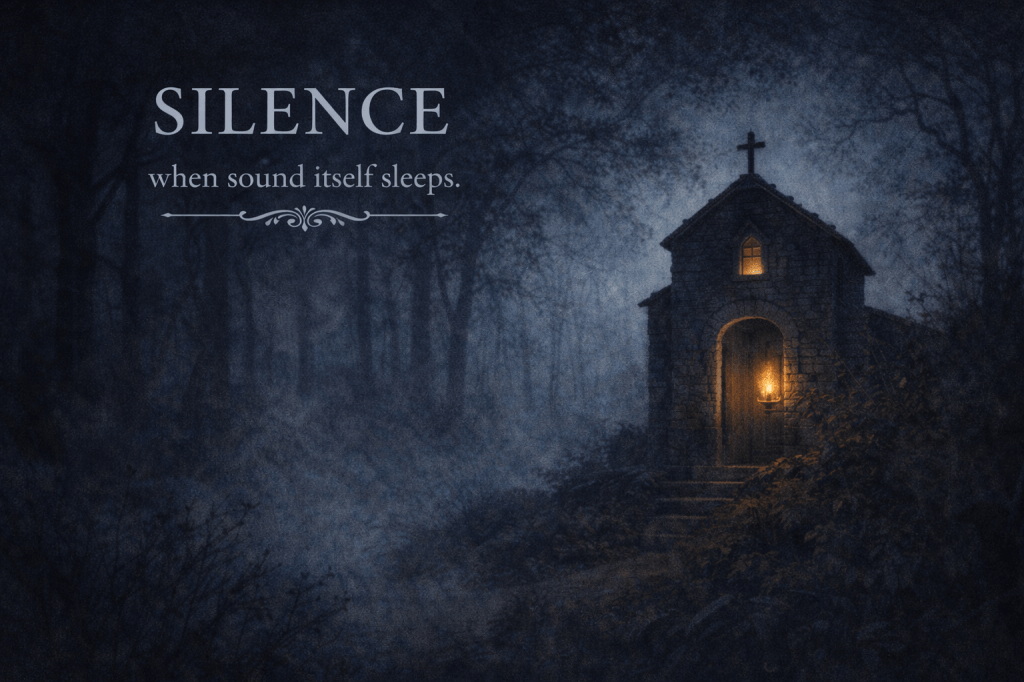
Silence
IPA Pronunciation: /ˈsaɪ.ləns/
Part of Speech: Noun
Origin
Silence belongs to the vocabularies of sound, absence, and perception. It refers to the state in which noise, speech, or disturbance is absent — but also to a condition that can carry meaning, tension, or depth.
It is not merely the lack of sound, but a presence defined by what is not spoken or heard.
Silence is absence that speaks.
Etymology
From Latin: silentium — stillness, quiet
From silere — to be quiet, to be still
The root suggests restraint — a holding back rather than a void.
Core Definitions
Absence of Sound
A state of quiet with no audible noise.
“The room fell into silence.”
Lack of Speech
The act or condition of not speaking.
“He answered with silence.”
Meaningful Quiet
A pause or absence that carries emotional or symbolic weight.
Explanation & Nuance
Silence is not uniform; it varies in quality and meaning.
It can be:
Peaceful — calm and restorative
Tense — charged with expectation
Oppressive — heavy and constraining
Reverent — filled with respect or awe
Silence may be:
Chosen — deliberate quiet
Imposed — enforced absence of speech
Thus, silence can express both freedom and constraint.
Acoustic Dimension
In physical terms, silence refers to minimal or absent sound waves.
Yet absolute silence is rare; even in quiet environments, there are:
Subtle ambient sounds
Internal bodily noise
Background vibrations
Silence is often relative — a contrast rather than a total void.
Social & Psychological Context
Silence plays a powerful role in human interaction:
Communication — what is unsaid can convey meaning
Emotion — grief, anger, or contemplation may resist words
Power — silence can assert control or withdraw participation
It can signal:
Agreement or refusal
Respect or resistance
Presence or absence
Symbolic Dimensions
Void — absence of expression
Pause — interruption in flow
Depth — space for thought
Shadow — what is hidden
Still Water — surface concealing movement
Silence symbolizes the space where meaning gathers without words.
Synonyms & Near-Relations
Quiet — low level of sound
Stillness — absence of movement and noise
Hush — intentional quiet
Mute — enforced silence
Calm — peaceful quiet
(Only silence fully captures both the absence of sound and the presence of meaning.)
Conceptual Relations
Sound — that which silence frames
Speech — that which silence withholds
Presence — paradox within absence
Time — marked by pauses
Perception — awareness of what is not heard
Cultural & Intellectual Resonance
Philosophy
Silence is often linked to the limits of language and expression.
Religion
It is associated with meditation, contemplation, and the sacred.
Art & Music
Silence functions as structure — pauses that shape experience.
Psychology
It can be restorative or unsettling, depending on context.
Takeaway
Silence names the space where sound withdraws —
and meaning, paradoxically, expands.
It reminds us that not all communication is spoken,
that absence can carry weight,
and that within quiet
there can be depth, tension, or peace.
Silence is not emptiness —
it is a field of possibility,
where what is unsaid
waits,
resonates,
and endures.
Silence is where words end—and meaning begins.


 Word Nook
Leave a comment