
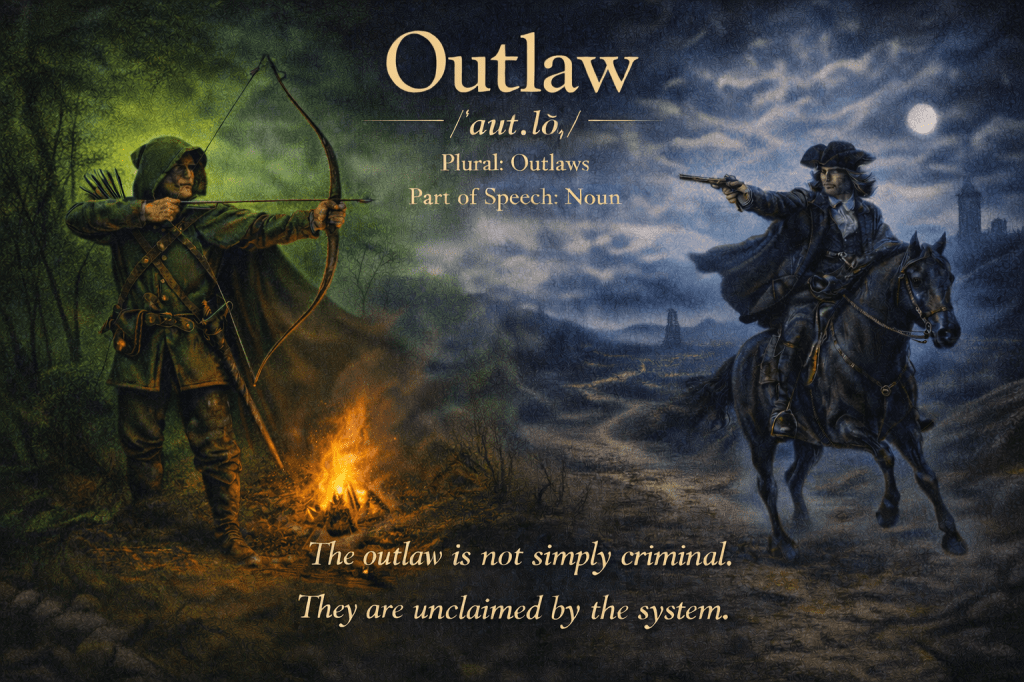
Outlaw
IPA Pronunciation: /ˈaʊt.lɔː/
Plural: Outlaws
Part of Speech: Noun (also used adjectivally)
Origin
The term outlaw emerges from early medieval legal systems, where it designated a person formally expelled from the protection of the law. To be outlawed was not simply to have committed a crime, but to have been placed beyond legal recognition altogether.
An outlaw could not appeal to courts, could not claim protection, and could be harmed with impunity. In this sense, outlawry functioned as a form of civil death — the individual remained biologically alive but was socially and legally erased.
Over centuries, this legal condition underwent a powerful imaginative transformation. In legend, literature, and cultural myth, the outlaw came to embody not only exclusion but defiance, autonomy, and alternative moral order.
The outlaw marks the point where law and justice diverge.
Etymology
Old English: ūtlaga — one placed outside the law
From ūt (“out”) + lagu (“law”)
The word does not mean “one who breaks the law,” but one whom the law has abandoned.
Core Definitions
A Person Legally Cast Outside Protection
An individual stripped of legal status and civic rights.
“He was declared an outlaw.”
A Fugitive Existing Beyond Authority
One who survives by evading or rejecting institutional power.
“The outlaw vanished into the borderlands.”
A Symbolic Figure of Defiance
A person who embodies resistance to unjust or illegitimate rule.
“She became an outlaw to the system.”
Explanation & Nuance
The concept of the outlaw is inherently ambivalent.
Key tensions include:
- Crime vs. Conscience — illegality does not equal immorality
- Exile vs. Freedom — independence gained through loss
- Violence vs. Vulnerability — power without protection
- Law vs. Justice — legitimacy put on trial
- Isolation vs. Myth — solitude transformed into legend
The outlaw exposes the limits of authority by existing where authority no longer functions.
Historical Dimensions
In medieval Europe, outlawry meant:
- Total loss of legal identity
- Forfeiture of property
- Exposure to violence without consequence
- Social erasure
Outlawry was used not only against criminals, but against political enemies, debtors, and dissidents, making it a tool of sovereign power.
To declare someone an outlaw was to assert absolute authority — and, paradoxically, to reveal its fear.
The Outlaw in Myth & Literature
Folklore
Robin Hood: the outlaw who restores justice by violating unjust law.
Romanticism
The solitary rebel who rejects social constraint.
The Western
The gunslinger on the frontier, living between wilderness and civilization.
Modern Literature
The antihero, dissenter, or marginalized subject navigating systems of power.
Across traditions, the outlaw becomes a moral testing ground: sympathy for the outlaw often signals critique of the law itself.
Psychological Dimensions
Psychologically, the outlaw can represent:
- Alienation — exclusion from belonging
- Autonomy — radical self-determination
- Shame or Pride — depending on internalized values
- Identity Formation — self defined through opposition
- Survival Ethics — morality adapted to precarity
The outlaw psyche lives in a state of permanent vigilance, shaped by exposure and risk.
Political & Social Resonance
Outlawry continues in modern forms:
- Criminalization of dissent
- Statelessness and refugeehood
- Blacklisting and social cancellation
- Informal exclusion from systems of power
Modern outlaws may not live in forests, but in bureaucratic blind spots.
Examples in Context
Historical:
“The crown branded him an outlaw.”
Literary:
“The outlaw obeyed a private code.”
Political:
“The regime treated its critics as outlaws.”
Cultural:
“He cultivated an outlaw persona.”
Psychological:
“She lived as an outlaw to belonging.”
Symbolic Dimensions
- The Borderland — beyond jurisdiction
- The Road — perpetual movement
- The Forest / Desert — refuge and danger
- The Mask — concealed identity
- The Campfire — temporary community
The outlaw symbolizes freedom stripped of guarantees.
Synonyms & Near-Relations
- Renegade — ideological break
- Fugitive — emphasis on pursuit
- Pariah — social exclusion
- Rebel — political framing
- Bandit — criminal emphasis
(Only outlaw unites legal erasure with mythic possibility.)
Conceptual Relations
- Antihero — moral ambiguity
- Exile — loss of civic belonging
- Anomie — normlessness
- Sovereignty — power to exclude
- Moral Reckoning — justice tested
Cultural & Intellectual Resonance
Law
Defines itself through exclusion.
Literature
Sympathy challenges legitimacy.
Philosophy
Obedience versus conscience.
Politics
Power exercised by erasure.
Myth
Exclusion transformed into legend.
Takeaway
Outlaw names the condition of being cast beyond the guarantees of society — where survival depends on autonomy, and justice must be privately negotiated.
The outlaw stands at the edge of order, forcing a difficult question:
when law expels a person entirely,
does it preserve justice — or expose its failure?
The outlaw lives where legitimacy ends,
and meaning begins to fracture into myth.
When the law lets go, the legend begins.
Curious about what happened today in history? Want to learn a new word every day?
You’ll find it all—first and in one place—at The-English-Nook.com!
If you love languages, this is your space.
Enjoy bilingual short stories, fun readings, useful vocabulary, and so much more in both English and Spanish.
Come explore!
 Word of the Day - The English Nook
Leave a comment