
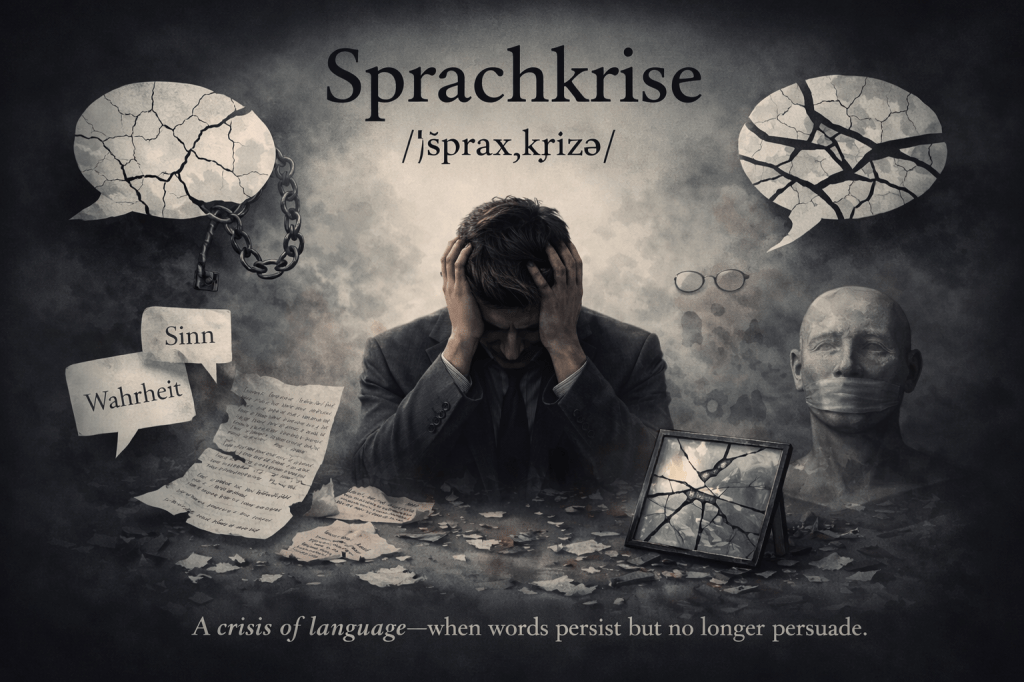
Sprachkrise
IPA Pronunciation: /ˈʃpʁaːxˌkʁiːzə/ (German)
Approximate English Rendering: /ˈʃpraːkˌkriːzə/
Part of Speech: Noun (Critical / Philosophical Term)
Literal Meaning: Language crisis
Origin
Sprachkrise names a profound crisis of language itself—a moment when words are felt to be inadequate to experience, truth, or reality. The term emerges from German-speaking modernism at the turn of the 20th century, when writers and thinkers confronted the collapse of inherited linguistic, moral, and epistemological frameworks.
Most famously articulated in Hugo von Hofmannsthal’s 1902 “Letter of Lord Chandos,” the Sprachkrise describes a condition in which language no longer coheres, no longer binds perception to meaning. Objects resist naming; abstractions dissolve; speech feels hollow, artificial, or false.
The crisis is not silence.
It is speech that no longer believes in itself.
Etymology
German: Sprache — language
Krise — crisis, turning point
Krise implies not permanent collapse, but a decisive moment of reckoning.
Sprachkrise is language at its breaking point.
Core Definitions
A Breakdown of Linguistic Confidence
Loss of faith in words as reliable carriers of meaning.
A Modernist Condition of Expression
Language perceived as inadequate to reality.
“The text stages a Sprachkrise.”
A Philosophical Problem of Representation
Tension between experience and articulation.
Explanation & Nuance
Sprachkrise is not simple inarticulateness.
Its defining qualities include:
- Mistrust of Abstraction — concepts feel empty
- Overload of Signification — words mean too much or too little
- Fragmentation — syntax and narrative strain
- Self-Reflexivity — language turns on itself
- Existential Stakes — meaning, identity, and truth at risk
Language continues, but it fails to console.
Historical & Intellectual Context
- Fin-de-siècle Vienna
- Modernism’s rupture with realism
- Collapse of metaphysical certainty
- Rise of psychoanalysis
- Crisis of bourgeois discourse
Sprachkrise marks the moment when language is no longer transparent.
Examples in Context
Literary:
“Hofmannsthal’s letter exemplifies Sprachkrise.”
Philosophical:
“The work confronts the limits of language.”
Modernist Prose:
“Meaning disintegrates into fragments.”
Poetic:
“The poem speaks from within Sprachkrise.”
Critical:
“The text dramatizes linguistic exhaustion.”
Symbolic Dimensions
- Broken Sentence — syntax under strain
- Mute Object — resistance to naming
- Echo Chamber — words referring only to words
- Silence — meaning withdrawing
- Shattered Mirror — language no longer reflecting reality
Sprachkrise symbolizes meaning in retreat.
Synonyms & Near-Relations
- Crisis of Representation – broader theoretical term
- Linguistic Skepticism – philosophical stance
- Inexpressibility – experiential
- Semantic Breakdown – technical
- Modernist Fragmentation – stylistic
(Sprachkrise uniquely unites existential, aesthetic, and linguistic collapse.)
Cultural & Intellectual Resonance
Modernist Literature
Language under suspicion.
Philosophy
Limits of representation (Wittgenstein).
Psychoanalysis
Speech as symptom.
Literary Theory
Self-reflexive language.
Postmodernism
Inherited distrust of meaning.
Sprachkrise vs. Silence
- Silence is absence of speech.
- Sprachkrise is speech that cannot fulfill its task.
One stops speaking.
The other speaks despite futility.
Takeaway
Sprachkrise names the moment when language falters under the weight of reality —
when words persist but no longer persuade,
when naming feels like betrayal,
and when expression itself becomes a problem.
It marks not the end of language,
but the beginning of writing that knows it may fail.
From this crisis emerge modern poetry, fractured narrative,
and a new honesty about the limits of saying anything at all.
Language speaks on even when it no longer believes.
Curious about what happened today in history? Want to learn a new word every day?
You’ll find it all—first and in one place—at The-English-Nook.com!
If you love languages, this is your space.
Enjoy bilingual short stories, fun readings, useful vocabulary, and so much more in both English and Spanish.
Come explore!
 Word of the Day - The English Nook
Leave a comment