
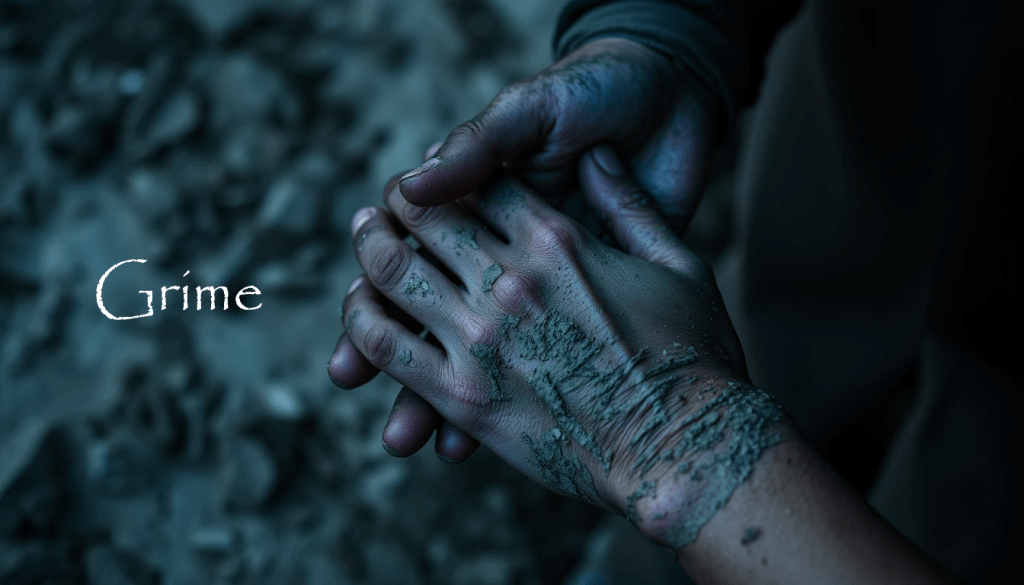
Grime
IPA Pronunciation: /ɡraɪm/
Plural: (uncountable; rarely pluralized as grimes in poetic or technical contexts)
Part of Speech: Noun
Origin
Grime entered English in the late Middle Ages, used to describe dirt accumulated through neglect, labor, or time rather than simple soil. Unlike mud or dust, grime implies adhesion — a residue that clings, darkens, and resists easy removal.
Over time, the word expanded from physical filth to signify moral, social, or atmospheric corruption, becoming a favored term in urban, industrial, and noir vocabularies.
Etymology
Middle English: grime — dirt, soot
Likely of Germanic origin, related to words meaning smear or stain.
The etymology emphasizes marking rather than covering — grime leaves evidence.
Core Definitions
Accumulated Dirt or Filth
A layer of stubborn, embedded dirt.
“The windows were thick with grime.”
Residue from Labor or Environment
Dirt associated with work, industry, or urban life.
“Coal grime coated the walls.”
A Metaphorical Stain
Moral or emotional defilement.
“The city’s glamour concealed its grime.”
Explanation & Nuance
Grime differs from ordinary dirt in intent and implication.
Its nuances include:
- Time: grime builds slowly
- Resistance: it is difficult to scrub away
- Urbanity: associated with streets, machines, and bodies
- Labor: often marks work rather than neglect alone
- Visibility: grime darkens and dulls surfaces
Grime is evidence of contact — with the world, with effort, with decay.
Examples in Context
Descriptive:
“Grime clouded the glass.”
Industrial:
“Factories left a film of grime.”
Literary:
“The novel dwells in alleyway grime.”
Metaphorical:
“Power left its grime on him.”
Aesthetic:
“The artist embraces urban grime.”
Symbolic Dimensions
- Stained Surface — history made visible
- Urban Skin — cities marked by use
- Unwashed Truth — reality without polish
- Embedded Past — residue of time
- Resistance to Cleanliness — defiance of erasure
Grime symbolizes the world refusing to stay pristine.
Synonyms & Near-Relations
- Filth – stronger, moralized
- Soot – industrial residue
- Muck – wet or heavy dirt
- Grit – coarser texture
- Stain – mark rather than substance
(Only grime implies accumulation through lived contact.)
Cultural & Intellectual Resonance
Urban Literature:
Conveys realism and decay.
Industrial History:
Marks labor and mechanization.
Aesthetics:
Used to reject polish and idealization.
Social Critique:
Symbolizes systemic neglect.
Psychology:
Associated with discomfort and aversion.
Takeaway
Grime is dirt with memory —
a residue that testifies to use, time, and friction.
It is not accidental,
but earned, accumulated, and stubborn,
a reminder that contact leaves marks
and the world does not pass through us cleanly.
Grime is where the world leaves fingerprints.
Curious about what happened today in history? Want to learn a new word every day?
You’ll find it all—first and in one place—at The-English-Nook.com!
If you love languages, this is your space.
Enjoy bilingual short stories, fun readings, useful vocabulary, and so much more in both English and Spanish.
Come explore!
 Word Nook
Leave a comment