
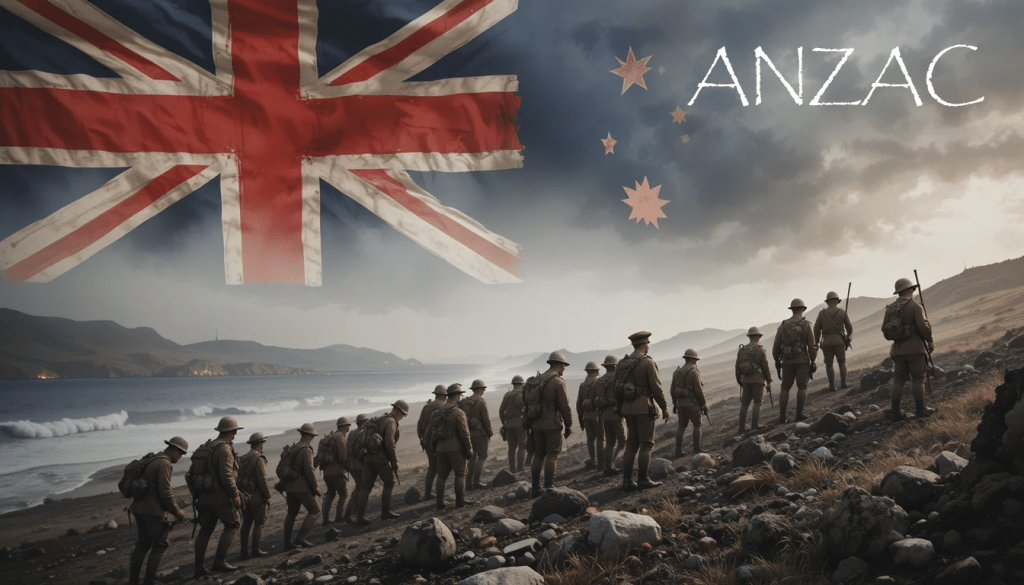
ANZAC
Pronunciation: /ˈæn.zæk/
Plural: (collective noun; not pluralized)
Part of Speech: Proper Noun / Acronym
Origin
ANZAC stands for Australian and New Zealand Army Corps, a military formation created during World War I. The term entered history through the Gallipoli Campaign of 1915, where ANZAC forces landed on the Gallipoli Peninsula as part of a failed Allied attempt to secure the Dardanelles.
Although the campaign was a military defeat, it became a defining moment in the national consciousness of both Australia and New Zealand. Gallipoli marked the first large-scale international conflict in which these young nations fought under their own banners rather than as colonial extensions of Britain.
From this crucible emerged not victory, but identity.
Etymology
ANZAC — an acronym formed from:
- Australian
- New
- Zealand
- Army
- Corps
What began as bureaucratic shorthand evolved into a sacred national symbol, its letters accumulating emotional and moral weight far beyond their administrative origin.
Core Definitions
A World War I Military Corps
The combined Australian and New Zealand forces deployed in WWI.
“The ANZACs landed at Gallipoli in 1915.”
A Foundational National Mythos
A symbolic origin story emphasizing sacrifice, endurance, and comradeship.
“ANZAC shaped national identity.”
A Cultural and Moral Ideal
Representing values associated with service and collective memory.
“The ANZAC spirit.”
Explanation & Nuance
ANZAC is both historical fact and cultural construction.
Its nuances include:
- Defeat as Meaningful: significance derived from sacrifice rather than success
- Nationhood Through Loss: identity forged in shared suffering
- Comradeship: emphasis on loyalty and mutual care
- Ambivalence Toward Empire: pride mixed with critical reflection
- Ritualized Memory: remembrance formalized through ceremony
ANZAC is not merely remembered — it is performed annually.
Examples in Context
Historical:
“ANZAC troops faced devastating losses at Gallipoli.”
Cultural:
“ANZAC Day is observed on April 25.”
Political:
“ANZAC memory shapes national narratives.”
Literary:
“Writers interrogate the ANZAC legend.”
Critical:
“The ANZAC myth has been both honored and contested.”
Symbolic Dimensions
- Dawn — beginnings and remembrance
- Grave Abroad — sacrifice far from home
- Slouch Hat / Lemon Squeezer — national military iconography
- Silence — reverence and mourning
- Mate — egalitarian bond
ANZAC symbolizes identity shaped by endurance rather than triumph.
Synonyms & Near-Relations
- ANZAC Spirit – cultural ethos
- Gallipoli Legacy – historical focus
- Commemorative Nationalism – analytical framing
- Martial Memory – broader category
- Foundational Sacrifice – interpretive term
(ANZAC uniquely fuses military history with national self-conception.)
Cultural & Intellectual Resonance
National Identity:
Central to Australian and New Zealand self-understanding.
Literature & Film:
A recurring site of reflection and critique.
Ritual & Memory Studies:
A model of commemorative culture.
Postcolonial Analysis:
Marks a transition from imperial dependence to national voice.
Ethics of War:
Raises questions about sacrifice, meaning, and remembrance.
Takeaway
ANZAC names more than a corps —
it names a moment when nations learned who they were
by witnessing what they lost.
It stands as a reminder that history is not only written by victory,
but remembered through sacrifice,
and that identity is often forged
not in conquest, but in shared grief and resolve.
Forged in loss, remembered at dawn.
Curious about what happened today in history? Want to learn a new word every day?
You’ll find it all—first and in one place—at The-English-Nook.com!
If you love languages, this is your space.
Enjoy bilingual short stories, fun readings, useful vocabulary, and so much more in both English and Spanish.
Come explore!
 Word of the Day - The English Nook
Leave a comment