
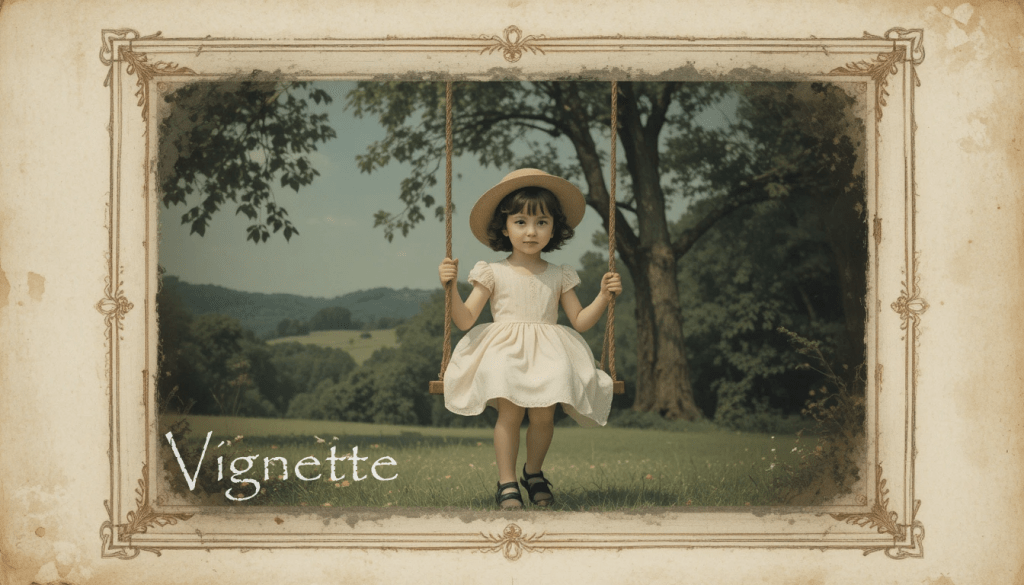
Vignette
IPA Pronunciation: /vɪˈnjɛt/
Plural: Vignettes
Part of Speech: Noun
Origin
Vignette entered English in the 18th century from French vignette, meaning “little vine,” a diminutive of vigne — “vine.” Originally, the word referred to decorative designs of trailing vines used to ornament book pages, particularly title pages and chapter headings.
From this visual embellishment grew a literary meaning: just as vines delicately framed text, so too did a vignette come to denote a brief, evocative scene — a small illustration in prose, capturing a moment rather than a plot, an impression rather than an explanation.
Over time, the concept expanded into photography, film, and narrative theory, retaining its core essence: a small, concentrated window into a world.
Etymology
French:
- vignette — small ornamental vine design
- from vigne — “vine”
Latin root:
- vinea — vineyard, entwining growth
Thus, the term carries a sense of delicate framing, of details that curl around a moment like tendrils, shaping and softening it.
Core Definitions
A Brief, Evocative Scene or Descriptive Sketch
A short piece of writing that captures a mood, character, or moment without full plot development.
“The novel opens with a vignette of a child watching snowfall from a dim stairwell.”
A Decorative Illustration or Border
Originally, ornamental vine-like designs in books; now any small decorative graphic.
“The old book contained vignettes etched into the margins like curling whispers.”
A Focused Moment in Photography or Film
A short scene or shot emphasizing atmosphere or emotion rather than narrative progression.
“The film’s vignettes assembled themselves into a portrait of a city at twilight.”
Explanation & Nuance
A vignette is the art of the glimpse.
It does not argue, unfold, or resolve — it impresses.
Nuanced qualities include:
- Atmospheric Concentration: a mood distilled to its essentials
- Fragmentary Beauty: a moment held still without demanding context
- Suggestive Power: implication rather than exposition
- Intimacy: the smallness of a scene inviting closeness
- Soft Boundaries: like the blurred edges of a photograph, the vignette gestures rather than defines
Where a story expands, a vignette focuses. Where narrative drives forward, the vignette pauses.
Examples in Context
Literary:
“Her memoir is a constellation of vignettes — brief illuminations that together shape a life.”
Cinematic:
“The director used vignettes to reveal the characters’ inner worlds, one quiet scene at a time.”
Artistic/Design:
“Floral vignettes decorated the margins, lending the manuscript a tender, botanical frame.”
Journalistic:
“The article concluded with a vignette of a single shopkeeper closing her stall as dusk fell over the market.”
Personal/Reflective:
“He kept a notebook of vignettes: fragments of memory captured like pressed leaves.”
Symbolic Dimensions
- Windowpane — a view into a single instant
- Pressed Flower — preserved detail, small yet resonant
- Soft Edge — boundaries that blur rather than confine
- Fragment of Memory — moments stored without narrative scaffolding
- Small Frame — the power of detail to evoke a world
A vignette symbolizes intensity in miniature, the truth that a single moment can speak volumes.
Synonyms & Near-Relations
- Sketch – brief depiction, though often less atmospheric
- Snapshot – instantaneous capture, more visual than literary
- Cameo – short appearance, typically of a character or figure
- Tableau – posed scene, more static
- Anecdote – short narrative, usually with a point or punchline
(Only the vignette merges brevity with impressionistic depth — a moment framed, not explained.)
Cultural & Intellectual Resonance
Literature:
A favored form for modernists, memoirists, and poets seeking compression over plot.
Photography:
The vignette effect softens edges, directing attention inward to emotional or visual center.
Film:
Used to evoke mood, tone, or theme without strict narrative connection.
Memory & Cognition:
Human recollection naturally operates in vignettes — bright fragments surrounded by soft uncertainty.
Design & Book Arts:
The original vine-like flourish remains a symbol of ornamentation that frames without overwhelming.
Takeaway
Vignette names the art of the concentrated moment —
a brief scene, an impression, a decorative flourish that captures essence without insisting on completion.
It is the beauty of the small,
the power of a single gesture,
the world glimpsed rather than explained.
A moment framed, a world implied.
Curious about what happened today in history? Want to learn a new word every day?
You’ll find it all—first and in one place—at The-English-Nook.com!
If you love languages, this is your space.
Enjoy bilingual short stories, fun readings, useful vocabulary, and so much more in both English and Spanish.
Come explore!
 Word Nook
Leave a comment