
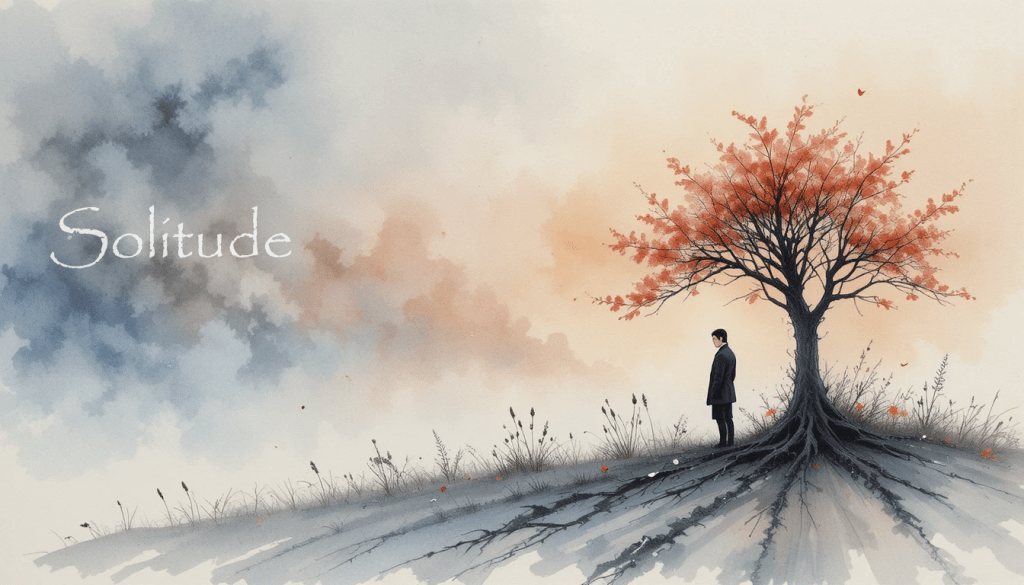
Solitude
IPA Pronunciation: /ˈsɒl.ɪ.tjuːd/
Plural: Solitudes
Part of Speech: Noun
Origin
Solitude entered English in the Middle Ages via Old French solitude, descending from Latin sōlitūdō — “state of being alone,” from sōlus, meaning “alone, unaccompanied.”
Historically, solitude referred to physical isolation — the hermit’s cave, the monk’s cell, the wilderness beyond habitation. Over centuries, it evolved from a condition of separation into a complex emotional and philosophical state, capable of fostering clarity, creativity, spiritual awakening, or deep introspection.
From desert ascetics to Romantic poets, solitude has long been understood as a space where one meets the self more fully than in company.
Etymology
Latin:
- sōlus — “alone, single, by oneself”
- sōlitūdō — “loneliness, solitary place, state of being alone”
The root connotes both withdrawal and wholeness — the individual in undivided presence with oneself.
Thus, solitude is not necessarily deprivation; it is the state of being singular, undiluted by others.
Core Definitions
The State of Being Alone, Apart from Others
Physical separation from company or society.
“She sought solitude by the lake, letting the quiet settle around her.”
A Condition of Reflective, Intentional Aloneness
A chosen or valued state of privacy and inner focus.
“In solitude, he finally heard his own thoughts again.”
A Psychological or Emotional Space Distinct from Loneliness
Aloneness experienced not as lack but as presence — of mind, selfhood, or clarity.
“The solitude of the cabin was not emptiness but profound restoration.”
Explanation & Nuance
Solitude is not loneliness, though the two share a border.
Where loneliness aches, solitude listens.
Nuances include:
- Restorative Silence: a respite from noise, duty, and distraction
- Interior Depth: a space for thought, creativity, or emotional clarity
- Vulnerability: the stripping away of social masks
- Autonomy: a reminder of self-sufficiency and personal rhythm
- Elegy & Expanse: solitude can feel like vastness — at times liberating, at times haunting
Solitude is the landscape where the self becomes audible.
Examples in Context
Literary:
“The poet embraced solitude as a place where words rose unbidden from the quiet.”
Psychological:
“Healthy solitude allows the mind to recover from constant social negotiation.”
Philosophical:
“To think clearly requires a measure of solitude — a step back from the inertia of crowds.”
Spiritual:
“Retreating into solitude, the monk sought a silence large enough to contain the divine.”
Environmental:
“High in the mountains, he felt the rare solitude only wide landscapes grant.”
Symbolic Dimensions
- Still Water — reflection undisturbed
- Empty Room — space cleared for presence
- Desert Path — the journey inward
- Candle Flame — quiet focus, small but steady
- Distant Horizon — vastness that both invites and humbles
Solitude symbolizes the union of emptiness and fullness — a world emptied of others so one may meet oneself.
Synonyms & Near-Relations
- Seclusion – physical removal, sometimes enforced
- Isolation – separation with negative or involuntary connotations
- Retreat – purposeful withdrawal for rest or reflection
- Quietude – calmness, stillness, though not necessarily alone
- Loneliness – emotional pain of unwanted aloneness
(Only solitude balances aloneness with richness — a state that can be nourishing rather than desolate.)
Cultural & Intellectual Resonance
Spiritual Traditions:
Solitude as purification, discipline, or encounter with the sacred.
Romanticism:
The solitary observer as visionary, finding truth in nature and introspection.
Philosophy:
The solitary thinker as one who steps outside collective assumptions.
Psychology:
Solitude as essential for emotional regulation, creativity, and identity formation.
Art & Creativity:
The artist’s studio, the writer’s room — solitude as crucible for expression.
Takeaway
Solitude names the state of being alone with clarity and intention —
a stillness that sharpens awareness, restores inner balance,
and reveals the contours of the self.
It is the quiet chamber of thought,
the spaciousness where one finally hears one’s own life.
Solitude: where silence stops being empty and starts becoming yours.
Curious about what happened today in history? Want to learn a new word every day?
You’ll find it all—first and in one place—at The-English-Nook.com!
If you love languages, this is your space.
Enjoy bilingual short stories, fun readings, useful vocabulary, and so much more in both English and Spanish.
Come explore!
 Word of the Day - The English Nook
Leave a comment