
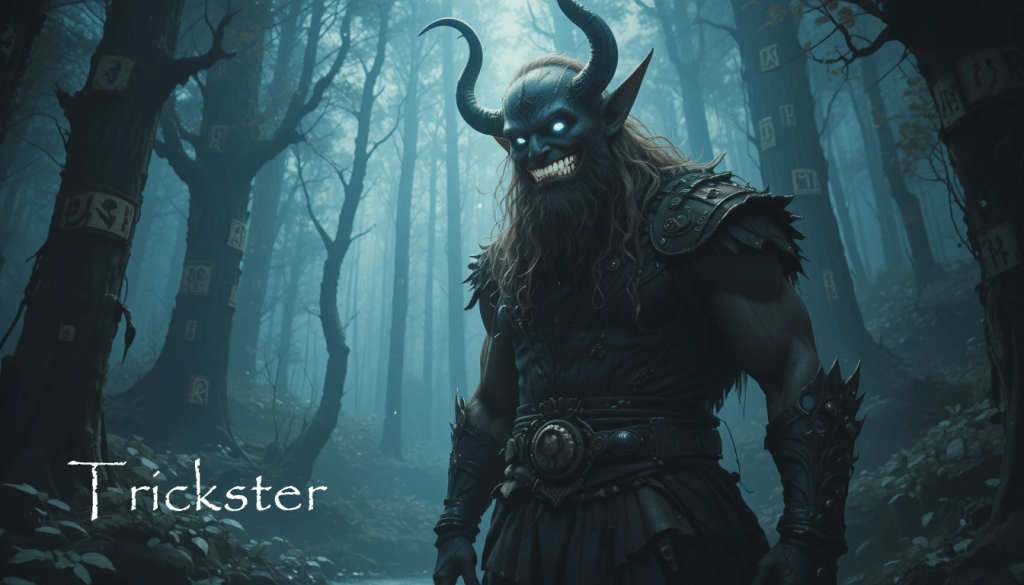
Trickster
IPA Pronunciation: /ˈtrɪk.stər/
Plural: Tricksters
Part of Speech: Noun
Origin
The word trickster arises from the English trick — a deceit, ruse, or clever maneuver — combined with the agentive suffix -ster, forming “one who tricks.” Although the English term is comparatively late (17th–18th century), the figure it names is ancient, found across mythologies, folktales, religions, and literature worldwide.
From the West African Anansi to the Norse Loki, from the Native American Coyote to the Greek Hermes, the trickster archetype appears wherever human cultures grapple with paradox, wit, boundary-crossing, and disruption. The trickster is at once creator and destroyer, teacher and rogue — a figure who lives at the edge of order, revealing truth through mischief.
Etymology
English:
- trick — deception, artifice, clever device
- -ster — agentive suffix forming “one who does” (as in spinster, teamster)
Beyond its linguistic roots, the concept draws on a global archetypal pattern:
- Boundary-breaker
- Shape-shifter
- Rebel against norms
- Bearer of upside-down wisdom
Thus, trickster is less a simple deceiver than a mythic disruptor, a figure whose cunning reveals the limits of structures and the flexibility of truth.
Core Definitions
A Mischievous, Cunning Figure in Myth or Folklore
A character who uses deception, wit, or shape-shifting to subvert norms and create upheaval.
“The trickster spirit stole the sun, bringing both chaos and illumination to the world.”
One Who Exploits Cleverness to Overcome Power
A person who survives or triumphs not through strength but through ingenuity.
“Like a trickster hero, she outwitted bureaucracy more than she confronted it.”
A Symbol of Ambiguity, Disruption, and Transformation
A force that reveals the fragility of rules and the creativity hidden in disorder.
“The film’s protagonist served as the trickster, unraveling the story’s assumptions piece by piece.”
Explanation & Nuance
The trickster is not simply a liar —
he is the necessary disruptor, the catalyst of change.
Nuances include:
- Ambivalence: neither purely good nor evil
- Transgression: crossing borders — moral, social, metaphysical
- Subversion: overturning power through cunning
- Creation through destruction: chaos as the seed of renewal
- Humor as revelation: truth delivered with a grin or a prank
The trickster exposes hypocrisy, mocks authority, and reveals reality’s contingency. He is the one who breaks rules to remind us they exist.
Examples in Context
Mythic:
“Coyote, the Native American trickster, reshaped the world with pranks that often backfired but always transformed.”
Literary:
“In Shakespeare, the Fool often embodies the trickster — speaking truth the wise cannot utter.”
Psychological:
“The trickster archetype represents the unconscious urge to disrupt stagnant patterns.”
Cultural/Anthropological:
“Across societies, tricksters thrive on liminality — crossroads, borders, and transitional states.”
Modern/Pop Culture:
“The hacker-as-trickster navigates systems through wit, exploiting the cracks in digital order.”
Symbolic Dimensions
- Mask — identity as fluid, performative
- Mirror — reflecting contradictions in culture
- Crossroads — threshold where rules blur
- Shadow — hidden or disowned impulses
- Fire-Stolen Light — knowledge acquired through daring transgression
The trickster symbolizes the paradox that disruption makes renewal possible.
Synonyms & Near-Relations
- Rogue – mischievous but lacks the cosmic dimension
- Jester – humorous critic of power, often confined to courts
- Charlatan – deceit for selfish ends, without mythic resonance
- Shape-shifter – related but focused on transformation
- Subversive – challenges norms, though less playful
(Only the trickster intertwines mischief, creativity, and mythic boundary-crossing.)
Cultural & Intellectual Resonance
Mythology:
A universal archetype embodying disorder as a creative force.
Anthropology:
A figure who thrives in liminal spaces — between worlds, roles, and rules.
Psychology (Jungian):
A representation of the unconscious impulse toward change and unpredictability.
Literature & Art:
A narrative disruptor, revealing new possibilities by undoing old patterns.
Sociology:
A critic of structure — the outsider who sees what insiders cannot.
Takeaway
Trickster names the archetype of cunning disruption —
the figure who bends rules, shatters expectations, and remakes the world through mischief and ingenuity.
He is the playful shadow of order,
the reminder that creativity often begins with a clever breach of the expected.
Where mischief becomes revelation and boundaries become doorways.
Curious about what happened today in history? Want to learn a new word every day?
You’ll find it all—first and in one place—at The-English-Nook.com!
If you love languages, this is your space.
Enjoy bilingual short stories, fun readings, useful vocabulary, and so much more in both English and Spanish.
Come explore!
 Word of the Day - The English Nook
Leave a comment