
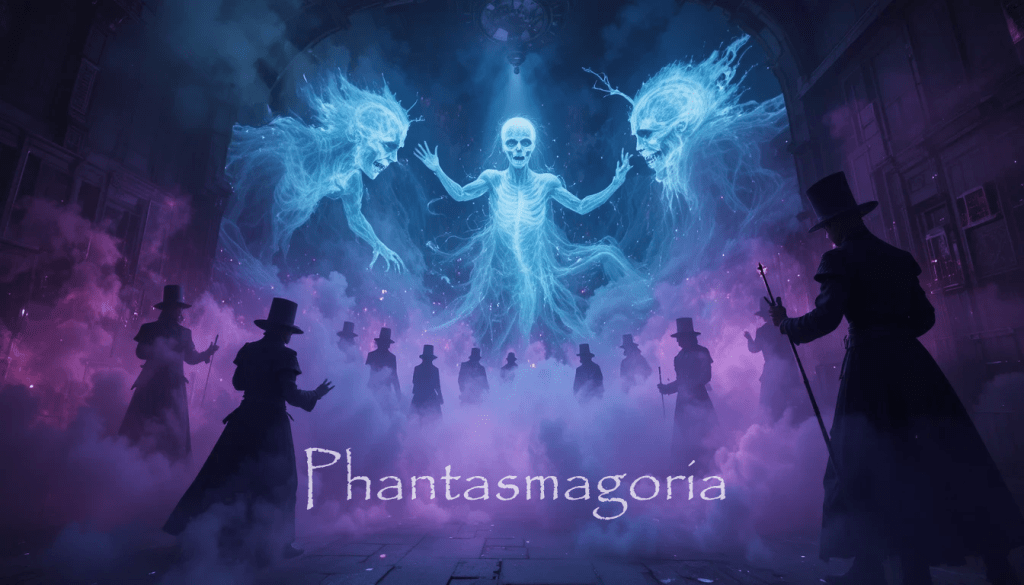
Phantasmagoria
IPA Pronunciation: /ˌfænˌtæz.məˈɡɔːr.i.ə/
Plural: Phantasmagorias
Part of Speech: Noun
Origin
Phantasmagoria entered English in the early 19th century, describing a theatrical spectacle in which images of ghosts, demons, or fantastical scenes were projected onto smoke or screens using a “magic lantern.” These performances blended illusion, optics, movement, and darkness — engineering a world where shadows seemed alive.
The word blends phantasm (apparition, vision) with a suffix suggesting assembly or collection, creating a term that evokes a procession of shifting, unreal images. Over time it expanded beyond stagecraft to describe dreamscapes, hallucinations, and any kaleidoscopic play of the imagination.
Etymology
Greek:
- phantasma (φάντασμα) — “ghost, apparition, image”
- from phainein (φαίνειν) — “to show, bring to light”
French:
- fantasmagorie — an illusionistic show of projected images
Thus, phantasmagoria conveys both the appearance and the performance of the unreal — visions that shift, dissolve, and recombine in uncanny succession.
Core Definitions
A Shifting Sequence of Imaginary or Unreal Images
A dreamlike, often eerie cascade of visions or impressions.
“As fever overtook him, a phantasmagoria of colors and shapes spilled through his mind.”
A Theatrical Display of Optical Illusions
Originally, a magic-lantern show creating ghosts or fantastical scenes through projection.
“Victorian audiences gasped as the phantasmagoria summoned specters from darkness.”
A Chaotic, Surreal, or Overwhelming Experience
Any environment or event marked by swirling, disorienting impressions.
“The bustling market at dusk became a phantasmagoria of voices, lights, and shadows.”
Explanation & Nuance
Phantasmagoria is a word of motion, mutation, and spectacle. It suggests:
- Instability: images that flicker, distort, dissolve
- Surreality: a dream logic where forms morph without warning
- Atmosphere: shadows, fog, uncertainty, and theatricality
- Excess: sensory overload, the mind unable to anchor itself
- Enchantment: the pleasure and terror of illusion
It does not merely describe chaos but curated chaos — the choreography of images that blur the boundary between vision and hallucination.
Examples in Context
Literary:
“The city at night became a phantasmagoria — neon bleeding into puddles, silhouettes crossing like drifting ghosts.”
Psychological:
“In the grip of exhaustion, her thoughts dissolved into a phantasmagoria of memories and imagined futures.”
Artistic:
“The painter’s work was a phantasmagoria of impossible architectures and spectral colors.”
Cinematic:
“The film’s final sequence unfolds as a phantasmagoria — rapid cuts, distorting angles, and dreamlike sound.”
Historical/Theatrical:
“Early phantasmagoria shows exploited darkness, movement, and smoke to animate the uncanny.”
Symbolic Dimensions
- Mirage — vision without substance
- Shadowplay — forms that hint but never settle
- Dream Current — drifting, ungoverned imagination
- Labyrinth of Images — perception without center
- Smoke & Light — the mechanics of illusion
Phantasmagoria symbolizes the human fascination with the unreal — the mind’s capacity to conjure worlds that shimmer and vanish.
Synonyms & Near-Relations
- Illusion – a single deceptive image
- Hallucination – perception without external cause
- Surreal Vision – dreamlike imagery, often artistic
- Spectacle – impressive performance, not necessarily unreal
- Kaleidoscope – shifting patterns, though lacking the uncanny
(Only phantasmagoria contains the full sense of theatrical, shifting unreality — a procession of visions in motion.)
Cultural & Intellectual Resonance
Gothic Literature:
Used to evoke the uncanny, the dreamlike, the psychologically unstable.
Visual Arts:
Linked to surrealism, collage, and imagery that fractures and reforms.
Cinema:
A touchstone for sequences that break narrative logic and dive into sensory delirium.
Psychology:
Describes mental states where thought becomes spectacle — fleeting, disordered, spectral.
Theater & Illusionism:
The roots of cinematic special effects and the fascination with projected ghosts.
Takeaway
Phantasmagoria names the spectacle of shifting visions —
a dance of images that enchant, unsettle, and dissolve as swiftly as they appear.
It is the poetry of illusion,
the architecture of the unreal,
the mind dreaming in motion.
Phantasmagoria: where imagination steps into the light—and disappears.
Curious about what happened today in history? Want to learn a new word every day?
You’ll find it all—first and in one place—at The-English-Nook.com!
If you love languages, this is your space.
Enjoy bilingual short stories, fun readings, useful vocabulary, and so much more in both English and Spanish.
Come explore!
 Word Nook
Leave a comment