
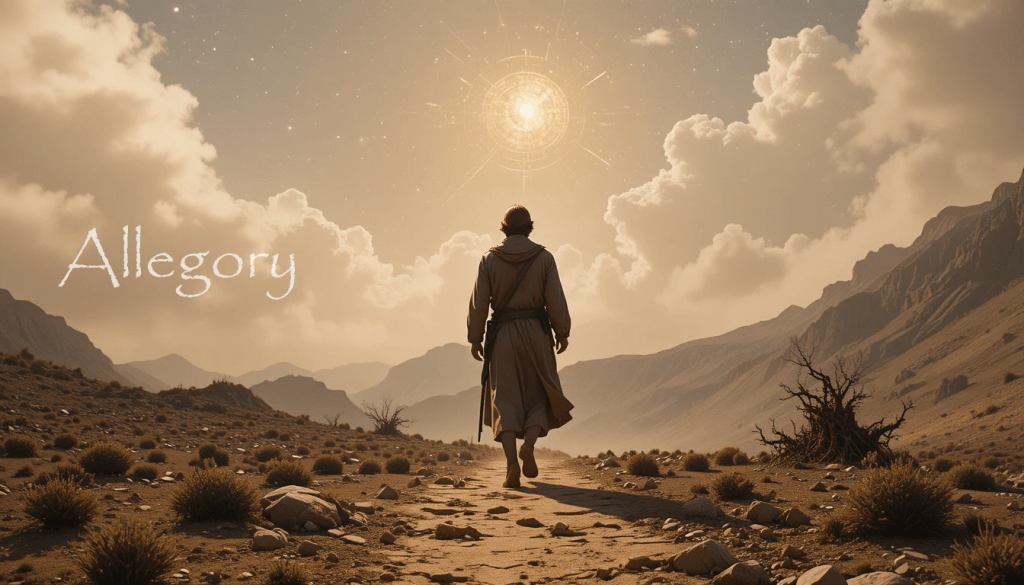
Allegory
IPA Pronunciation: /ˈælɪˌɡɔːri/
Part of Speech: Noun
Origin
First attested in English in the 14th century, from Old French allégorie, derived from Latin allegoria, and ultimately from Greek allēgoria — “speaking otherwise,” from allos (“other”) + agoreuein (“to speak publicly, to declare”).
The root belongs to the Proto-Indo-European base al- — “beyond, other,” and ger- — “to gather, to speak before an assembly.”
Thus, allegory literally means “other-speaking” — speech that says one thing and means another, a form of truth veiled in image.
Etymology
- Greek: allēgoria → “veiled or symbolic discourse.”
- Latin: allegoria → “figurative language, extended metaphor.”
- Old French: allégorie → “fable, parable, symbolic story.”
It denotes both the act of conveying meaning through symbols and the work that embodies such meaning.
Core Definitions
- A Story or Image Conveying a Hidden or Moral Meaning
A narrative in which characters, events, or settings symbolize abstract ideas or universal truths.
“The pilgrimage in Bunyan’s The Pilgrim’s Progress is an allegory of the soul’s journey toward salvation.” - The Expression of One Thing Under the Image of Another
A literary or artistic device by which concrete imagery reveals a deeper level of significance.
“The forest of temptation in the poem serves as an allegory of conscience and desire.” - By Extension: Any Symbolic Representation of an Idea
Used more loosely to describe works or moments that invite layered interpretation.
“The crumbling city became an allegory for the fragility of civilization.”
Explanation & Nuance
Allegory is the art of indirection — truth spoken through disguise.
It operates on two simultaneous planes:
- The literal — what is told or shown.
- The symbolic — what is meant or implied.
Unlike simple metaphor, allegory extends across an entire structure: story, poem, or painting becomes a system of symbols, each element reinforcing a hidden moral, spiritual, or philosophical message.
Its tone depends on intention:
- In medieval theology, it reveals divine mysteries.
- In Renaissance art, it moralizes beauty.
- In political literature, it conceals dissent beneath imagery.
- In modern art, it may question the very act of interpretation.
At its heart, allegory is a way of thinking — seeing the world as layered, where appearance and essence are eternally entwined.
Examples in Context
Literary / Classical:
“Plato’s Allegory of the Cave depicts human ignorance and enlightenment through the image of shadows and light.”
Religious / Moral:
“Medieval writers turned every story into allegory, finding divine truth behind every earthly symbol.”
Political:
“Orwell’s Animal Farm stands as an allegory of revolution betrayed, power corrupted.”
Artistic:
“In Baroque painting, the figure of Justice with her scales and sword is an allegory of moral order.”
Philosophical:
“To live allegorically is to see the visible world as the language of the invisible.”
Symbolic Dimensions
- Mirror – reflection of hidden truth.
- Veil – concealment that reveals through mystery.
- Path – journey of the soul or the mind.
- Light and Shadow – knowledge and ignorance.
- Figure and Meaning – the eternal tension between what appears and what is.
Synonyms & Related Terms
- Symbol – a single image representing a concept.
- Metaphor – a brief likeness between unlike things.
- Parable – a moral tale, often religious.
- Fable – a simple allegory using animals or nature.
- Myth – sacred narrative explaining existence.
(Among these, Allegory is the most architectonic — a whole world built to embody an idea.)
Cultural & Intellectual Resonance
Classical Philosophy: Plato’s allegories used image to guide intellect — the visible world as a shadow of the real.
Medieval Theology: Scripture was read allegorically, each word containing moral, anagogical, and spiritual dimensions.
Renaissance and Baroque Art: Allegory personified virtues, vices, and abstract qualities — making thought visible.
Romantic and Symbolist Literature: Allegory became inward and psychological, mirroring the landscape of emotion and imagination.
Modernism and Beyond: Allegory often turned ironic or self-aware — revealing the instability of meaning itself.
Takeaway
Allegory is the language of depth — a way of telling truths through veils, of saying more than is said.
It joins imagination with philosophy, transforming narrative into meditation.
Every allegory invites its reader to listen twice: once to the story, and again to the silence beneath it.
Allegory
A work or mode of expression in which surface narrative conceals deeper meaning; the art of speaking otherwise — of turning story into symbol, and symbol into truth.
Curious about what happened today in history? Want to learn a new word every day?
You’ll find it all—first and in one place—at The-English-Nook.com!
If you love languages, this is your space.
Enjoy bilingual short stories, fun readings, useful vocabulary, and so much more in both English and Spanish.
Come explore!
 Word of the Day - The English Nook
Leave a comment