

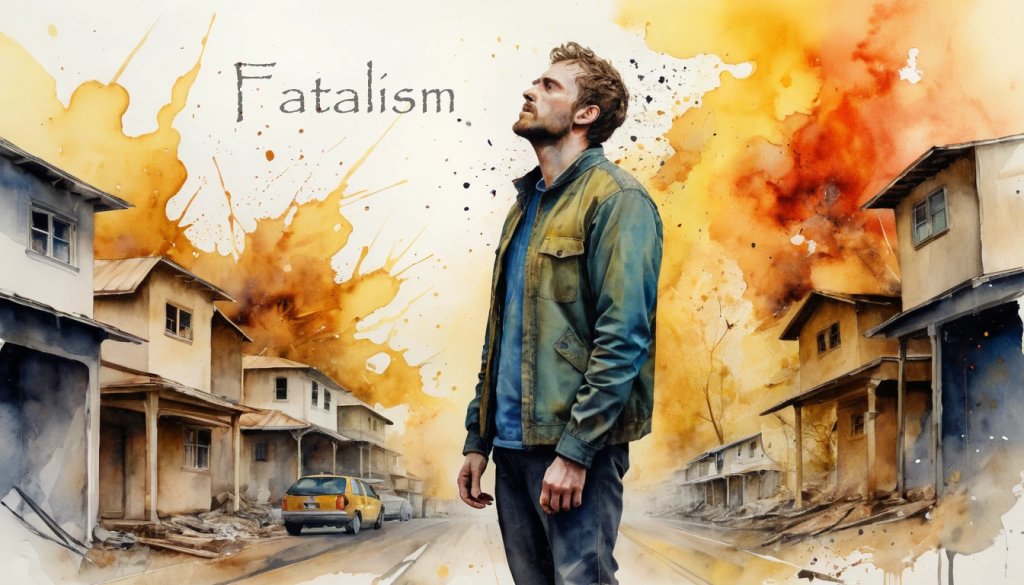
Fatalism
IPA Pronunciation: /ˈfeɪtəlɪz(ə)m/
Part of Speech: Noun
Origin
First attested in English in the 17th century, from French fatalisme, derived from Latin fatum — “that which has been spoken, decree, destiny,” from fari — “to speak.”
The root belongs to the Proto-Indo-European base bha- — “to speak, to say,” implying that fate is what has been uttered and cannot be unsaid.
The term arose in theological and philosophical discourse to describe the doctrine that all events are predetermined, unfolding according to an unalterable destiny — whether decreed by divine will, natural law, or cosmic necessity.
Etymology
- Latin: fatum → “utterance, decree, destiny.”
- Verb: fari → “to speak, to pronounce.”
- French: fatalisme → “belief in predetermined destiny.”
Thus, fatalism embodies the sense of spoken inevitability — that existence follows a script already written in the cosmos.
Core Definitions
- Philosophical Doctrine of Predetermination
The belief that all events are fixed in advance by fate or necessity, beyond human control or free will.
“In moments of despair, he surrendered to fatalism, believing every choice already foreclosed.” - Resigned Acceptance of Inevitable Events
A passive attitude toward destiny, viewing outcomes as unavoidable.
“Her calmness was not peace but fatalism — the stillness of one who has ceased to resist.” - Figurative: A Worldview of Inevitability
A broader mood or sensibility in which one perceives history, nature, or personal life as bound to a fixed pattern.
“The poem’s fatalism gives its beauty a tragic stillness, as though every moment knows its end.”
Explanation & Nuance
Fatalism occupies the uneasy border between belief and surrender.
It may appear as philosophy, temperament, or emotion:
- As philosophy, it challenges the idea of freedom.
- As temperament, it is stoic endurance.
- As emotion, it is quiet despair, or sometimes serenity.
The fatalist does not necessarily deny meaning, but questions agency — the power of will against the vast machinery of time.
In some traditions, this belief is tragic; in others, liberating.
The tone of fatalism varies with context:
- Classical: destiny as cosmic law.
- Religious: divine providence, inscrutable but ordered.
- Existential: futility before chaos.
- Romantic: melancholy acceptance of fate’s beauty.
Examples in Context
Philosophical / Doctrinal:
“Fatalism reduces history to repetition — each age performing a fate it cannot escape.”
Psychological:
“He met each failure with fatalism, as though disappointment were a natural climate.”
Poetic:
“The waves broke with the calm fatalism of the sea — unhurried, inevitable.”
Cultural / Historical:
“Empires fall not from surprise but from fatalism — the slow surrender of belief in change.”
Spiritual / Meditative:
“True faith may hide a kind of fatalism: a trust so complete it no longer distinguishes between freedom and fate.”
Symbolic Dimensions
- Thread / Weaving – the tapestry of fate spun before birth.
- Wheel – cyclical destiny, motion bound to return.
- Stars – fixed pattern of cosmic design.
- River – flow that can be followed but not reversed.
- Silence – acceptance of what words cannot alter.
Synonyms & Related Terms
- Determinism – events caused by prior conditions, often scientific or logical.
- Predestination – theological belief in divine foreordination.
- Resignation – emotional acceptance of the inevitable.
- Nihilism – denial of meaning or purpose, beyond mere acceptance.
- Stoicism – endurance without complaint, aligned with natural order.
(Among these, Fatalism alone unites belief and mood — both a doctrine of inevitability and the feeling it evokes.)
Cultural & Intellectual Resonance
Classical Thought: The Stoics embraced a cosmic fatalism, believing all events accorded with Logos — divine reason.
Medieval Theology: Christian thinkers debated whether predestination implied fatalism or divine justice; the line between them marked the soul’s freedom.
Renaissance and Enlightenment Literature: Fatalism became a moral question — does knowledge of destiny free or bind the will?
Romanticism: The idea of fate turned poetic — tragic beauty in the inevitability of loss and love.
Modern Existentialism: Fatalism transformed into metaphysical anxiety — the sense that meaning exists only within the unchangeable framework of time.
Takeaway
Fatalism is the philosophy of inevitability — the recognition that life may unfold according to a script already written, whether by gods, nature, or necessity.
It speaks to the tension between freedom and destiny, resistance and surrender, knowing and accepting.
Neither wholly despairing nor wholly serene, fatalism is the human gesture of bowing to what cannot be altered — the mind’s quiet acknowledgment of the stars.
Fatalism
The belief or feeling that all events are fixed and inevitable; the quiet conviction that destiny moves through all things, indifferent to will, yet strangely complete in its design.
Curious about what happened today in history? Want to learn a new word every day?
You’ll find it all—first and in one place—at The-English-Nook.com!
If you love languages, this is your space.
Enjoy bilingual short stories, fun readings, useful vocabulary, and so much more in both English and Spanish.
Come explore!

 Word Nook
Leave a comment