
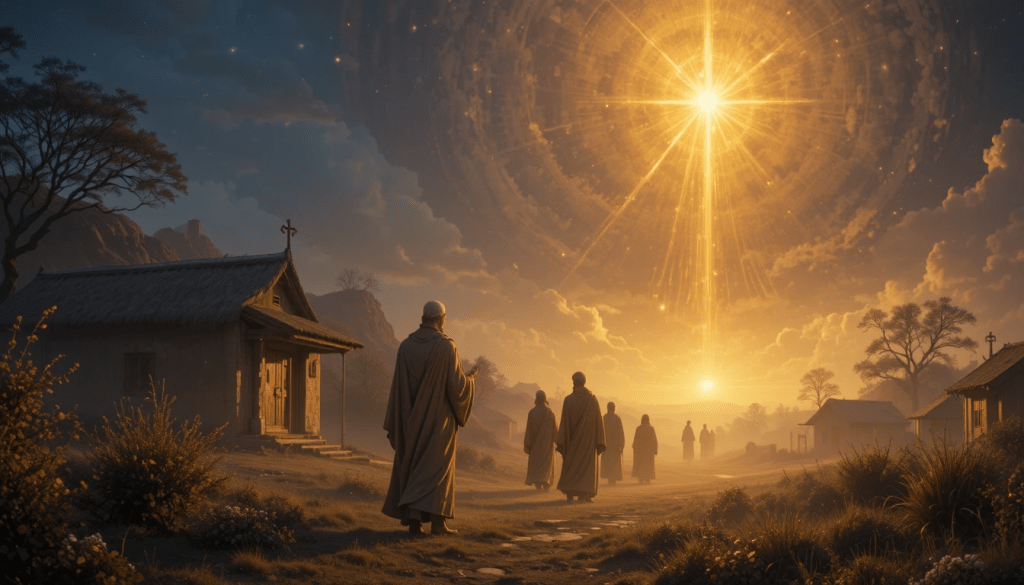
Epiphany
IPA Pronunciation: /ɪˈpɪf.ə.ni/
Plural: Epiphanies
Part of Speech: Noun
Origin
First attested in English in the 14th century, from Old French epiphanie, and directly from Latin epiphania, borrowed from Greek epipháneia (ἐπιφάνεια) — “manifestation, appearance, revelation.”
Derived from epi- (“upon, on”) + phainein (“to show, to make appear”).
Originally used in Christian theology to denote the manifestation of Christ to the Gentiles — specifically, the visit of the Magi as described in the Gospel of Matthew — the word later broadened to signify any sudden revelation, luminous realization, or moment of spiritual clarity.
Etymology
- Greek: epipháneia — “appearance, striking manifestation.”
- Prefix: epi- — “upon, toward.”
- Root: phainein — “to shine, bring to light, make visible.”
- Related words: phenomenon, fantasy, phantasm — all sharing the root of “appearance” or “illumination.”
Thus, Epiphany literally means “a shining upon” — a moment when truth or presence becomes visible, as if light has found a sudden aperture in the mind or world.
Core Definitions
- A Manifestation or Revelation of the Divine
A sacred appearing; the visible or felt disclosure of something holy or transcendent.
“In the silence of prayer, she felt an epiphany — the presence that needs no name.” - A Sudden Moment of Insight or Realization
A flash of understanding that unites perception, intuition, and truth.
“He had an epiphany while watching the leaves fall — that endings are simply beginnings in disguise.” - A Striking or Transformative Illumination in Art or Life
In literature or philosophy, a moment when hidden meaning becomes suddenly clear, often through an ordinary event.
“The novel’s closing scene is an epiphany — quiet, human, and unbearably luminous.”
Explanation & Nuance
- Epiphany is not a gradual understanding but a threshold moment — the veil lifts, the world discloses itself.
- It joins light with revelation: both a sensory and a spiritual unveiling.
- The experience may be religious, intellectual, or emotional, but it always bears the quality of recognition — not learning something new, but seeing what was always there.
- The tone of the word is numinous and transformative, carrying an aura of sacred immediacy, whether divine or human.
Examples in Context
Religious:
“The Magi’s arrival marks the Epiphany — the divine revealed not to kings, but to seekers.”
Philosophical:
“Every genuine epiphany is an act of remembering — the mind recalling what the soul already knew.”
Literary:
“Joyce’s characters live for those rare epiphanies when the ordinary world suddenly burns with meaning.”
Psychological:
“After years of confusion, a quiet epiphany settled over him: peace was never elsewhere.”
Natural:
“In the stillness of the forest, sunlight piercing through the canopy became her epiphany — a revelation without words.”
Symbolic Dimensions
- Light / Illumination – the act of seeing clearly after darkness.
- Unveiling / Manifestation – hidden truth made visible.
- Threshold / Awakening – the crossing from ignorance to understanding.
- Divine Presence – the sense that revelation is not constructed but received.
- Moment / Spark – the timeless condensed into a single instant.
Synonyms & Near-Relations
- Revelation – divine or dramatic disclosure; often more formal or theological.
- Illumination – enlightenment of mind or spirit; intellectual clarity.
- Insight – deep perception, less poetic in tone.
- Awakening – spiritual or existential realization.
- Aha Moment – modern, secular equivalent of sudden realization.
(Among these, epiphany alone marries intellectual clarity with spiritual radiance — understanding that glows rather than explains.)
Cultural & Intellectual Resonance
- Christian Tradition: The Feast of Epiphany (January 6th) celebrates divine revelation — the appearance of the sacred in the world.
- Literary Modernism: Popularized by James Joyce to describe moments of sudden self-awareness or transcendence in the mundane.
- Philosophy & Phenomenology: The appearance (phainesthai) of truth or Being — when existence reveals itself as presence.
- Psychology & Creativity: The “eureka moment” of inspiration; insight emerging after long gestation.
- Mysticism & Art: The encounter between the seen and the unseen, the mortal and the eternal.
Takeaway
Epiphany names the moment the invisible becomes visible, the instant of recognition when light and understanding converge.
It is not mere discovery, but revelation — something shown, not seized.
Every epiphany is both a flash and a fulfillment, a glimpse of eternity through the keyhole of the moment.
Epiphany
A sudden manifestation of meaning or divinity — the world briefly illuminated from within, as if truth itself had turned toward you.
Curious about what happened today in history? Want to learn a new word every day?
You’ll find it all—first and in one place—at The-English-Nook.com!
If you love languages, this is your space.
Enjoy bilingual short stories, fun readings, useful vocabulary, and so much more in both English and Spanish.
Come explore!
 Word of the Day - The English Nook
Leave a comment