

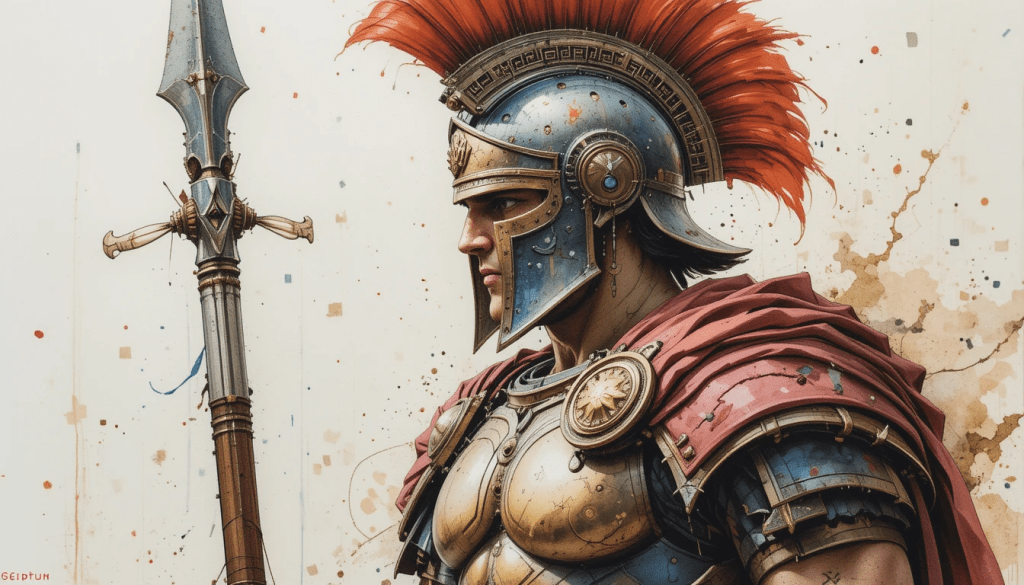
Centurion
IPA Pronunciation: /sɛnˈtjʊə.ri.ən/ (British) | /sɛnˈtʊr.i.ən/ (American)
Part of Speech: Noun
Etymology
From Latin centuriō, centuriōnis — “commander of a century,” from centuria (“a division of a legion; nominally one hundred men”) ← centum (“hundred”).
- In practice, a century usually numbered 60–80 men rather than exactly 100.
- Borrowed into Old French (centurion) → Middle English (14th century).
Thus, the centurion literally meant “the officer of a hundred.”
Core Definitions
1. Roman Military Officer
An officer in the Roman army who commanded a century, the basic unit of the legion.
“The centurion led his men with iron discipline and unflinching resolve.”
2. Symbol of Martial Discipline and Leadership
By extension, centurion signifies one who embodies toughness, command, and loyalty.
“He bore himself like a centurion, stern and immovable in the storm.”
Explanation & Nuance
- Role in the Legion:
- Centurions were not aristocrats but career soldiers, promoted from the ranks for valor, discipline, and leadership ability.
- They formed the backbone of Roman military structure — the enforcers of order, trainers of men, and leaders in battle.
- Each legion (c. 5,000–6,000 soldiers) had about 60 centurions.
- Symbols of Authority:
- A vine staff (vitis) was carried by centurions, both as a badge of office and as a tool to enforce discipline.
- Their helmets often bore transverse crests (running side-to-side rather than front-to-back), making them easily identifiable in battle.
- Status:
- Centurions earned better pay than ordinary legionaries (up to 15–20 times more for senior ranks).
- They were feared disciplinarians but also admired as fathers to their men.
Examples in Context
- Historical: “The centurion’s command voice rose above the chaos of battle.”
- Biblical: “A Roman centurion approached Jesus, saying, ‘Lord, I am not worthy that you should enter under my roof.’” (Matthew 8:8)
- Figurative: “The teacher was a centurion in the classroom, keeping perfect order.”
- Literary: “Amid the ruins stood the memory of centurions, the stewards of empire.”
Synonyms & Related Terms
- Legionary – the ordinary Roman foot soldier.
- Optio – deputy to a centurion, second-in-command of a century.
- Tribune – higher-ranking officer above the centurions.
- Captain / Commander – modern analogues of military leadership.
- Disciplinarian – broader figurative synonym.
Cultural & Historical Resonance
- Roman Empire: Centurions were essential to Rome’s dominance — ensuring formations held, training was rigorous, and punishments swift. They were the steel spine of the legions.
- Biblical Tradition: Centurions appear in the New Testament as figures of justice and faith. One oversaw the Crucifixion, declaring, “Truly, this man was the Son of God” (Mark 15:39). Another displayed humility in asking Jesus to heal his servant.
- Symbol of Leadership: In modern times, “centurion” often represents disciplined, steadfast leadership — the archetype of the seasoned, reliable commander.
- Legacy: The word survives in literature, military history, and even sports teams, where it symbolizes strength, discipline, and endurance.
Takeaway
A centurion was more than an officer: he was the embodiment of Roman authority and endurance. Hardened by campaigns, feared for discipline, and admired for courage, he carried the empire’s order on his shoulders.
Centurion
The living steel of Rome — commander of men, bearer of discipline, and enduring emblem of martial resolve.
Curious about what happened today in history? Want to learn a new word every day?
You’ll find it all—first and in one place—at The-English-Nook.com!
If you love languages, this is your space.
Enjoy bilingual short stories, fun readings, useful vocabulary, and so much more in both English and Spanish.
Come explore!

 Word Nook
Leave a comment