
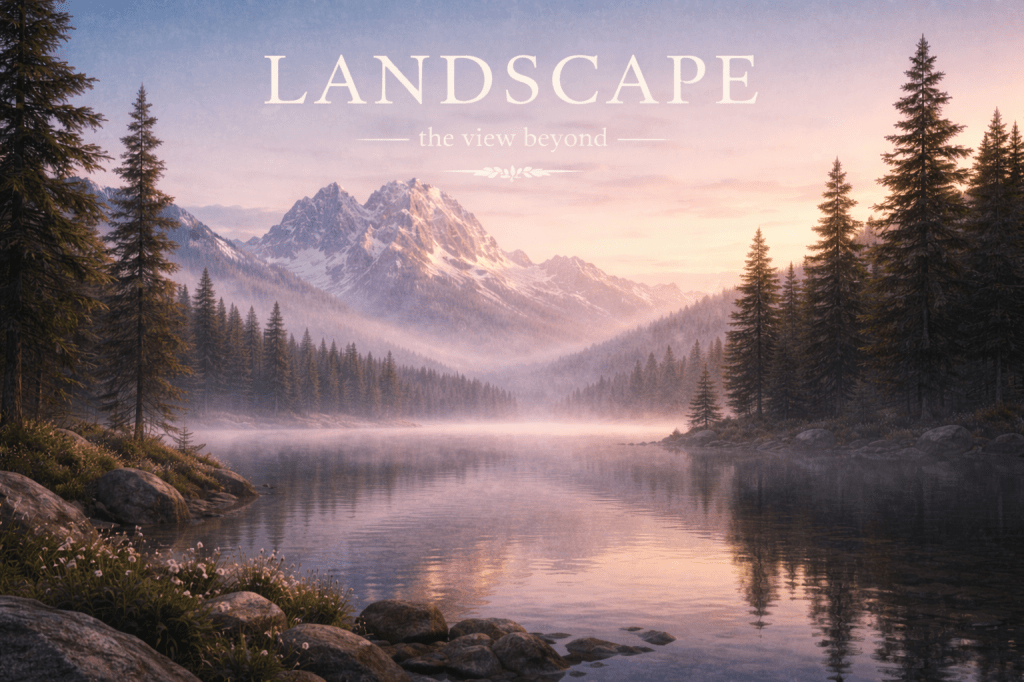
Landscape
IPA Pronunciation: /ˈlænd.skeɪp/
Part of Speech: Noun (also Verb, less common)
Origin
Landscape belongs to the vocabularies of geography, art, and perception. It refers to the visible features of an area of land — and, more broadly, to any field of view shaped by natural or conceptual elements.
The term bridges physical terrain and the way it is seen, interpreted, and represented.
A landscape is land as it is perceived.
Etymology
From Dutch: landschap — region, tract of land
From land + -schap (state, condition)
Originally used in painting to describe depictions of scenery, the word retains a connection between terrain and representation.
Core Definitions
Visible Terrain
The natural features of a land area.
“The landscape stretched to the horizon.”
Scenic View
A vista or expanse considered visually.
Conceptual Field
An abstract domain or environment.
“The political landscape changed rapidly.”
Explanation & Nuance
Landscape is not merely land — it is land as framed by perception.
It includes:
Natural elements — hills, rivers, sky
Human elements — buildings, roads, fields
Atmospheric conditions — light, weather, season
It is shaped by:
Viewpoint
Scale
Composition
Thus, landscape exists at the intersection of environment and observer.
Spatial & Visual Dimension
A landscape provides:
Depth — foreground, middle ground, background
Continuity — connection across space
Variation — contrast in form and texture
It may be:
Open — expansive and unobstructed
Enclosed — bounded by natural features
Dynamic — changing with time and light
Artistic Context
In art, landscape refers to a genre focused on scenery.
Artists shape landscapes through:
Framing
Perspective
Light and shadow
Color and atmosphere
The landscape becomes not just a place, but an interpretation.
Metaphorical Dimension
Landscape extends into abstract usage:
Political landscape — distribution of power
Cultural landscape — patterns of belief and practice
Emotional landscape — inner states and experiences
In each case, it suggests a field of elements interacting within a space.
Symbolic Dimensions
Horizon — limit and possibility
Terrain — conditions to navigate
Light — perception and mood
Elevation — perspective
Field — expanse of experience
Landscape symbolizes the world as it is encountered and understood.
Synonyms & Near-Relations
Scenery — visual appearance of a place
Terrain — physical features of land
Vista — wide scenic view
Environment — surrounding conditions
Topography — detailed mapping of land
(Only landscape fully combines physical features with perception and representation.)
Conceptual Relations
Perception — how land is seen
Space — physical expanse
Time — changing conditions
Context — surrounding environment
Viewpoint — position of observer
Cultural & Intellectual Resonance
Art
Landscape painting shapes how we see and value nature.
Geography
It describes the structure and features of land.
Philosophy
Landscape reflects the relationship between observer and world.
Literature
It often mirrors mood, theme, or inner state.
Takeaway
Landscape names the world as it appears before us —
not just land itself,
but land shaped by sight, light, and perspective.
It reminds us that what we see is always framed,
that terrain becomes meaningful through observation,
and that every view
is a meeting point between place and perception.
A landscape is more than ground —
it is a field of vision,
where earth, atmosphere, and awareness
come together
to form a world.
A landscape isn’t just what you see—it’s how the world takes shape in your eyes.
 Word of the Day - The English Nook
Leave a comment