
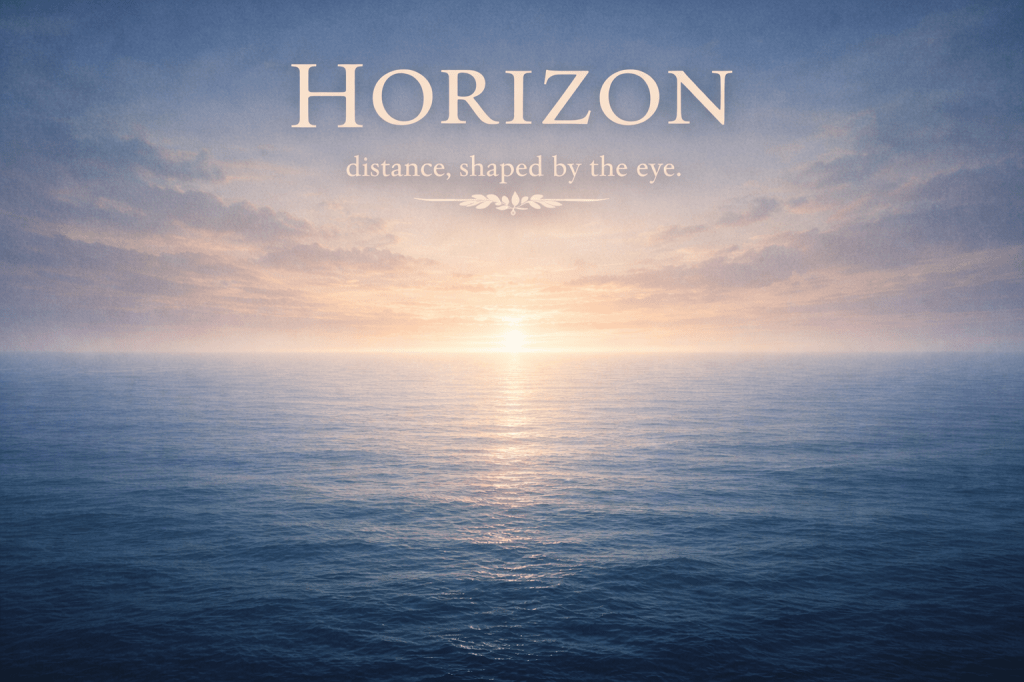
Horizon
IPA Pronunciation: /həˈraɪ.zən/
Part of Speech: Noun
Origin
Horizon belongs to the vocabularies of geography, perception, and possibility. It refers to the apparent line where the earth and sky meet — and, more broadly, to the limits of vision, knowledge, or experience.
It is not a fixed boundary, but a shifting one, moving as the observer moves.
The horizon is distance shaped by perspective.
Etymology
From Greek: horizōn (kyklos) — “dividing circle”
From horizō — to divide, separate
The term originally described a line that separates visible realms.
Core Definitions
Apparent Line of Meeting
The line where earth and sky seem to meet.
“The sun sank below the horizon.”
Limit of Perception
The farthest point visible or knowable.
“New ideas expanded his horizon.”
Range of Experience or Thought
The scope of awareness or understanding.
Explanation & Nuance
The horizon is an illusion grounded in reality.
It appears as a line, but it is:
Dependent on viewpoint
Always receding as one approaches
A function of perspective rather than a physical edge
It defines what is visible — and what lies beyond sight.
Spatial & Optical Dimension
Physically, the horizon is shaped by:
Earth’s curvature
Observer’s height
Atmospheric conditions
It provides:
Orientation — direction and position
Scale — sense of vastness
Boundary — limit of immediate perception
Experiential Dimension
As a metaphor, horizon represents:
Possibility — what lies ahead
Limitation — what cannot yet be seen
Aspiration — what one moves toward
It shifts with:
Movement
Knowledge
Time
The horizon expands as perspective changes.
Symbolic Dimensions
Line — boundary of vision
Edge — meeting of known and unknown
Light — emergence or disappearance
Distance — space yet to be crossed
Curve — hidden continuity
Horizon symbolizes the meeting point of reality and perception.
Synonyms & Near-Relations
Skyline — outline of land against sky
Vista — wide view
Limit — boundary of perception
Outlook — perspective or expectation
Frontier — edge of exploration
(Only horizon fully captures both the visual boundary and the conceptual limit of perception.)
Conceptual Relations
Perception — what can be seen
Distance — separation in space
Perspective — viewpoint shaping reality
Possibility — what lies beyond
Exploration — movement toward the unknown
Cultural & Intellectual Resonance
Literature
The horizon often symbolizes hope, distance, or unattainable goals.
Philosophy
It represents the limits of knowledge and understanding.
Art
Horizons structure composition and depth in visual work.
Science
It defines observable limits in fields such as astronomy.
Takeaway
Horizon names the edge of what we can see —
a line that both defines and escapes us.
It reminds us that limits are often shaped by perspective,
that what seems like an ending may only be a boundary of sight,
and that beyond every visible edge
there is more we have yet to encounter.
The horizon is not a wall —
it is a moving line,
drawing us forward,
expanding as we go,
always just beyond reach.
The horizon isn’t where things end—it’s where perspective begins.

 Word of the Day - The English Nook
Leave a comment