
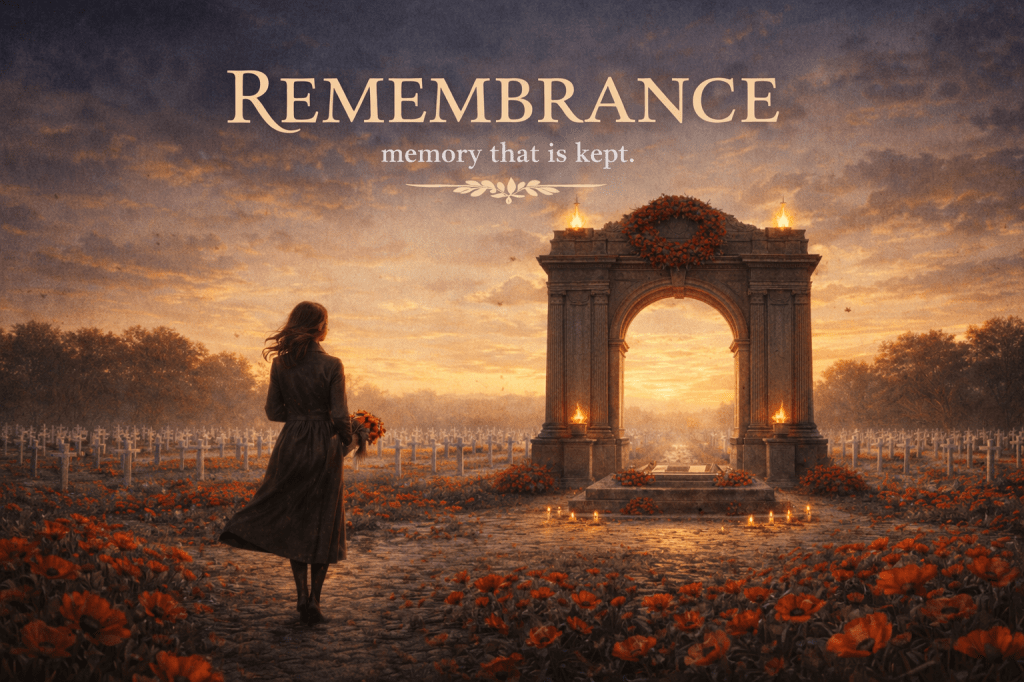
Remembrance
IPA Pronunciation: /rɪˈmɛm.brəns/
Part of Speech: Noun
Origin
Remembrance belongs to the vocabularies of memory, ritual, and reflection. It refers to the act of recalling, honoring, or keeping alive the presence of something or someone no longer immediate.
It is memory made intentional — not just recall, but preservation.
Remembrance is memory that is kept.
Etymology
From Old French: remembrer — to recall to mind
From Latin: rememorari — to remember again
The word carries the sense of bringing something back into awareness.
Core Definitions
Act of Remembering
The process of recalling past events or people.
“He spoke in remembrance of her.”
Commemoration
A formal or symbolic act of honoring memory.
“The ceremony was one of remembrance.”
Mental Retention
The continued presence of something in the mind.
Explanation & Nuance
Remembrance differs from simple memory.
Memory can be passive.
Remembrance is active.
It involves:
Attention
Intention
Emotional engagement
Remembrance may be:
Personal — recalling individual experiences
Collective — shared acts of commemoration
It transforms the past into something consciously held.
Temporal Dimension
Remembrance bridges time:
Past — what has occurred
Present — the act of recalling
Future — the continuation of memory
It resists disappearance, holding moments against the passage of time.
Cultural & Ritual Context
Remembrance is central to many traditions:
Memorial services
Anniversaries of events
Public commemorations
For example, Remembrance Day honors those who died in war, often marked by silence, symbols, and collective reflection.
Emotional Dimension
Remembrance often carries:
Grief
Respect
Nostalgia
Gratitude
It can be both:
Comforting — preserving connection
Painful — recalling loss
The act holds both presence and absence together.
Symbolic Dimensions
Flame — memory kept alive
Name — identity preserved
Circle — continuity
Echo — lingering presence
Stone — permanence
Remembrance symbolizes the persistence of meaning across time.
Synonyms & Near-Relations
Memory — general recall
Commemoration — formal honoring
Recollection — act of remembering
Memorial — object or act of remembrance
Reminiscence — reflective recall
(Only remembrance strongly emphasizes intentional, often solemn memory.)
Conceptual Relations
Time — passage and continuity
Loss — absence remembered
Identity — shaped by memory
History — collective remembrance
Presence — felt through memory
Cultural & Intellectual Resonance
Religion
Remembrance is central to rituals preserving sacred narratives.
History
Collective remembrance shapes identity and meaning.
Psychology
It reflects how memory is actively maintained.
Literature
Themes of remembrance explore loss, time, and continuity.
Takeaway
Remembrance names the act of holding the past in the present —
of refusing to let what has been
fade into absence.
It reminds us that memory can be chosen,
that meaning can be preserved through attention,
and that even what is gone
can remain present in awareness.
Remembrance is not just recall —
it is an act of keeping,
a quiet insistence
that something once lived
still matters now.
Remembrance is how the past refuses to disappear.

 Word of the Day - The English Nook
Leave a comment