
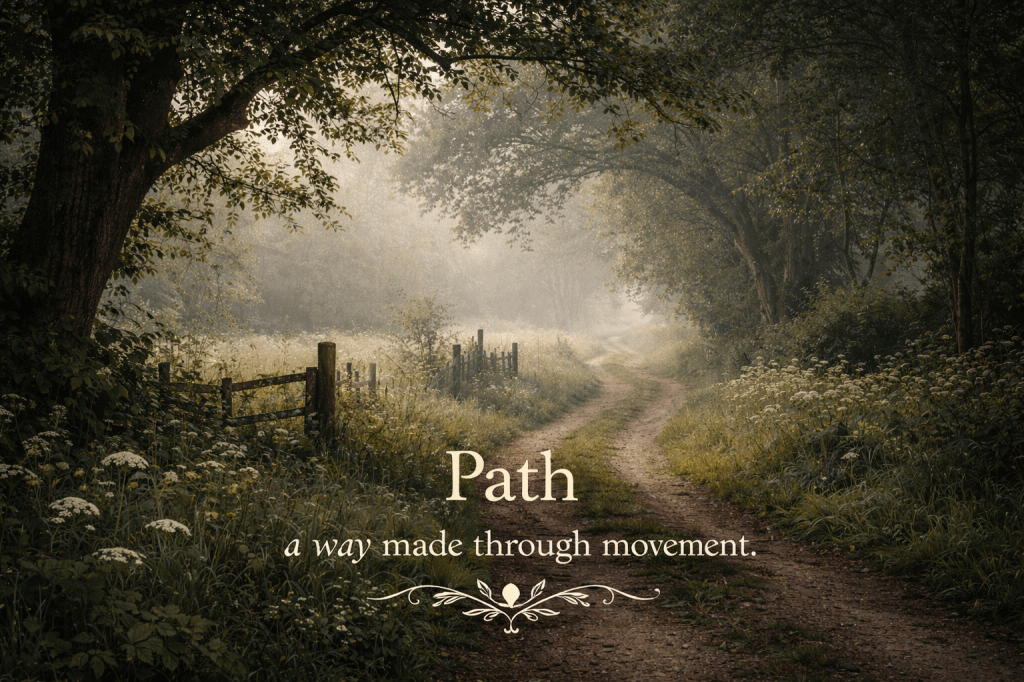
Path
IPA Pronunciation: /pæθ/
Plural: Paths /pæðz/
Part of Speech: Noun
Origin
Path belongs to the vocabularies of movement, direction, and meaning. It refers to a way or track laid down for walking or travel — and, more broadly, to any course or progression through space, time, or experience.
It is both literal and conceptual: a line one follows, and a direction one takes.
A path is a way made through movement.
Etymology
From Old English: pæþ — a track, trail
The root suggests something formed by repeated passage — a route shaped by use.
Core Definitions
Physical Track or Trail
A route for walking or travel.
“They followed a narrow path through the woods.”
Course or Direction
A way of proceeding or developing.
“She chose a different path in life.”
Sequence or Progression
A series of steps leading toward a goal or outcome.
Explanation & Nuance
A path differs from a road or route in scale and implication.
It is often:
Narrow
Informal
Organic
Shaped by use rather than design
A path may be:
Natural — formed by repeated movement
Constructed — intentionally laid out
Metaphorical — representing choices or development
It suggests intimacy and proximity rather than distance and speed.
Spatial Dimension
Physically, a path provides:
Guidance — a visible direction
Access — passage through terrain
Continuity — connection between points
Paths may wind, split, merge, or disappear, reflecting the complexity of terrain.
Metaphorical Dimension
As a concept, path represents:
Life direction
Moral or philosophical course
Process of growth or change
It implies:
Choice — selecting among possibilities
Movement — progression over time
Uncertainty — outcomes not fully known
Symbolic Dimensions
Line — direction and continuity
Crossroads — decision and divergence
Footprints — trace of passage
Horizon — destination or unknown
Turning — change in course
Path symbolizes movement shaped by choice and circumstance.
Synonyms & Near-Relations
Trail — natural track
Route — planned course
Way — general direction
Road — larger, constructed path
Course — abstract direction
(Only path fully captures the sense of a way formed through passage, both literal and metaphorical.)
Conceptual Relations
Journey — movement along a path
Choice — selection of direction
Time — progression forward
Space — terrain navigated
Purpose — reason for movement
Cultural & Intellectual Resonance
Literature
Paths often symbolize life choices and narrative direction.
Philosophy
They represent ways of living, thinking, or being.
Religion
Spiritual “paths” describe routes toward enlightenment or salvation.
Psychology
The idea of a path reflects personal development and identity formation.
Takeaway
Path names the way forward —
a line traced through space or time by movement and choice.
It reminds us that direction is often made, not given,
that every step contributes to the shape of the way,
and that even the smallest track
can lead somewhere meaningful.
A path is both guide and record —
a direction to follow,
and a trace of those who have passed before,
stretching toward what lies ahead.
A path isn’t found—it’s made, step by step.

 Word of the Day - The English Nook
Leave a comment