
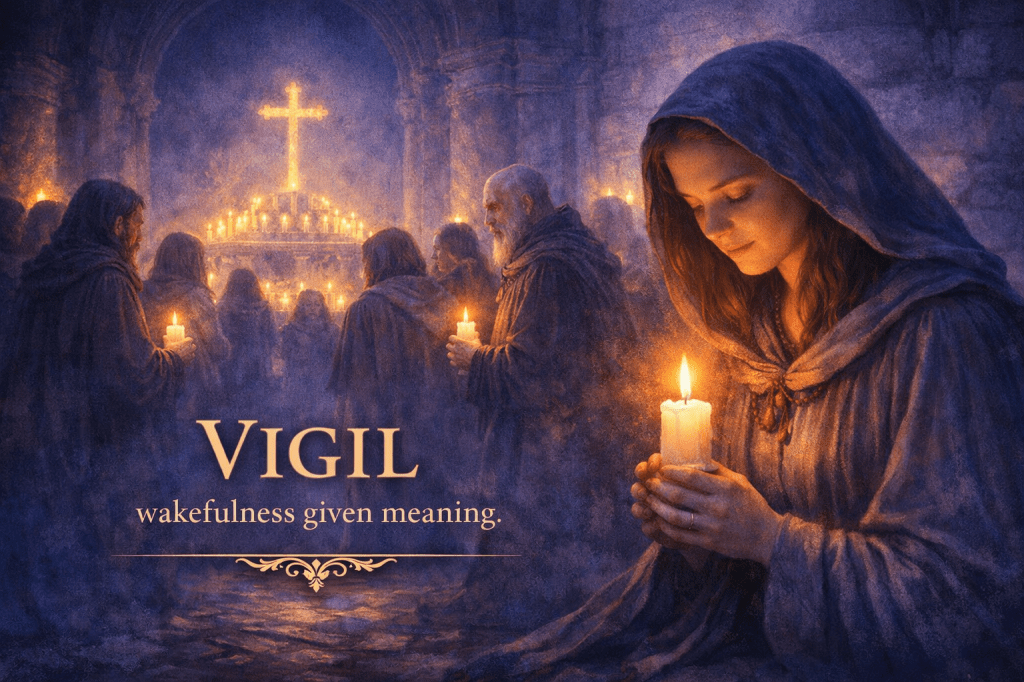
Vigil
IPA Pronunciation: /ˈvɪdʒ.ɪl/
Part of Speech: Noun
Origin
Vigil belongs to the vocabularies of ritual, watchfulness, and collective remembrance. It refers to a period of intentional wakefulness, often kept during the night, for purposes of prayer, mourning, reflection, or observance.
The term carries both solitude and solidarity — a quiet act that may be deeply personal or shared among many.
A vigil is wakefulness given meaning.
Etymology
From Latin: vigilia — wakefulness, watch
From vigil — awake, alert
The word preserves the sense of remaining conscious when one might otherwise sleep.
Core Definitions
Period of Wakeful Watching
Staying awake, especially at night, for a purpose.
“They kept a vigil through the night.”
Ritual Observance
A ceremonial act of prayer, remembrance, or reflection.
Public Gathering of Remembrance
A collective event held to honor, mourn, or show solidarity.
“A candlelight vigil was आयोजित.”
Explanation & Nuance
A vigil is defined less by action than by presence.
It involves:
Stillness
Attention
Duration
Intent
Unlike active ceremonies, a vigil emphasizes:
Quiet
Continuity
Endurance
It may be:
Solitary — personal reflection
Communal — shared mourning or support
Contexts of Use
Vigils appear across many settings:
Religious — prayer before holy days or events
Funerary — keeping watch over the dead
Civic — honoring victims or expressing solidarity
Personal — moments of private reflection
A common modern form is the candlelight vigil, where light symbolizes remembrance and unity.
Temporal Dimension
A vigil often occurs at liminal times:
Night
Eve of an event
Moments before transition
It marks a threshold between:
Life and death
Past and future
Loss and remembrance
Symbolic Dimensions
Candle — fragile but persistent light
Silence — shared presence without speech
Night — space for reflection
Circle — unity in stillness
Flame — memory that continues
Vigil symbolizes attention sustained against darkness.
Synonyms & Near-Relations
Watch — period of alertness
Observance — ritual recognition
Wake — gathering before burial
Commemoration — act of remembrance
Meditation — focused reflection
(Only vigil fully captures the blend of wakefulness, duration, and symbolic intent.)
Conceptual Relations
Memory — holding onto the past
Presence — being rather than doing
Ritual — structured meaning
Time — sustained duration
Loss — response to absence
Cultural & Intellectual Resonance
Religion
Vigils are central to many traditions of prayer and preparation.
Public Life
They serve as expressions of collective grief or solidarity.
Psychology
They offer a space for processing emotion through shared stillness.
Philosophy
A vigil reflects the human need to pause, attend, and bear witness.
Takeaway
Vigil names the act of staying awake for meaning —
of refusing to let a moment pass unmarked.
It reminds us that presence can be powerful,
that silence can carry weight,
and that even in darkness,
attention itself becomes a form of light.
A vigil is time held open —
a quiet resistance to forgetting,
where memory burns steadily
through the night.
Awake in silence, alive in meaning.
A word is never just a word.
It is a trace of how we think, live, and organize meaning.
At The English Nook, we explore that connection.
NEARBY IN MEANING
 Word of the Day - The English Nook
Leave a comment