
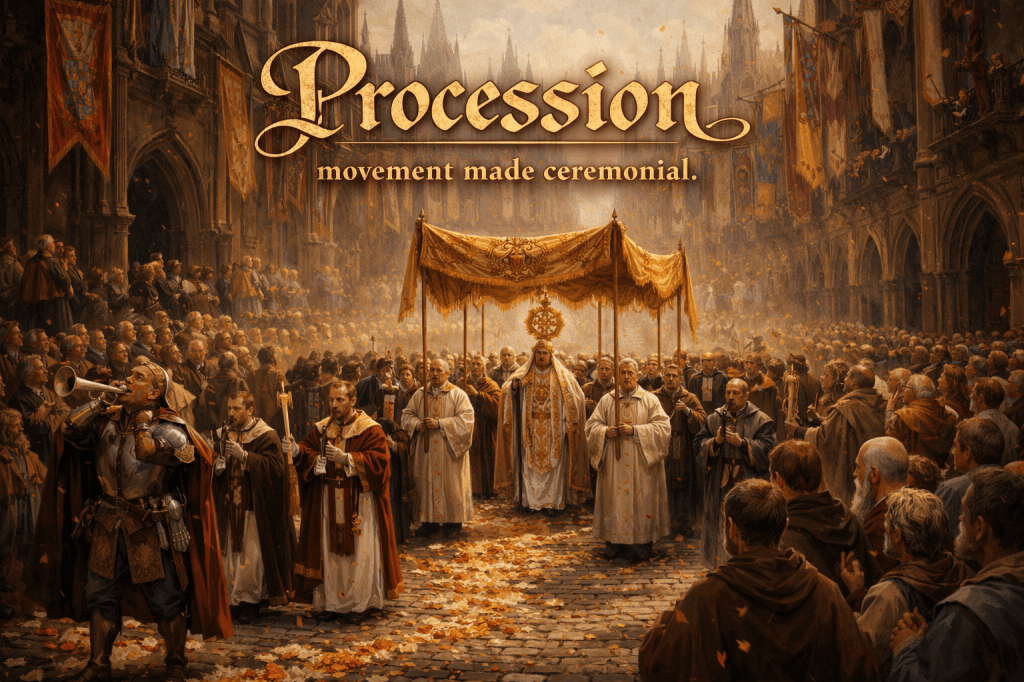
Procession
IPA Pronunciation: /prəˈsɛʃ.ən/
Part of Speech: Noun
Origin
Procession belongs to the vocabularies of ritual, ceremony, and collective movement. It refers to an organized group of people moving forward in a formal or symbolic manner, often for religious, civic, or celebratory purposes.
The term emphasizes not just movement, but ordered movement — guided by meaning, structure, and intention.
A procession is movement made ceremonial.
Etymology
From Latin: processio — a going forward, advance
From procedere — to go forth
The word retains the sense of forward motion shaped by purpose.
Core Definitions
Ceremonial Movement
A formal march of people, often for ritual or celebration.
“The procession moved through the streets.”
Ordered Group Advance
A sequence of individuals moving in a structured line.
Symbolic Journey
A movement representing transition, honor, or collective identity.
Explanation & Nuance
A procession differs from a crowd or casual movement.
It is:
Organized
Sequential
Purposeful
Often slow and deliberate
It may include:
Music
Banners
Ritual objects
Designated roles or positions
Participants are arranged in a meaningful order, reflecting hierarchy, tradition, or narrative.
Contexts of Use
Processions appear in many cultural settings:
Religious — festivals, pilgrimages, funerals
Civic — parades, commemorations
Royal — coronations, state ceremonies
Personal — weddings, graduations
Each type carries its own symbolism and structure.
Temporal & Spatial Dimension
A procession unfolds across space and time.
It creates:
A path — movement through a defined route
A sequence — order of participants
A rhythm — pace of progression
The act of moving becomes a visible narrative.
Symbolic Dimensions
Path — journey or transition
Line — order and continuity
Banner — identity and meaning
Rhythm — collective movement
Threshold — passage from one state to another
Procession symbolizes collective motion guided by meaning.
Synonyms & Near-Relations
Parade — public celebratory march
Cortege — formal procession, often funerary
March — organized movement
Pageant — ceremonial display
Pilgrimage — journey with spiritual purpose
(Only procession fully emphasizes ordered, symbolic movement across contexts.)
Conceptual Relations
Ritual — structured symbolic action
Community — collective participation
Time — unfolding sequence
Tradition — inherited forms
Movement — physical progression
Cultural & Intellectual Resonance
Religion
Processions express devotion and sacred movement.
Sociology
They reinforce group identity and shared meaning.
Art & Literature
They serve as metaphors for time, life, or historical progression.
Public Life
They mark significant events and collective memory.
Takeaway
Procession names the act of moving together with purpose —
a line of bodies becoming a line of meaning.
It reminds us that movement can be more than travel,
that order can transform motion into ritual,
and that walking together
can express what words cannot.
A procession is a path made visible —
a journey not just through space,
but through significance,
step by step.
Not just movement—meaning in motion.
A word is never just a word.
It is a trace of how we think, live, and organize meaning.
At The English Nook, we explore that connection.
NEARBY IN MEANING
 Word of the Day - The English Nook
Leave a comment