
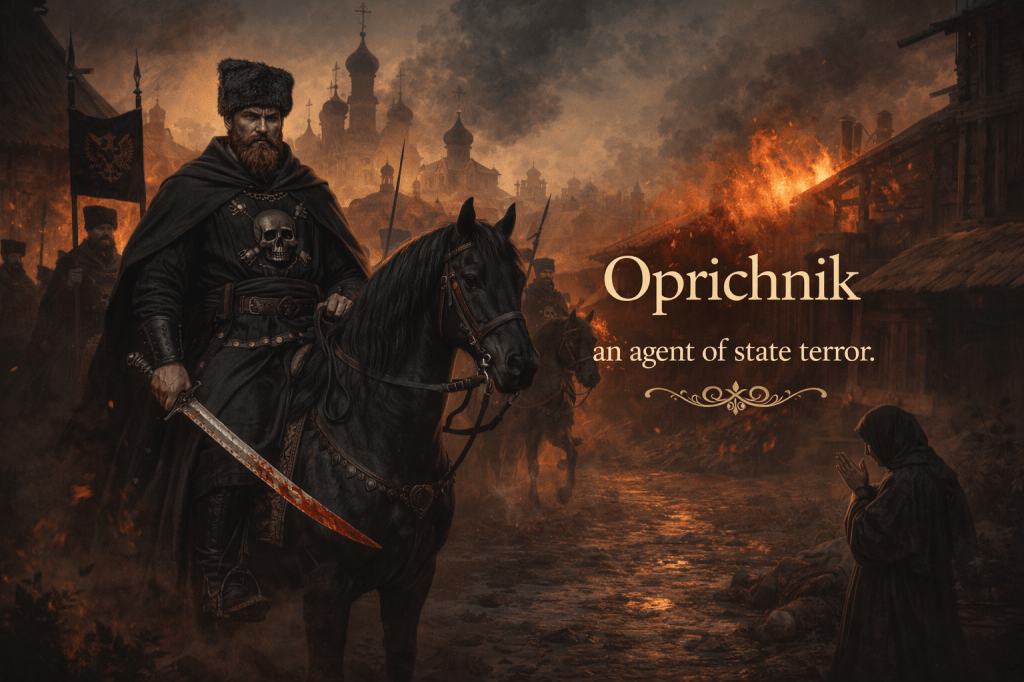
Oprichnik
IPA Pronunciation: /əˈprɪtʃ.nɪk/
Plural: Oprichniki /əˈprɪtʃ.nɪ.ki/
Part of Speech: Noun
Origin
Oprichnik belongs to the vocabularies of Russian history, political power, and state control. It refers to a member of a special corps established by Ivan IV (Ivan the Terrible) in the 16th century to enforce his authority.
These agents operated within the system known as the oprichnina, acting as instruments of surveillance, repression, and direct royal power.
An oprichnik is authority enforced through fear.
Etymology
From Russian: oprichnik — “one set apart”
From oprich — apart, separate
The term reflects their status as individuals separated from ordinary society, serving exclusively the ruler.
Core Definitions
Member of the Oprichnina
A state agent serving in Ivan IV’s special political and military force.
“The oprichniki rode under the tsar’s command.”
Enforcer of Autocratic Power
An individual tasked with suppressing opposition and consolidating authority.
Historical Political Figure
A symbol of centralized power and terror in early modern Russia.
Explanation & Nuance
The oprichniki were not conventional soldiers.
They functioned as:
Political enforcers
Secret police
Executioners
Confiscators of property
Their role included:
Identifying perceived enemies of the state
Punishing dissent
Seizing land from nobles
Maintaining loyalty to the tsar above all
They operated with broad, often unchecked authority.
Historical Context
During the reign of Ivan IV, the Russian state was divided into:
The oprichnina — directly controlled by the tsar
The zemshchina — governed through traditional structures
Oprichniki enforced this division and carried out campaigns of terror, including the massacre of Novgorod in 1570.
They were known for their distinctive imagery:
Black garments
Symbols such as a dog’s head and broom — representing sniffing out treason and sweeping it away
Political Significance
The oprichniki represent an early form of:
Centralized autocratic enforcement
State surveillance
Political terror as governance
Their actions weakened traditional aristocratic power while strengthening the authority of the ruler.
Symbolic Dimensions
Dog’s Head — detection of betrayal
Broom — eradication of enemies
Black Cloak — secrecy and fear
Horseman — mobility of power
Shadow — unseen authority
Oprichnik symbolizes the embodiment of state power operating beyond restraint.
Synonyms & Near-Relations
Secret police — state security agents
Enforcer — agent of authority
Inquisitor — investigator of dissent
Executioner — agent of punishment
Agent of repression — instrument of control
(Only oprichnik specifically denotes the historical agents of Ivan IV’s oprichnina.)
Conceptual Relations
Autocracy — centralized rule
Terror — governance through fear
Surveillance — monitoring of subjects
Power — authority enforced
Loyalty — allegiance to ruler
Cultural & Intellectual Resonance
Russian History
Oprichniki symbolize a formative moment in the development of centralized state power.
Political Theory
They illustrate the use of fear and force in maintaining authority.
Literature & Art
They appear as archetypes of dark state power and fanatic loyalty.
Modern Reflection
The term is sometimes invoked metaphorically to describe oppressive enforcement systems.
Takeaway
Oprichnik names the figure set apart to serve power —
an agent who acts in the name of authority without ordinary constraint.
It reminds us that governance can take forms both visible and hidden,
that loyalty can be demanded through fear,
and that the machinery of power often operates through individuals
who stand outside the rules they enforce.
An oprichnik is the shadow of the state —
moving where authority is absolute,
and where opposition
is meant to disappear.
Where power fears resistance, shadows do its work.
A word is never just a word.
It is a trace of how we think, live, and organize meaning.
At The English Nook, we explore that connection.
NEARBY IN MEANING
 Word of the Day - The English Nook
Leave a comment