
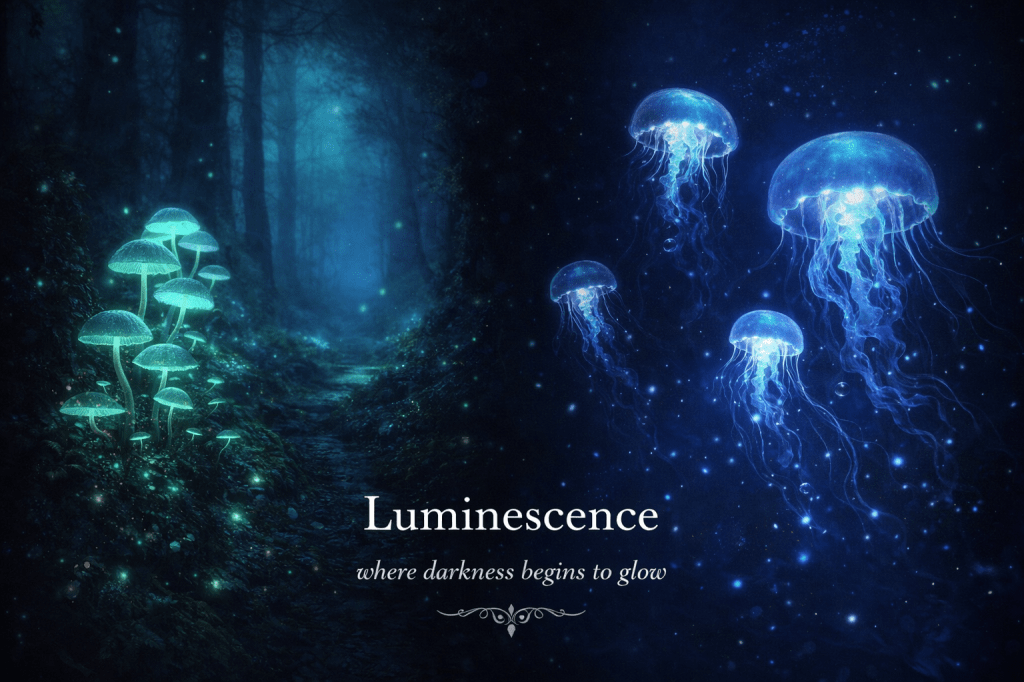
Luminescence
IPA Pronunciation: /ˌluː.mɪˈnɛs.əns/
Part of Speech: Noun
Origin
Luminescence belongs to the vocabularies of physics, chemistry, and natural phenomena. It refers to the emission of light by a substance not resulting from heat — often described as “cold light.”
The concept appears across both scientific study and natural observation, from glowing minerals to living organisms that produce their own light.
Luminescence is light without fire.
Etymology
From Latin: lumen — light
- suffix -escence — process of becoming
The term suggests the act or process of giving off light.
Core Definitions
Cold Light Emission
Light produced without significant heat.
“The mineral displayed faint luminescence.”
Physical Phenomenon
Emission of light resulting from chemical, electrical, or biological processes.
General Glow
A soft or subtle radiance not caused by high temperature.
Explanation & Nuance
Luminescence differs from ordinary light sources such as flames or incandescent bulbs.
Instead of heat, it arises from:
Electron excitation and release of energy
Chemical reactions
Biological processes
Electrical stimulation
Types of luminescence include:
Fluorescence — immediate light emission under radiation
Phosphorescence — delayed emission after excitation
Bioluminescence — light produced by living organisms
Chemiluminescence — light from chemical reactions
Each involves energy transforming directly into visible light.
Scientific Context
In physics and chemistry, luminescence occurs when electrons in a material absorb energy and then release it as light.
This process is fundamental to:
LED technology
Glow-in-the-dark materials
Analytical chemistry techniques
Medical imaging
It allows light to be generated efficiently without excessive heat loss.
Natural Phenomena
Luminescence appears in many natural settings, such as:
Fireflies glowing in the dark
Deep-sea organisms producing light
Certain fungi emitting faint glows
Minerals fluorescing under ultraviolet light
These phenomena reveal hidden processes within nature.
Symbolic Dimensions
Glow — quiet presence
Spark — release of energy
Darkness Lit — light emerging without flame
Pulse — intermittent radiance
Signal — communication through light
Luminescence symbolizes illumination arising from within.
Synonyms & Near-Relations
Glow — soft light emission
Radiance — shining brightness
Phosphorescence — delayed glow
Fluorescence — immediate emission under excitation
Bioluminescence — biological light production
(Only luminescence broadly denotes light emission without heat across multiple processes.)
Conceptual Relations
Energy — source of emission
Light — visible radiation
Excitation — elevation of energy states
Transformation — conversion of energy forms
Visibility — making the unseen perceptible
Cultural & Intellectual Resonance
Science
Luminescence is central to modern lighting and imaging technologies.
Nature
It reveals hidden biological and chemical processes.
Art & Aesthetics
The concept inspires imagery of subtle or internal light.
Metaphor
Often used to describe inner brilliance or quiet radiance.
Takeaway
Luminescence names the glow that does not burn —
light released without heat,
quietly emerging from within matter itself.
It reminds us that illumination need not be forceful,
that energy can express itself gently,
and that even in darkness,
there are processes that produce light unseen.
Luminescence is the language of hidden energy —
a soft radiance
that reveals the world
without consuming it.
Not all light burns—some simply awakens.
A word is never just a word.
It is a trace of how we think, live, and organize meaning.
At The English Nook, we explore that connection.
NEARBY IN MEANING
 Word of the Day - The English Nook
Leave a comment