
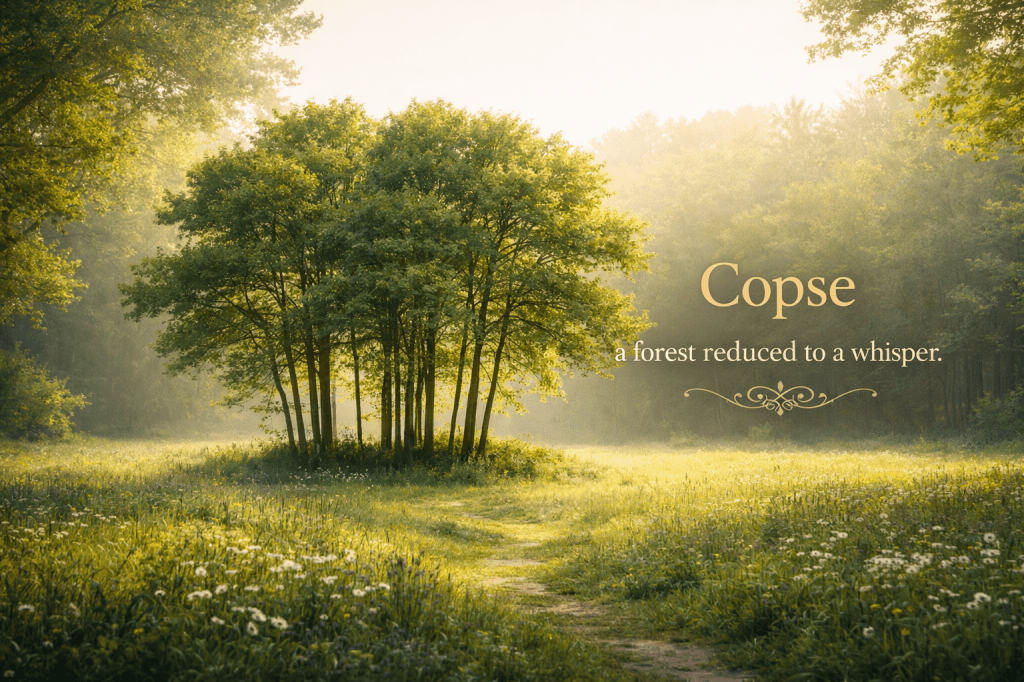
Copse
IPA Pronunciation: /kɒps/ (British) • /kɑːps/ (American)
Part of Speech: Noun
Origin
Copse belongs to the vocabularies of landscape, forestry, and pastoral description. It refers to a small group or thicket of trees, often dense and somewhat secluded within a larger open area.
The word evokes a modest, contained woodland — not vast like a forest, but intimate and enclosed.
A copse is a forest reduced to a whisper.
Etymology
From Middle English: coppis
Derived from Old French: copeiz — a cutting, from coper (to cut)
The term is historically connected to coppicing, a method of cutting trees near the base to promote regrowth, producing dense clusters of shoots.
Core Definitions
Small Group of Trees
A compact cluster of trees or shrubs.
“A copse stood at the edge of the field.”
Thicket or Grove
A dense, often tangled patch of woodland growth.
Managed Woodland Patch
An area of trees historically maintained through coppicing.
Explanation & Nuance
A copse differs from larger wooded areas in scale and feeling.
It is typically:
Small and contained
Dense or closely spaced
Partially enclosed
Often found in rural or pastoral landscapes
It may serve as:
Shelter for animals
Windbreak in open land
A visual boundary
A quiet, hidden space
The word carries a sense of intimacy rather than wilderness.
Ecological Context
Copses can support diverse ecosystems by providing:
Habitat for birds and small mammals
Shelter from weather
Microenvironments for plant growth
In traditional agriculture, coppiced woodland was an important renewable resource for:
Firewood
Fencing materials
Charcoal production
Visual & Sensory Qualities
A copse often appears as:
A dark cluster against open fields
A pocket of shade
A place where light filters through leaves
It can feel:
Quiet
Enclosed
Slightly mysterious
Protective
Symbolic Dimensions
Shelter — refuge within openness
Cluster — unity in small scale
Threshold — boundary between open and hidden
Shade — concealment and rest
Pocket — contained world
Copse symbolizes intimacy within landscape.
Synonyms & Near-Relations
Grove — small group of trees (often more open)
Thicket — dense shrub or tree growth
Woodlot — small managed woodland
Spinney — small wooded area (especially British usage)
Stand — group of trees
(Only copse strongly carries the sense of a small, dense, often managed cluster of trees.)
Conceptual Relations
Landscape — natural environment
Scale — size shaping perception
Ecology — living systems
Rural Life — agricultural setting
Shelter — protection within nature
Cultural & Intellectual Resonance
Literature
Copses often appear as settings for quiet encounters or hidden moments.
Painting
They serve as compositional elements in pastoral landscapes.
Ecology
They illustrate how small habitats contribute to biodiversity.
Memory & Place
A copse can feel like a remembered corner of land — familiar and enclosed.
Takeaway
Copse names a small gathering of trees —
a place where the landscape folds inward.
It reminds us that not all nature is vast,
that some spaces invite closeness rather than awe,
and that even a modest cluster of growth
can hold depth, shelter, and quiet.
A copse is a contained woodland —
a pocket of shade and stillness
set gently within the open world.
Not all forests are vast—some whisper.
A word is never just a word.
It is a trace of how we think, live, and organize meaning.
At The English Nook, we explore that connection.
NEARBY IN MEANING
 Word of the Day - The English Nook
Leave a comment