
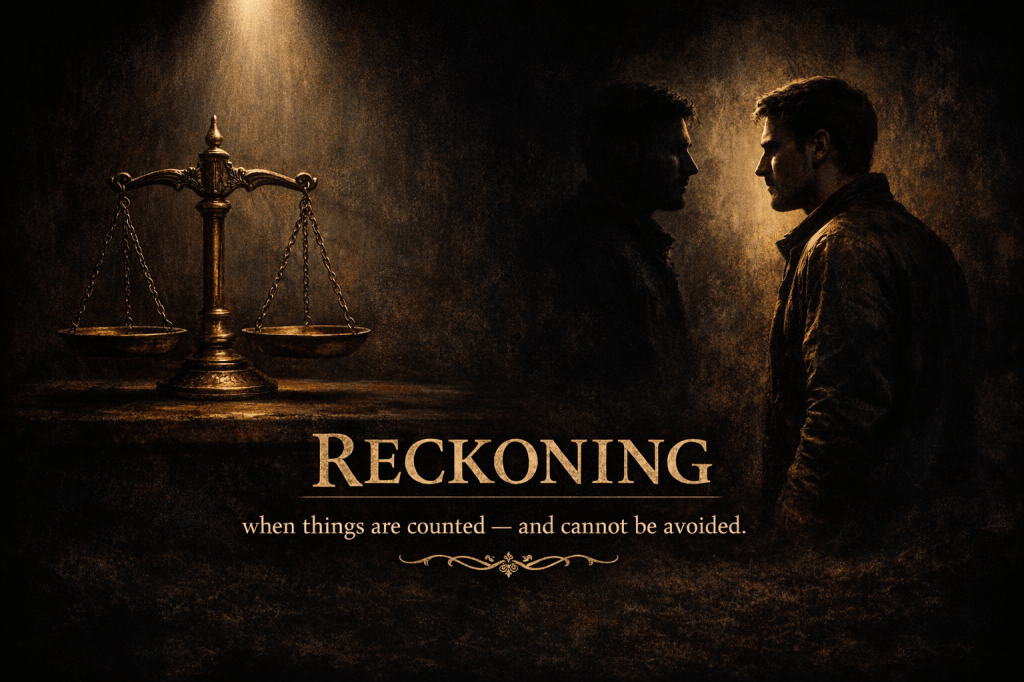
Reckoning
IPA Pronunciation: /ˈrɛk.ən.ɪŋ/
Part of Speech: Noun
Origin
Reckoning belongs to the vocabularies of accounting, judgment, and existential reflection. It refers to the act of calculation, settlement, or the moment when accounts — literal or moral — are brought into balance.
Over time, the term has expanded from numerical calculation to include moments of judgment, consequence, and realization.
Reckoning is the moment when things are counted — and cannot be avoided.
Etymology
From Old English: gerecenian — to recount, explain, or calculate
Related to reccan — to narrate, give account
The word carries a dual sense: counting and telling — numbers and narrative brought together.
Core Definitions
Calculation or Accounting
The act of computing or totaling.
“The final reckoning showed a loss.”
Settlement of Accounts
The balancing or closing of debts or obligations.
“It was time for a reckoning.”
Moment of Judgment
A time when consequences must be faced.
“He feared the reckoning would come.”
Explanation & Nuance
Reckoning operates across both concrete and abstract domains.
In practical terms, it involves:
Counting
Measuring
Balancing accounts
In broader usage, it refers to:
Moral evaluation
Acceptance of consequences
Recognition of truth
Confrontation with past actions
It often implies inevitability — a point that cannot be deferred indefinitely.
Temporal and Moral Dimension
Reckoning suggests a convergence of past and present.
Actions accumulate over time.
Consequences may be delayed.
But eventually, they are gathered into a single moment of clarity or judgment.
Thus, reckoning is both:
A process — gradual accumulation
A moment — sudden confrontation
Historical & Cultural Usage
The term appears in various contexts:
Financial — settling debts
Religious — divine judgment or “day of reckoning”
Personal — moments of self-realization
Historical — collective confrontation with past actions
It often carries a tone of gravity and inevitability.
Symbolic Dimensions
Ledger — record of actions
Scale — balance of consequence
Mirror — confrontation with truth
Threshold — crossing into accountability
Storm — gathering forces culminating in impact
Reckoning symbolizes the convergence of action and consequence.
Synonyms & Near-Relations
Accounting — numerical calculation
Settlement — resolution of obligations
Judgment — evaluation of actions
Consequence — result of behavior
Day of reckoning — moment of final accountability
(Only reckoning fully captures both calculation and moral confrontation.)
Conceptual Relations
Responsibility — ownership of actions
Time — accumulation of events
Justice — balance of fairness
Memory — record of the past
Truth — acknowledgment of reality
Cultural & Intellectual Resonance
Religion
Often associated with final judgment or divine accounting.
Literature
Used to mark climactic moments where characters face consequences.
History
Applied to societal acknowledgment of past wrongs.
Psychology
Represents moments of self-awareness and acceptance.
Takeaway
Reckoning names the moment when the past is gathered and counted —
when actions, long dispersed, return as consequence.
It reminds us that nothing remains unaccounted forever,
that time stores what we do,
and that clarity often arrives all at once.
Reckoning is the balance at the end of accumulation —
the point where numbers become meaning,
and where what has been done
must finally be faced.
In the end, everything adds up—and asks to be answered.
A word is never just a word.
It is a trace of how we think, live, and organize meaning.
At The English Nook, we explore that connection.
 Word of the Day - The English Nook
Leave a comment