
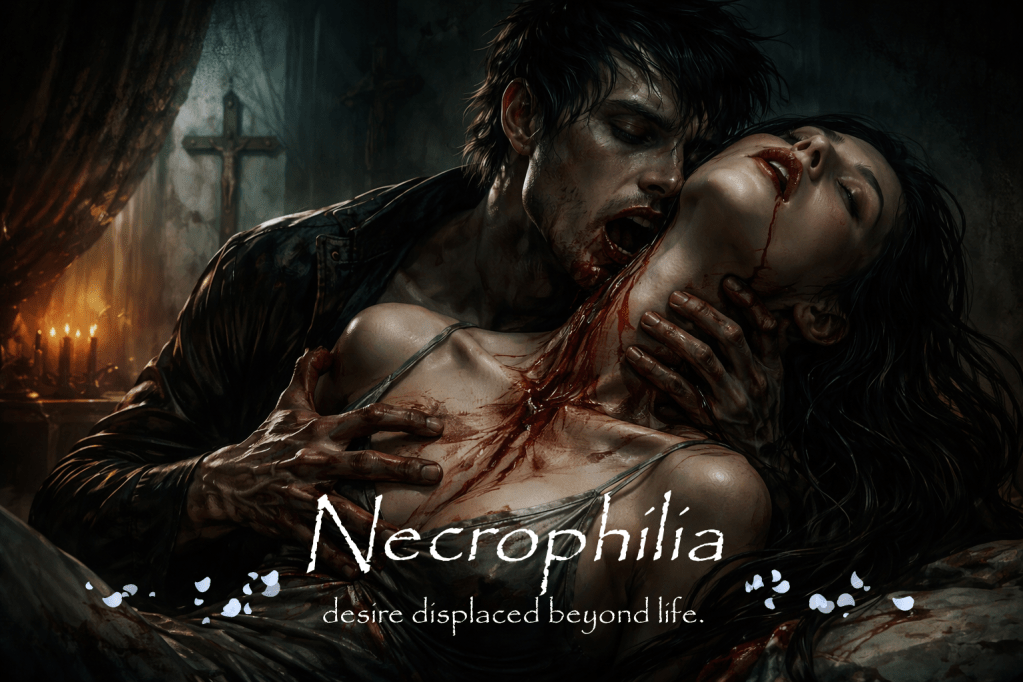
Necrophilia
IPA Pronunciation: /ˌnɛk.rəˈfɪl.i.ə/
Part of Speech: Noun
Origin
Necrophilia belongs to the vocabularies of psychology, psychiatry, and forensic science. It refers to a pathological attraction to or sexual interest in corpses.
The term is used primarily in clinical and legal contexts to describe a rare and extreme form of paraphilia, often associated with severe psychological disturbance.
Necrophilia is desire displaced beyond life.
Etymology
From Greek:
nekros — dead body, corpse
- philia — love, attraction
The word literally means “love of the dead.”
Core Definitions
Psychological Condition
A paraphilia involving sexual attraction to corpses.
“Necrophilia is classified as a disorder in forensic contexts.”
Forensic Term
A category used in legal and criminal investigations involving abuse of the dead.
Pathological Behavior
An extreme deviation from normative sexual patterns involving the deceased.
Explanation & Nuance
Necrophilia is not a typical psychological variation but a rare and serious condition.
It is generally understood as involving:
A desire for control without reciprocity
Avoidance of rejection or interaction
Distorted perceptions of intimacy
In clinical analysis, it may be linked to:
Severe trauma
Personality disorders
Psychotic conditions
Extreme social isolation
Clinical Context
In psychiatry, necrophilia is categorized among paraphilic disorders when it leads to harmful or illegal behavior.
It is often examined in relation to:
Impulse control
Attachment disorders
Deviant behavioral patterns
Because it involves deceased individuals, it intersects strongly with legal and ethical boundaries.
Legal and Ethical Dimensions
Necrophilia is illegal in most jurisdictions and considered a violation of:
Human dignity
Cultural and social norms surrounding death
Legal protections for the deceased
It is treated as a serious criminal offense and a form of abuse.
Symbolic Dimensions
Stillness — absence of response
Boundary — line between life and death
Silence — lack of reciprocity
Transgression — violation of fundamental norms
Void — absence mistaken for presence
Necrophilia symbolizes the breakdown of boundaries between life and death.
Synonyms & Near-Relations
Paraphilia — atypical sexual interest
Necrolagnia — more specific term for sexual arousal from corpses
Pathological fixation — disordered attachment
Forensic abnormality — legal/clinical classification
(These terms overlap, but necrophilia specifically denotes attraction to corpses.)
Conceptual Relations
Death — end of life
Taboo — socially prohibited behavior
Psychopathology — study of mental disorders
Consent — absence of agency
Boundary Violation — crossing ethical limits
Cultural & Intellectual Resonance
Psychiatry
Necrophilia is studied as an extreme deviation requiring clinical interpretation.
Forensic Science
It appears in criminal investigations involving the abuse of bodies.
Ethics
It raises fundamental questions about dignity, consent, and respect for the dead.
Cultural Taboos
Across societies, it is among the most universally condemned behaviors.
Takeaway
Necrophilia names a condition where desire crosses into death —
a violation not only of law,
but of the deepest human boundaries.
It reminds us that attraction is shaped by ethics as well as impulse,
that consent defines the limits of intimacy,
and that respect for the dead reflects the values of the living.
Necrophilia stands as a stark boundary —
a point at which human behavior
ceases to recognize
the line between life
and what lies beyond it.
Where desire ignores life, humanity draws its firmest line.
A word is never just a word.
It is a trace of how we think, live, and organize meaning.
At The English Nook, we explore that connection.
 Word of the Day - The English Nook
Leave a comment