
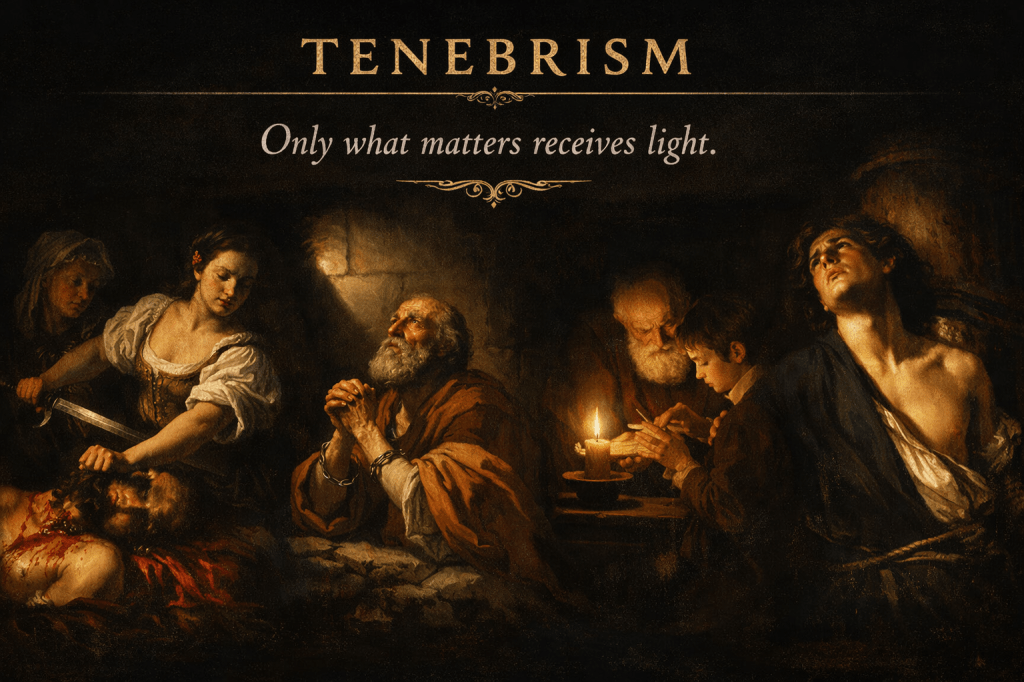
Tenebrism
IPA Pronunciation: /ˈtɛn.ə.brɪz.əm/
Part of Speech: Noun
Definition (simple):
A Baroque painting style in which figures emerge dramatically from deep shadow through intense, focused light.
Origin
Tenebrism belongs to the vocabularies of art history, Baroque painting, and visual aesthetics. It refers to a style of dramatic illumination in which figures emerge starkly from deep shadow, with extreme contrasts between light and dark.
The technique is most strongly associated with Caravaggio, whose works revolutionized the use of light to heighten emotional intensity, realism, and psychological drama.
Tenebrism is light sharpened by darkness.
Etymology
From Italian tenebroso — dark, shadowy
From Latin tenebrae — darkness
The term emphasizes the dominance of shadow as an active element in composition, not merely a background condition.
Core Definitions
Artistic Technique
A style of painting using intense contrasts of light and dark.
“The composition employs tenebrism.”
Dramatic Illumination
Use of spotlight-like lighting to isolate figures against dark backgrounds.
Baroque Aesthetic
A visual strategy enhancing emotional and narrative impact through shadow.
Explanation & Nuance
Tenebrism goes beyond simple contrast.
Unlike general chiaroscuro (light–dark modeling), tenebrism suppresses the background almost entirely and isolates the subject in sudden, concentrated light.
Chiaroscuro shapes form.
Tenebrism reveals it.
In tenebrism, light does not gently model form — it reveals it abruptly.
Large areas of the composition are consumed by shadow, and only what is essential is illuminated.
In tenebrism, darkness is not absence, but presence.
Artistic Context
Tenebrism flourished during the Baroque period, influencing painters such as:
- Artemisia Gentileschi
- Georges de La Tour
- Jusepe de Ribera
In these works, light often appears as:
- A candle flame
- A divine illumination
- A focused beam from an unseen source
The effect creates psychological depth, dramatic immediacy, and intense emotional focus.
Visual Characteristics
Tenebrist works often feature:
- Dark, undefined backgrounds
- Sharp, directional lighting
- High contrast between illuminated and shadowed areas
- Emphasis on faces and gestures
- Minimal distraction from the central subject
The eye is drawn immediately to what is lit, while the surrounding darkness absorbs everything else.
Symbolic Dimensions
Tenebrism is not only a technique but also a symbolic language:
- Light — revelation, truth, knowledge
- Darkness — mystery, ignorance, the unknown
- Beam of light — divine presence or sudden insight
- Shadow — concealment, tension, uncertainty
- Stage-like lighting — reality presented as drama
Tenebrism often symbolizes revelation emerging from obscurity.
Synonyms & Near-Relations
- Chiaroscuro — general light–dark modeling
- Baroque lighting — dramatic illumination style
- High contrast — visual intensity
- Spotlighting — focused illumination
- Dramatic realism — heightened visual storytelling
Only tenebrism specifically denotes the extreme, shadow-dominant style associated with Baroque painting.
Conceptual Relations
Tenebrism connects to broader ideas such as:
- Perception — how light reveals form
- Drama — heightened emotional intensity
- Realism — lifelike depiction
- Religious art — frequent use in sacred scenes
- Theatricality — staging within visual art
It is not only a way of painting, but a way of directing attention and meaning.
Cultural & Intellectual Resonance
Art History
Tenebrism marks a turning point toward emotional immediacy and psychological realism in painting.
Religious Imagery
It enhances spiritual drama by contrasting light and darkness, often symbolizing divine revelation.
Cinema
Modern film lighting frequently draws on tenebrist techniques to create tension, focus, and atmosphere.
Aesthetics
Tenebrism demonstrates how contrast shapes perception — we see what is illuminated, and we imagine what remains in shadow.
Takeaway
Tenebrism names the moment when light breaks through darkness —
not gently, but with force.
It reminds us that what we see depends on contrast,
that revelation often arrives suddenly,
and that shadow can be as powerful as light.
Tenebrism is vision under pressure —
a world where darkness dominates,
and meaning appears only where illumination strikes.
A word is never just a word.
It is a trace of how we think, live, and organize meaning.
At The English Nook, we explore that connection.
 Word of the Day - The English Nook
Leave a comment