
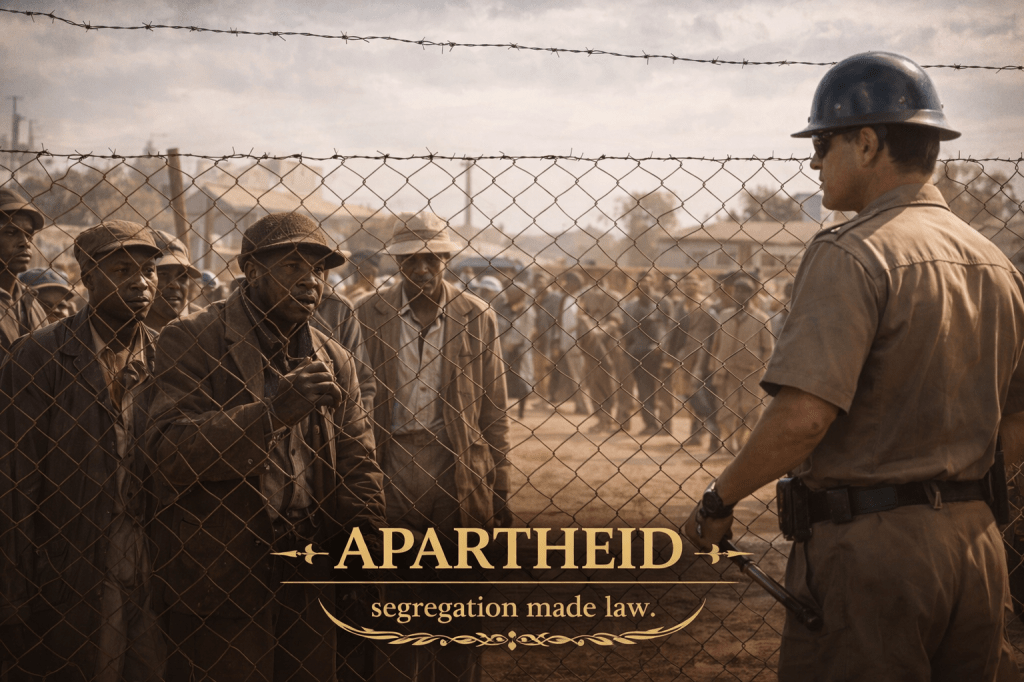
Apartheid
IPA Pronunciation: /əˈpɑːrt.heɪt/ (English) • /aˈpartɦɛit/ (Afrikaans)
Part of Speech: Noun
Origin
Apartheid belongs to the vocabularies of political history, human rights, and racial segregation. It refers to the system of institutionalized racial separation and discrimination enforced in South Africa from 1948 until the early 1990s.
Under apartheid, the state organized society along rigid racial lines, granting political and economic power to the white minority while systematically oppressing nonwhite populations.
Apartheid is segregation made law.
Etymology
From Afrikaans: apartheid — “apartness”
From apart — separate
- suffix -heid — condition or state
The term directly encodes the principle of enforced separation.
Core Definitions
System of Racial Segregation
A legal and political system enforcing separation between racial groups.
“Apartheid governed South African society.”
Institutionalized Discrimination
A regime in which inequality is codified into law.
“Laws of apartheid restricted movement and rights.”
Historical Political System
The specific system implemented in South Africa from 1948 to 1994.
Explanation & Nuance
Apartheid was not merely social prejudice but a comprehensive legal structure.
It regulated:
Where people could live
Whom they could marry
Where they could work
How they could travel
What political rights they possessed
The system divided the population into racial categories and enforced strict separation in:
Housing
Education
Healthcare
Public facilities
It was segregation backed by state power.
Legal Structure
Key features of apartheid included:
Pass laws controlling movement
Forced removals from designated areas
Creation of “homelands” (Bantustans)
Denial of voting rights to nonwhite citizens
Separate and unequal institutions
The system aimed to maintain economic and political dominance by a minority.
Historical Context
Apartheid became official policy after the 1948 election victory of the National Party.
Resistance came from individuals and organizations such as Nelson Mandela and the African National Congress.
International pressure, internal resistance, and political change led to its dismantling, culminating in democratic elections in 1994.
Ethical and Human Impact
Apartheid resulted in:
Systematic inequality
Economic exploitation
Social fragmentation
Political repression
Widespread human rights violations
It is widely regarded as one of the most significant examples of institutionalized injustice in the modern era.
Symbolic Dimensions
Wall — enforced separation
Line — arbitrary division
Passbook — control of movement
Broken Chain — struggle for liberation
Open Door — transition to equality
Apartheid symbolizes the codification of inequality.
Synonyms & Near-Relations
Segregation — enforced separation
Racial discrimination — unequal treatment based on race
Institutional racism — systemic inequality
Jim Crow — U.S. segregation system
Ethnic stratification — hierarchical division
(Only apartheid specifically denotes the South African system of legally enforced racial separation.)
Conceptual Relations
Human Rights — universal dignity and equality
Justice — fairness under law
Oppression — systemic denial of freedom
Resistance — struggle against injustice
Democracy — inclusive political participation
Cultural & Intellectual Resonance
Political History
Apartheid is a defining case in the study of modern state-enforced inequality.
Human Rights
It shaped international law and global activism against discrimination.
Sociology
The system illustrates how institutions can structure inequality.
Collective Memory
It remains a powerful symbol of both oppression and the struggle for justice.
Takeaway
Apartheid names a system that divided people by law —
separating lives,
rights,
and futures along imposed lines.
It reminds us that injustice can be organized,
that inequality can be enforced through institutions,
and that resistance is often required to restore dignity.
Apartheid is a warning written into history —
that separation,
when made absolute,
becomes oppression,
and that justice demands not division,
but equality.
Separation, when written into law, becomes a system.
A word is never just a word.
It is a trace of how we think, live, and organize meaning.
At The English Nook, we explore that connection.
 Word of the Day - The English Nook
Leave a comment