
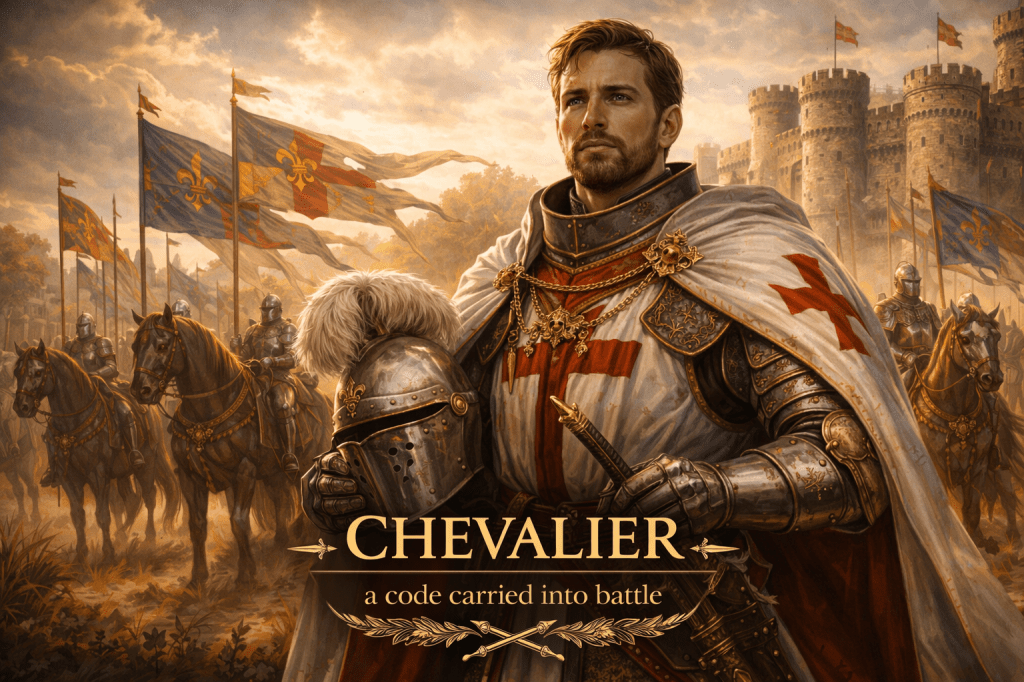
Chevalier
IPA Pronunciation: /ˌʃɛv.əˈlɪər/ (English) • /ʃə.va.lje/ (French)
Part of Speech: Noun
Origin
Chevalier belongs to the language of medieval chivalry, European nobility, and cultural memory. It denotes a knight, a member of a chivalric order, and by extension, a man marked by courtesy, honor, and disciplined conduct.
The word evokes the mounted warrior of the Middle Ages—
bound not only to combat, but to a code.
A chevalier is honor made mobile.
Etymology
From Old French chevalier — “horseman, knight”
From cheval — “horse”
The term originally emphasized mobility and status, reflecting the decisive role of cavalry in medieval warfare.
Core Definitions
Knight
A mounted warrior of medieval Europe.
“The chevalier rode into battle.”
Member of an Order
A person admitted to a chivalric or honorary order.
“He was named a chevalier of the order.”
Gallant Gentleman
A man distinguished by courtesy, bravery, or refined conduct.
Explanation & Nuance
The chevalier stands at the intersection of force and form.
Historically, he was:
- a trained combatant
- a landholding noble or retainer
- bound by fealty
- governed by expectation
These expectations were codified—implicitly or explicitly—into what we now call chivalry:
- honor
- loyalty
- courage
- courtesy
- protection of the vulnerable
The word therefore exceeds its military origin. It describes not only what one does, but how one is expected to act.
Historical Context
Chevaliers occupied a central position in medieval European society, particularly within feudal structures. They served kings, lords, and at times religious institutions, functioning as both military assets and social agents of order.
In France, the term later acquired a ceremonial dimension. Chevalier became the entry rank in state honors such as the Légion d’honneur, marking a transition from battlefield designation to institutional recognition.
Cultural Significance
In literature and legend, the chevalier becomes an archetype.
He appears as:
- the questing knight
- the courtly lover
- the defender of justice
- the participant in ritualized combat
Here, history is refined into ideal. The figure is no longer only a warrior, but a model of conduct.
Symbolic Dimensions
- Horse — mobility, status
- Sword — sanctioned violence, honor
- Shield — protection, obligation
- Crest — lineage, identity
- Kneeling figure — oath, submission to a code
The chevalier represents the attempt to bind power to principle.
Takeaway
Chevalier names the rider shaped by obligation—
a figure moving between battlefield and court,
between action and restraint.
It preserves the memory of a world in which strength was not sufficient on its own,
and where identity was measured as much by conduct as by capability.
A chevalier is more than a knight.
He is an ideal carried into motion—
disciplined, visible, and judged.
More than a rider—he carried honor wherever he went.
A word is never just a word.
It is a trace of how we think, live, and organize meaning.
At The English Nook, we explore that connection.
 Word of the Day - The English Nook
Leave a comment