
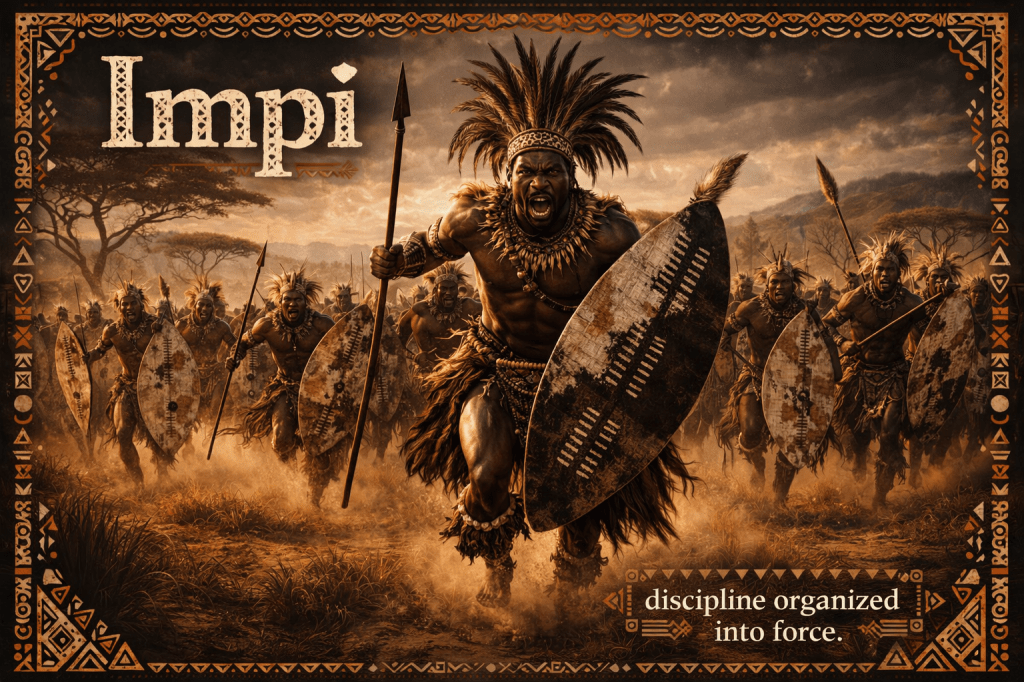
Impi
IPA Pronunciation: /ˈɪm.piː/
Part of Speech: Noun
Origin
Impi belongs to the vocabularies of African history, military organization, and Zulu culture. It refers to a regiment or body of warriors in the traditional army system of the Zulu Kingdom.
The term became especially prominent during the reign of Shaka Zulu, who reorganized and transformed Zulu military structure in the early 19th century.
An impi is discipline organized into force.
Etymology
From Zulu: impi — war, battle, or regiment
The word encompasses both the idea of conflict and the organized group that carries it out.
Core Definitions
Zulu Military Unit
A regiment of warriors within the Zulu army.
“The impi advanced in formation.”
Armed Force
A body of fighters organized for battle.
“The king summoned the impi.”
Warband (Historical Context)
A structured group trained and mobilized for combat.
Explanation & Nuance
An impi was not merely a gathering of fighters but a highly organized military unit with:
Age-based regimental structure
Strict discipline
Centralized command
Cohesive identity and loyalty
Under Shaka’s reforms, impis were trained intensively and lived together in military kraals (settlements), strengthening unity and readiness.
Military Structure
Key features of the impi system included:
Regimental grouping by age cohort
Standardized training and tactics
Close-combat weaponry, notably the short stabbing spear (iklwa)
Large shields for coordinated formations
One of the most famous tactical formations was the “horns of the buffalo,” which used:
Encircling wings
A central force
Reserve units
This allowed the impi to surround and overwhelm opponents.
Historical Context
Impis played a central role in the expansion of the Zulu Kingdom in the early 19th century.
They were later involved in conflicts such as the Anglo-Zulu War, where Zulu forces achieved notable victories despite technological disadvantages.
The effectiveness of the impi system made it one of the most formidable military organizations in pre-colonial southern Africa.
Cultural Significance
Beyond warfare, impis were embedded in Zulu society:
They reinforced social structure
They fostered identity and loyalty
They served as institutions of discipline and transition into adulthood
The impi was both a military and social formation.
Symbolic Dimensions
Shield — unity and defense
Spear — direct action
Circle — encirclement and cohesion
Drumbeat — rhythm of coordinated movement
Brotherhood — shared identity
Impi symbolizes collective strength shaped by discipline.
Synonyms & Near-Relations
Regiment — organized military unit
Warband — group of fighters
Army — large organized force
Phalanx — tightly coordinated formation
Militia — citizen-based fighting force
(Only impi specifically denotes the regimented warrior units of the Zulu military system.)
Conceptual Relations
Warfare — organized conflict
Discipline — structured training
Tactics — strategic organization in battle
Leadership — centralized command
Identity — group cohesion
Cultural & Intellectual Resonance
African History
Impis are central to understanding the rise of the Zulu Kingdom.
Military Studies
They demonstrate effective organization and tactics without modern weaponry.
Anthropology
The impi system reflects the integration of military and social structures.
Historical Memory
They remain a powerful symbol of resistance and indigenous statecraft.
Takeaway
Impi names the organized force of warriors —
a unit shaped by discipline, identity, and shared purpose.
It reminds us that strength can arise from cohesion,
that strategy and unity can rival technology,
and that armies are not only weapons,
but expressions of culture.
An impi is more than a group in battle.
It is a living formation —
moving as one,
bound by rhythm,
purpose,
and the will to act together.
Not just warriors—an impi moved as one will in motion.
 Word of the Day - The English Nook
Leave a comment