
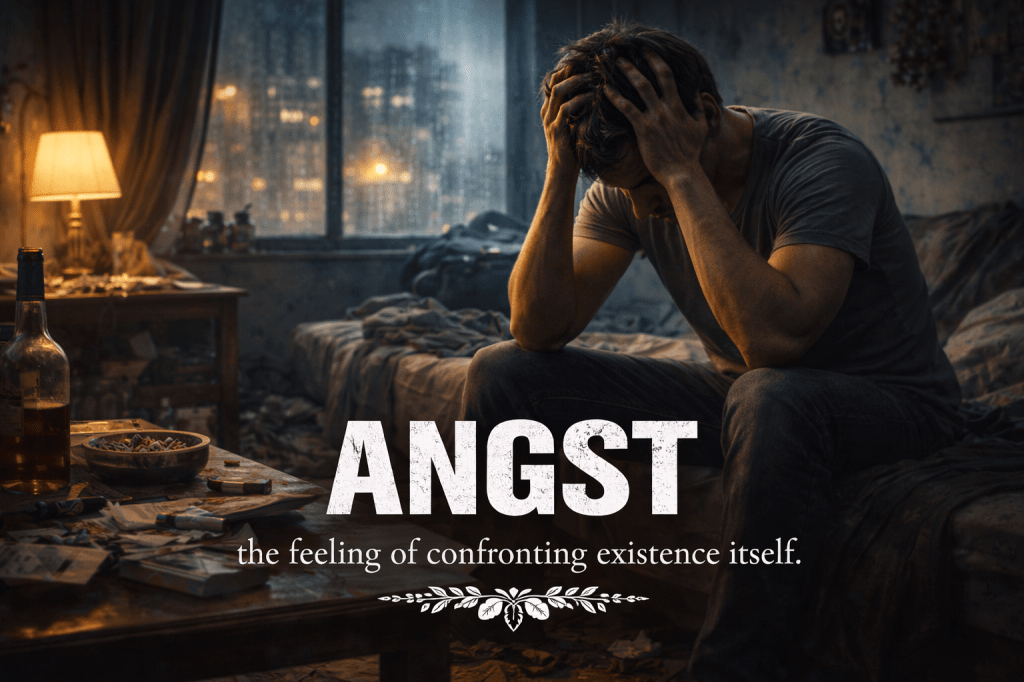
Angst
IPA Pronunciation: /æŋkst/ (English) • /aŋst/ (German)
Part of Speech: Noun
Origin
Angst belongs to the vocabularies of philosophy, psychology, and existential literature. It refers to a deep, often diffuse feeling of anxiety, dread, or existential unease — a sense of inner tension not always tied to a specific cause.
The term entered English from German philosophical writing, particularly in the works of Søren Kierkegaard and later Martin Heidegger, who used it to describe the anxiety arising from human freedom and the awareness of existence.
Angst is the feeling of confronting existence itself.
Etymology
From German: Angst — fear, anxiety, dread
Related to Old High German angust and Latin angustus (“narrow” or “constricted”), suggesting a feeling of inner tightening or pressure.
The term preserves the idea of emotional constriction — a psychological narrowing under tension.
Core Definitions
Existential Anxiety
A deep unease related to freedom, meaning, or mortality.
“He felt a quiet angst about the future.”
Diffuse Psychological Dread
A sense of anxiety without a clearly defined object.
“The novel captures adolescent angst.”
Philosophical Concept
A state of awareness of the uncertainty and responsibility inherent in existence.
Explanation & Nuance
Angst differs from ordinary fear.
Fear usually has a clear object:
A threat
A danger
An identifiable cause
Angst, by contrast, arises from more abstract conditions:
Freedom
Uncertainty
Responsibility
Awareness of mortality
Lack of inherent meaning
It is anxiety directed not at something specific, but at the condition of being.
Philosophical Context
In existential philosophy, angst appears when individuals recognize:
Their radical freedom to choose
The absence of predetermined meaning
The inevitability of death
For thinkers such as Jean-Paul Sartre, this awareness can produce both dread and liberation.
Angst reveals that humans must create meaning rather than discover it ready-made.
Psychological Dimension
Angst can appear in various forms:
Adolescent identity struggles
Creative or intellectual uncertainty
Periods of life transition
Moments of self-reflection
It often accompanies deep questioning about purpose, identity, or direction.
Symbolic Dimensions
Abyss — confrontation with the unknown
Tightening Chest — emotional constriction
Crossroads — necessity of choice
Shadow — awareness of mortality
Silence — absence of clear answers
Angst symbolizes the emotional weight of freedom and uncertainty.
Synonyms & Near-Relations
Anxiety — general nervous unease
Dread — intense anticipatory fear
Existential anxiety — philosophical form of angst
Melancholy — reflective sadness
Alienation — feeling of disconnection
(Only angst carries the philosophical sense of deep existential unease.)
Conceptual Relations
Existentialism — philosophy of human freedom
Freedom — capacity to choose
Meaning — search for purpose
Mortality — awareness of death
Identity — formation of self-understanding
Cultural & Intellectual Resonance
Philosophy
Angst is central to existential thought about freedom and responsibility.
Literature
Modernist and existential writers often depict characters experiencing profound angst.
Psychology
The term is widely used to describe emotional tension tied to identity and purpose.
Popular Culture
“Teen angst” has become a common phrase describing adolescent emotional intensity.
Takeaway
Angst names the uneasy awareness of being human —
the tension that arises when freedom meets uncertainty.
It reminds us that existence offers no simple instructions,
that meaning must often be created rather than found,
and that the weight of choice
can produce both anxiety and possibility.
Angst is the shadow of freedom —
the quiet dread
that appears
when we realize
the future is ours to shape.
Angst is not fear of something—it is the weight of everything. 🖤
 Word of the Day - The English Nook
Leave a comment