
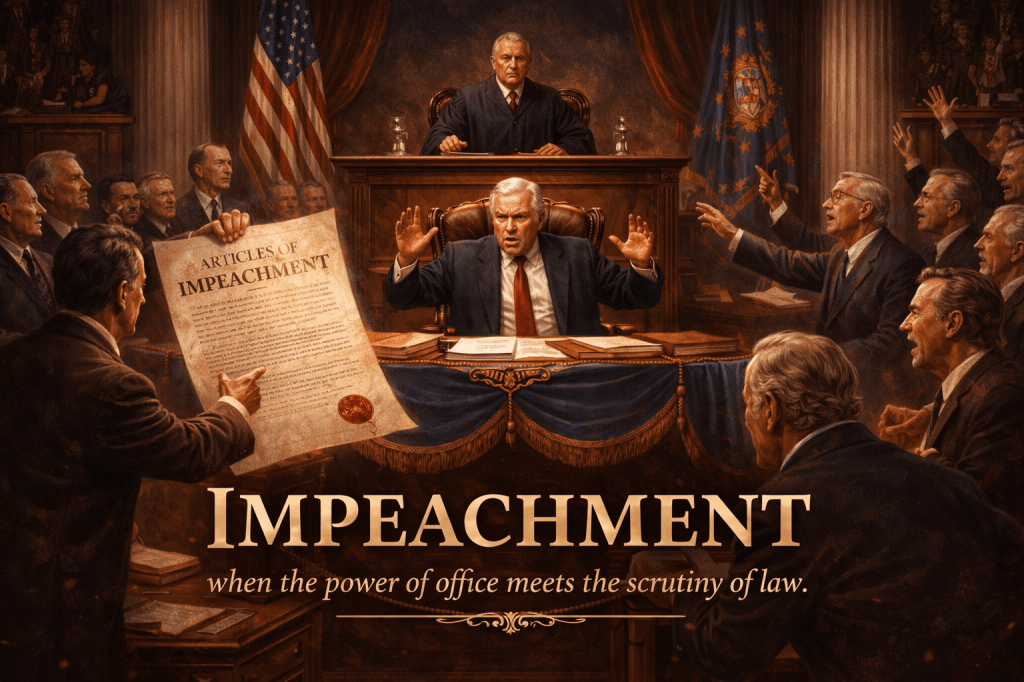
Impeachment
IPA Pronunciation: /ɪmˈpiːtʃ.mənt/
Part of Speech: Noun
Origin
Impeachment belongs to the vocabularies of constitutional law, political institutions, and democratic governance. It refers to the formal process by which a legislative body charges a public official with misconduct or abuse of office.
The procedure is a mechanism for holding powerful officials accountable while preserving the rule of law.
Impeachment is accusation within a constitutional system.
Etymology
From Middle English: empechement — hindrance or accusation
From Old French: empeechier — to obstruct or accuse
From Latin: impedicare — to entangle or hinder
The word originally carried the sense of preventing someone from continuing in authority by legal challenge.
Core Definitions
Formal Political Charge
A legal accusation brought by a legislative body against a public official.
“The legislature voted for impeachment.”
Constitutional Procedure
The first step in a process that may lead to removal from office.
“Impeachment triggered a trial in the senate.”
Mechanism of Accountability
A process designed to investigate alleged misconduct by officials holding high office.
Explanation & Nuance
Impeachment does not automatically remove an official from office.
Instead, it generally involves two stages:
- Impeachment — the formal charge or indictment issued by a legislative body.
- Trial and Judgment — a separate proceeding that determines guilt and potential removal.
The exact procedures vary across constitutional systems.
Impeachment functions as a political-legal safeguard against abuses of authority.
Historical Context
The concept originated in English parliamentary practice as a means for Parliament to prosecute royal ministers.
The process was later incorporated into constitutional systems such as that of the United States.
Several American presidents have been impeached, including Andrew Johnson, Bill Clinton, and Donald Trump, though impeachment alone does not necessarily result in removal from office.
Legal and Political Significance
Impeachment exists to address serious misconduct such as:
Abuse of power
Corruption
Violation of constitutional duties
Obstruction of justice
Because it involves elected bodies, impeachment often sits at the intersection of law and politics.
It is both a legal process and a constitutional safeguard.
Symbolic Dimensions
Gavel — authority of legal judgment
Balance — accountability within power
Charge — formal accusation
Barrier — protection against tyranny
Threshold — boundary of lawful governance
Impeachment symbolizes the principle that even the highest offices remain subject to law.
Synonyms & Near-Relations
Indictment — formal criminal charge
Censure — official condemnation
Recall — removal by voter decision
Removal from office — consequence of conviction
Accountability — responsibility for actions
(Only impeachment specifically denotes the constitutional process of formally charging high officials.)
Conceptual Relations
Rule of Law — legal authority above individuals
Separation of Powers — division of governmental authority
Checks and Balances — mechanisms preventing abuse
Constitutional Governance — rule structured by legal framework
Public Accountability — answerability of officials to institutions
Cultural & Intellectual Resonance
Political History
Impeachment has shaped major constitutional crises and debates.
Legal Theory
It illustrates the balance between democratic governance and legal accountability.
Civic Education
The process is often taught as a key element of constitutional systems.
Public Discourse
Impeachment proceedings frequently become focal points of national political attention.
Takeaway
Impeachment names the moment when authority is called to answer —
when the power of office meets the scrutiny of law.
It reminds us that leadership does not stand above accountability,
that constitutions provide tools for confronting misconduct,
and that the legitimacy of governance
rests on the ability to question even the most powerful.
Impeachment is the formal language of political responsibility —
a reminder that no office
is beyond judgment.
When power is questioned, impeachment is the language of accountability.
 Word of the Day - The English Nook
Leave a comment