
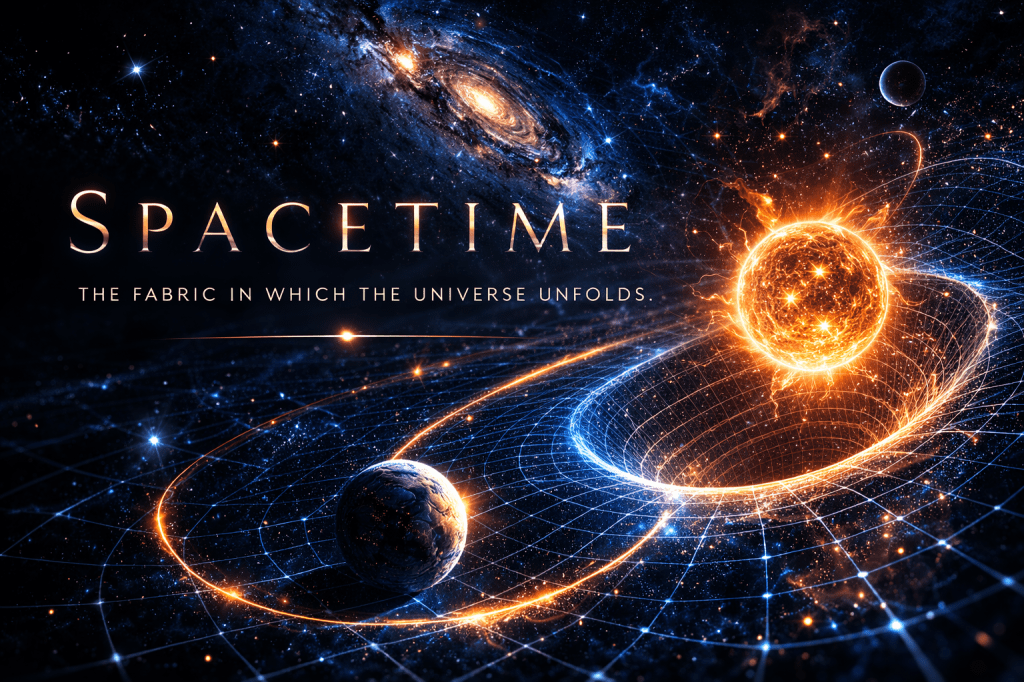
Spacetime
IPA Pronunciation: /ˈspeɪs.taɪm/
Part of Speech: Noun • Scientific Concept
Origin
Spacetime belongs to the vocabularies of theoretical physics, cosmology, and modern scientific philosophy. It refers to the unified framework in which space and time are treated as a single, four-dimensional continuum.
The concept emerged from the work of Albert Einstein, whose theories of relativity transformed the classical understanding of the universe.
Instead of existing separately, space and time are interwoven into one structure through which matter and energy move.
Spacetime is the fabric in which the universe unfolds.
Etymology
From English:
space — the three dimensions of physical extension
- time — the dimension of temporal sequence
The compound reflects the realization that these two aspects of reality cannot be separated at fundamental physical scales.
Core Definitions
Four-Dimensional Continuum
The combined structure of space and time in modern physics.
“Events occur within spacetime.”
Framework of Relativity
The geometric stage on which gravity and motion operate.
“Mass bends spacetime.”
Cosmic Structure
The dynamic geometry describing the universe.
Explanation & Nuance
In classical physics, space and time were treated as independent.
Einstein’s theories revealed that:
Time passes differently depending on motion and gravity.
Distances depend on the observer’s frame of reference.
Gravity arises from curvature in spacetime rather than a force acting across empty space.
The mathematical description of this geometry was later formalized by Hermann Minkowski, who described spacetime as a four-dimensional manifold.
Structure of Spacetime
Spacetime includes:
Three spatial dimensions (length, width, height)
One temporal dimension (time)
Every physical occurrence can be described as an event — a specific point within this four-dimensional structure.
Objects move through spacetime along paths called worldlines.
Gravitational Geometry
In General Relativity, gravity emerges from the curvature of spacetime.
Mass and energy bend the surrounding geometry.
This curvature influences how objects move, producing effects such as:
Planetary orbits
Gravitational lensing
Black holes
Time dilation
Matter tells spacetime how to curve, and spacetime tells matter how to move.
Cosmic Significance
Spacetime is the foundation for modern cosmology.
It allows scientists to describe:
The expansion of the universe
The structure of galaxies
Gravitational waves
The geometry of the cosmos itself
The universe is not merely located in spacetime — it is the evolving shape of spacetime.
Symbolic Dimensions
Fabric — woven continuum of existence
Stage — arena of cosmic events
River — flow through temporal dimension
Grid — geometry underlying reality
Curved Surface — gravity as shape rather than force
Spacetime symbolizes the deep structure of the universe.
Synonyms & Near-Relations
Space–time continuum — common descriptive phrase
Four-dimensional manifold — mathematical description
Relativistic spacetime — context of Einstein’s theories
Cosmic geometry — structure of the universe
Metric field — mathematical representation of curvature
(Only spacetime specifically denotes the unified structure combining spatial and temporal dimensions.)
Conceptual Relations
Relativity — physics of space and time
Gravity — curvature of spacetime
Cosmology — study of the universe
Events — points in spacetime
Worldlines — trajectories through spacetime
Cultural & Intellectual Resonance
Physics
Spacetime is central to modern theoretical descriptions of the universe.
Philosophy of Time
The concept challenges traditional notions of past, present, and future.
Science Fiction
Stories about time travel and wormholes often rely on spacetime concepts.
Mathematics
It connects geometry with physical reality.
Takeaway
Spacetime names the union of where and when —
the structure that holds every event in the universe.
It reminds us that space is not an empty container,
and time is not an independent clock,
but that both form a single, dynamic geometry.
Spacetime is the architecture of reality —
the invisible fabric
that bends under stars,
stretches with the expanding universe,
and carries every moment
through the vast structure of existence.
The universe isn’t just in space and time—it is the shape of spacetime itself.
 Word of the Day - The English Nook
Leave a comment