
Scat
IPA Pronunciation: /skæt/
Part of Speech: Noun • Verb (informal)
Origin
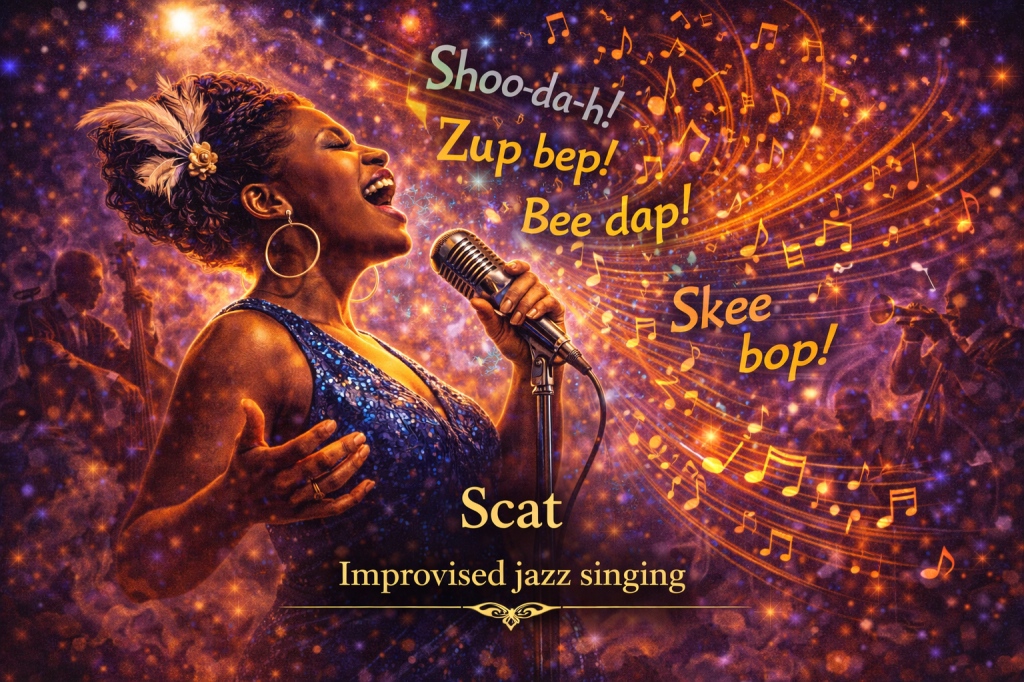
Scat belongs to several vocabularies: jazz music, informal speech, and zoology. Its most celebrated meaning refers to a vocal improvisation technique in jazz in which singers use nonsensical syllables to imitate instruments.
The style became widely recognized through performers such as Louis Armstrong, Ella Fitzgerald, and Cab Calloway, who transformed improvised syllables into virtuosic musical expression.
Scat is voice used as instrument.
Etymology
Likely imitative in origin.
The word echoes the sharp, percussive syllables used in jazz improvisation:
“ba-da-bop”
“doo-bee-doo”
“sha-ba-da”
It also resembles older English interjections like “scat!” used to shoo animals away.
Core Definitions
Jazz Vocal Improvisation
A style of singing using meaningless syllables instead of lyrics.
“She performed a dazzling scat solo.”
Improvised Vocal Instrumentation
Using the voice to mimic the phrasing and rhythms of jazz instruments.
Animal Droppings (Zoological Term)
Informal word for the feces of wild animals.
“The ranger identified wolf scat on the trail.”
Slang Verb: To Leave Quickly
An informal command meaning “go away” or “leave.”
“Scat! Get out of here.”
Explanation & Nuance
In jazz, scat singing allows performers to improvise freely over chord progressions.
Instead of words, singers create spontaneous melodic lines using rhythmic syllables.
Characteristics include:
Syncopation
Swing rhythm
Rapid melodic runs
Playful syllabic invention
The technique places the singer in the role traditionally held by instrumental soloists.
Musical Context
Scat became a hallmark of jazz performance in the early 20th century.
Singers use it to:
Extend solos
Interact with band instruments
Display improvisational skill
Express rhythm without linguistic limits
Famous recordings feature entire passages where meaning arises purely from musical phrasing.
Scat dissolves the boundary between voice and instrument.
Zoological Usage
In wildlife biology, “scat” refers to animal droppings found in natural environments.
Scientists analyze scat to study:
Diet
Territorial behavior
Population presence
Ecosystem interactions
Thus the word also appears frequently in field research and tracking.
Symbolic Dimensions
Voice as Instrument — human voice becoming music itself
Play — improvisation without fixed meaning
Rhythm — language replaced by sound
Trace — physical evidence of unseen animals
Departure — sharp command to move away
Scat symbolizes expression freed from literal language.
Synonyms & Near-Relations
In music
Vocal improvisation — spontaneous melodic singing
Jazz vocalese — lyrical adaptation of instrumental solos
In zoology
Droppings — animal waste
Tracks and sign — evidence of wildlife presence
In slang
Shoo — command to leave
Scram — informal order to depart
Conceptual Relations
Jazz — improvisational musical tradition
Swing — rhythmic foundation of early jazz
Improvisation — spontaneous creative expression
Field Ecology — study of wildlife traces
Sound Symbolism — words shaped by sound rather than meaning
Cultural & Intellectual Resonance
Jazz History
Scat singing showcases the improvisational spirit at the heart of jazz.
Music Education
It is often used to teach rhythm, phrasing, and melodic creativity.
Performance Art
Scat transforms language into pure musical texture.
Wildlife Science
In a different context, the same word provides practical terminology for ecological tracking.
Takeaway
Scat names a moment when sound escapes the limits of language —
when syllables become rhythm,
and the human voice moves like a saxophone through melody.
It reminds us that meaning is not always carried by words,
that music can speak through pure sound,
and that sometimes expression begins
exactly where language ends.
Scat is the laughter of jazz —
syllables dancing freely
through rhythm and breath.
When words run out, jazz answers with rhythm: ba-da-bop, doo-bee-doo.
 Word of the Day - The English Nook
Leave a comment