
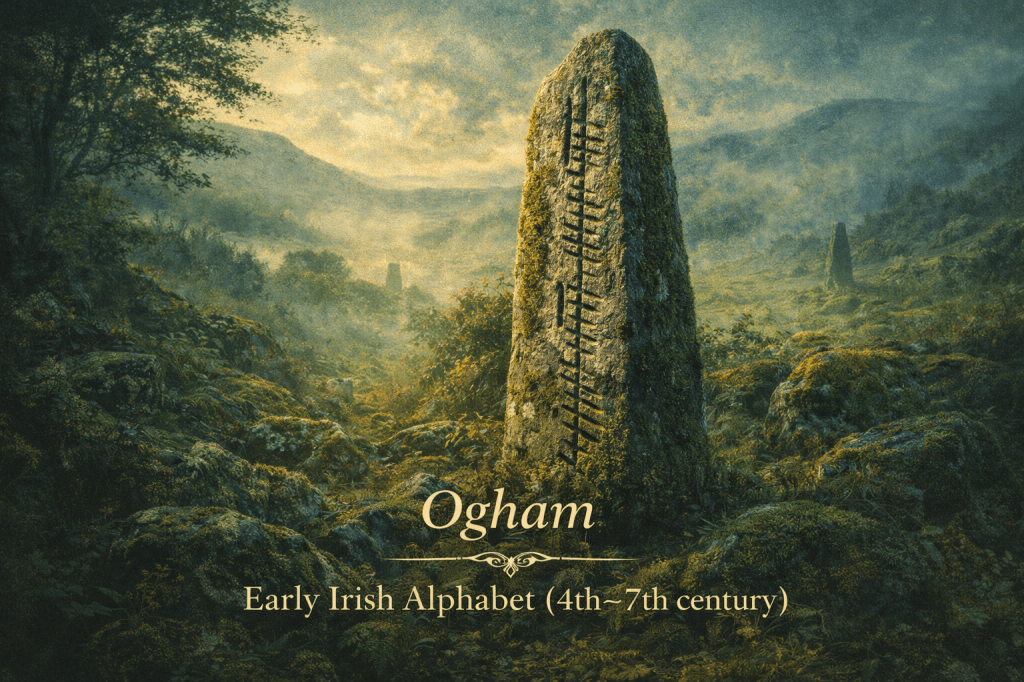
Ogham
IPA Pronunciation: /ˈɒɡ.əm/ (British) • /ˈoʊ.əm/ (American)
Part of Speech: Noun
Origin
Ogham belongs to the vocabularies of early medieval linguistics, Celtic studies, and epigraphy. It refers to an early alphabet used primarily to write Primitive Irish, carved mainly on stone monuments in Ireland and parts of western Britain.
The script appears chiefly on standing stones dating from roughly the 4th to the 7th centuries CE. These inscriptions typically record personal names and territorial markers.
Ogham is language carved into stone.
Etymology
The origin of the word is uncertain. It may derive from the name of Ogma, a figure in Irish mythology associated with eloquence and writing.
Traditional Irish lore attributed the creation of the script to this divine source, reinforcing its symbolic connection to knowledge and speech.
Core Definitions
Early Irish Alphabet
A writing system consisting of strokes and notches along a central line.
“The monument bears an Ogham inscription.”
Stone-Carved Script
An epigraphic system used on standing stones.
“Ogham marks run along the edge.”
Historical Writing System
A script representing sounds of Primitive Irish.
Structural Characteristics
Ogham letters are formed by groups of strokes relative to a central line (often the edge of a stone).
These strokes may appear:
To the right of the line
To the left of the line
Across the line
As notches along it
The system contains roughly twenty primary characters, grouped into sets known as aicmí.
The visual form resembles a series of tally marks aligned along a spine.
Archaeological Context
Ogham inscriptions are most commonly found in:
Southern Ireland
Wales
Western England
The Isle of Man
Parts of Scotland
They often appear on standing stones marking:
Graves
Territorial boundaries
Lineages
The inscriptions typically follow the format:
“X son of Y of the tribe Z.”
Linguistic Significance
Ogham provides some of the earliest written evidence of the Irish language.
It helps scholars study:
Early Celtic languages
Tribal and familial naming systems
Migration patterns
Early Irish society
Though later replaced by the Latin alphabet, Ogham preserves a transitional stage of linguistic history.
Symbolic Dimensions
Stone Edge — writing integrated with landscape
Notches — marks of memory
Line Spine — backbone of language
Boundary Marker — claim and identity
Root Script — origin of literacy
Ogham symbolizes the meeting of language, land, and lineage.
Synonyms & Near-Relations
Runic Script — early Germanic writing system
Epigraphy — study of inscriptions
Alphabet — system of written characters
Primitive Irish — language recorded in Ogham
Stone Inscription — carved writing
(Only Ogham specifically denotes the early Celtic script of notches and strokes carved along stone edges.)
Conceptual Relations
Language — system of communication
Memory — recording identity
Territory — marking ownership
Myth — legendary origins of writing
Archaeology — physical remains of culture
Cultural & Intellectual Resonance
Celtic Studies
A crucial source for early Irish linguistic history.
Archaeology
Standing stones bearing Ogham inscriptions remain key artifacts of early medieval Ireland.
Mythology
Later Irish traditions linked the script to sacred or magical knowledge.
Modern Revival
Ogham symbols sometimes appear in contemporary Celtic art and symbolism.
Takeaway
Ogham names a script cut along the edge of stone —
simple strokes forming a language of lineage and place.
It reminds us that writing once grew directly from landscape,
that names were carved into earth itself,
and that language,
before paper,
was something that endured in rock.
Ogham is memory etched in stone —
a quiet alphabet
standing in fields,
carrying voices
from the earliest Irish past.
Before ink and paper, Irish words were written in the language of stone.
 Word of the Day - The English Nook
Leave a comment