
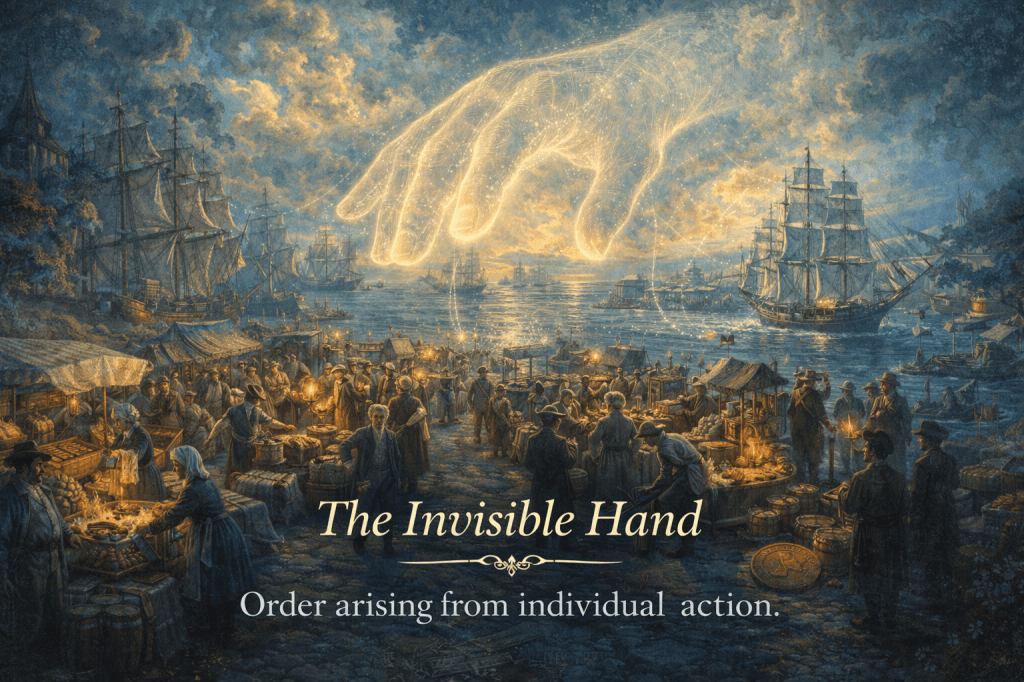
Invisible Hand
IPA Pronunciation: /ɪnˈvɪz.ə.bəl hænd/
Part of Speech: Noun phrase • Economic Concept
Origin
Invisible Hand belongs to the vocabularies of economics, political philosophy, and social theory. It refers to the idea that individual actions pursuing personal interest can unintentionally produce beneficial outcomes for society as a whole.
The phrase is most famously associated with Adam Smith, particularly in his work The Wealth of Nations.
Smith used the metaphor to illustrate how decentralized decision-making in markets can coordinate economic activity without centralized control.
The invisible hand is order emerging from self-interest.
Etymology
From English metaphor:
invisible — unseen or indirect
hand — guiding force or influence
The phrase evokes the image of an unseen mechanism guiding outcomes without deliberate orchestration.
Core Definitions
Economic Metaphor
The process by which self-interested actions can unintentionally benefit society.
“Market forces act as an invisible hand.”
Market Coordination Mechanism
The way prices and competition allocate resources efficiently.
“The invisible hand directs production.”
Philosophical Idea
A concept suggesting spontaneous order in complex systems.
Explanation & Nuance
The invisible hand does not imply a literal force or intentional guidance. Instead, it describes a systemic pattern.
In competitive markets:
Producers seek profit.
Consumers seek value.
Prices signal scarcity and demand.
Through these interactions:
Resources shift toward desired goods.
Inefficient producers exit markets.
Supply adapts to demand.
Without central planning, coordination emerges.
Economic Mechanism
Key processes associated with the invisible hand include:
Price signals
Competition
Voluntary exchange
Specialization
Resource allocation
Together they form a self-adjusting system in which millions of independent decisions interact.
Limits and Interpretations
The invisible hand does not guarantee perfect outcomes.
Economists recognize conditions where markets fail, such as:
Externalities
Monopolies
Information asymmetry
Public goods
Thus, the concept describes a tendency toward coordination, not an infallible rule.
Symbolic Dimensions
Hidden Mechanism — unseen coordination
Web — interconnected decisions
Current — flow guiding movement
Balance — self-correcting forces
Clockwork — complex system functioning without visible operator
The invisible hand symbolizes emergent order.
Synonyms & Near-Relations
Market Forces — supply and demand dynamics
Spontaneous Order — structure arising without design
Price Mechanism — allocation through pricing
Decentralized Coordination — distributed decision-making
Self-Regulating System — adaptive balance
(Only invisible hand specifically refers to Smith’s metaphor describing market coordination through self-interest.)
Conceptual Relations
Capitalism — market-based economic system
Competition — rivalry shaping outcomes
Efficiency — optimal resource allocation
Incentives — motivations driving behavior
Complex Systems — patterns arising from many interactions
Cultural & Intellectual Resonance
Economic Theory
A foundational metaphor in classical economics.
Political Philosophy
Often invoked in debates about government intervention and free markets.
Complexity Science
Used as an example of emergent order in large systems.
Public Discourse
Frequently cited in discussions of capitalism and regulation.
Takeaway
Invisible hand names the paradox of coordination without command —
the pattern that emerges when countless individuals pursue their own aims.
It reminds us that complex systems can organize themselves,
that order sometimes grows from freedom,
and that the architecture of markets
is often built not by planners,
but by interactions.
The invisible hand is not a ruler,
nor a designer.
It is a metaphor for the quiet mathematics of collective behavior.
Millions of choices, no master plan—yet the market still finds its balance.
 Word of the Day - The English Nook
Leave a comment