
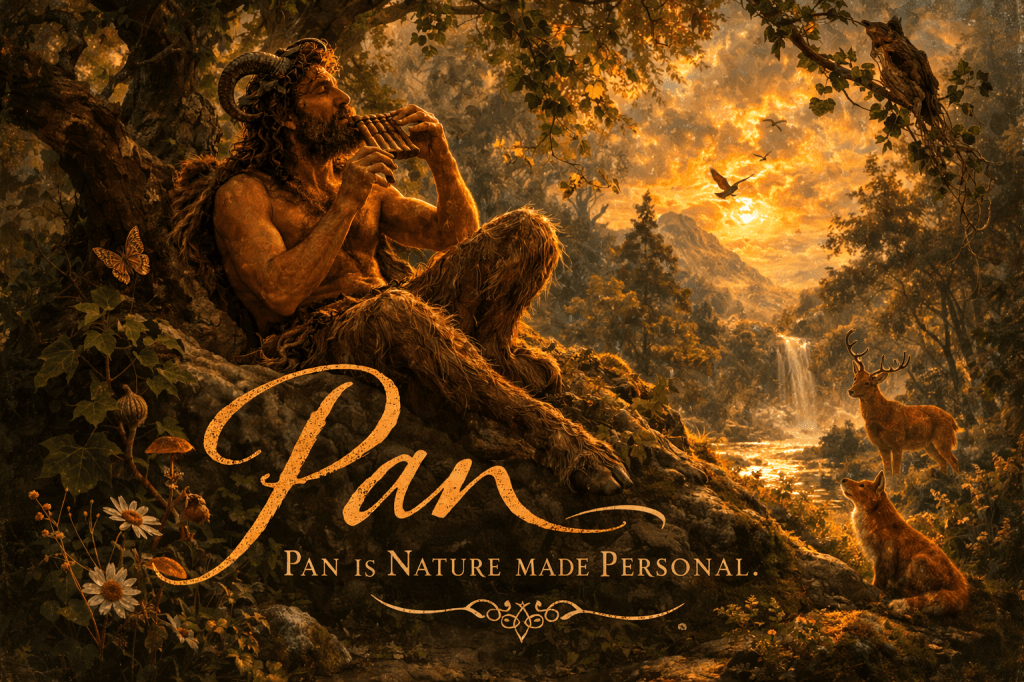
Pan
IPA Pronunciation: /pæn/
Part of Speech: Proper Noun • Mythological Figure
Origin
Pan belongs to the vocabularies of Greek mythology, pastoral religion, and cultural symbolism. He is the rustic god of wild nature, shepherds, flocks, forests, and untamed landscapes in ancient Greek belief.
Associated with mountains, caves, and wooded places, Pan embodies the vitality and unpredictability of the natural world. His presence was thought to animate the wilderness and stir both delight and sudden fear.
Pan is nature made personal.
Etymology
From Ancient Greek: Πάν (Pán).
The name may be connected with:
pa- — to pasture or feed
or the Greek word pan meaning “all,” which later thinkers interpreted symbolically as representing nature in its totality.
Core Definitions
Greek Nature Deity
A god of forests, fields, and shepherds.
“Pan roamed the mountains with his pipes.”
Symbol of the Wild
Personification of untamed natural forces.
“The forest felt haunted by Pan.”
Mythological Archetype
Embodiment of instinct, vitality, and rustic freedom.
Mythological Description
Pan is typically depicted as a hybrid being:
Upper body of a man
Legs, horns, and beard of a goat
He inhabits:
Woodlands
Mountains
Pastures
Remote caves
He is often shown playing the panpipes, an instrument associated with pastoral music.
Mythic Narratives
According to myth, Pan invented the Pan flute after the nymph Syrinx transformed into reeds to escape him. He cut the reeds and fashioned them into pipes, producing the haunting sound linked with pastoral landscapes.
Pan also accompanied the wine god Dionysus, sharing themes of ecstasy, wilderness, and instinctive life.
Psychological Dimension
Pan represents forces beyond civilized control:
Instinct
Sexual vitality
Animal energy
Spontaneous joy
Sudden fear
The English word panic derives from ancient belief that Pan could startle travelers in lonely places with sudden terror — “panic fear.”
Symbolic Dimensions
Forest — untamed life
Goat — fertility and wildness
Pipe Music — natural rhythm
Shadowed Grove — mysterious presence
Sudden Cry — primal fear
Pan symbolizes the living pulse of nature that exists outside human order.
Cultural & Intellectual Resonance
Mythology
Pan represents the pastoral side of Greek religion, contrasting with urban Olympian gods.
Literature
He appears in Romantic and modern literature as a symbol of nature’s vitality.
Psychology
In modern interpretation, Pan can represent the instinctual or unconscious aspects of human life.
Art and Music
The image of Pan playing pipes remains a classic motif of pastoral beauty.
Synonyms & Near-Relations
Satyr — woodland spirit with goat traits
Faun — Roman pastoral spirit
Nature Spirit — general embodiment of natural forces
Wild God — deity of untamed landscapes
Pastoral Deity — protector of rural life
(Only Pan specifically denotes the Greek god combining rustic joy, wild nature, and sudden fear.)
Conceptual Relations
Nature — living environment
Instinct — primal drives
Pastoral Life — rural simplicity
Ecstasy — ecstatic connection to nature
Myth — symbolic narrative of natural forces
Takeaway
Pan names the spirit of the wild —
the laughter in the hills,
the music of reeds beside a stream,
the sudden fear in a silent forest.
He reminds us that nature is not only beautiful,
but alive with instinct,
energy,
and mystery.
Pan is the voice of the wilderness —
half joy,
half terror —
echoing wherever the civilized world
meets the untamed earth.
Wherever the forest feels alive, Pan is already there.
 Word of the Day - The English Nook
Leave a comment