
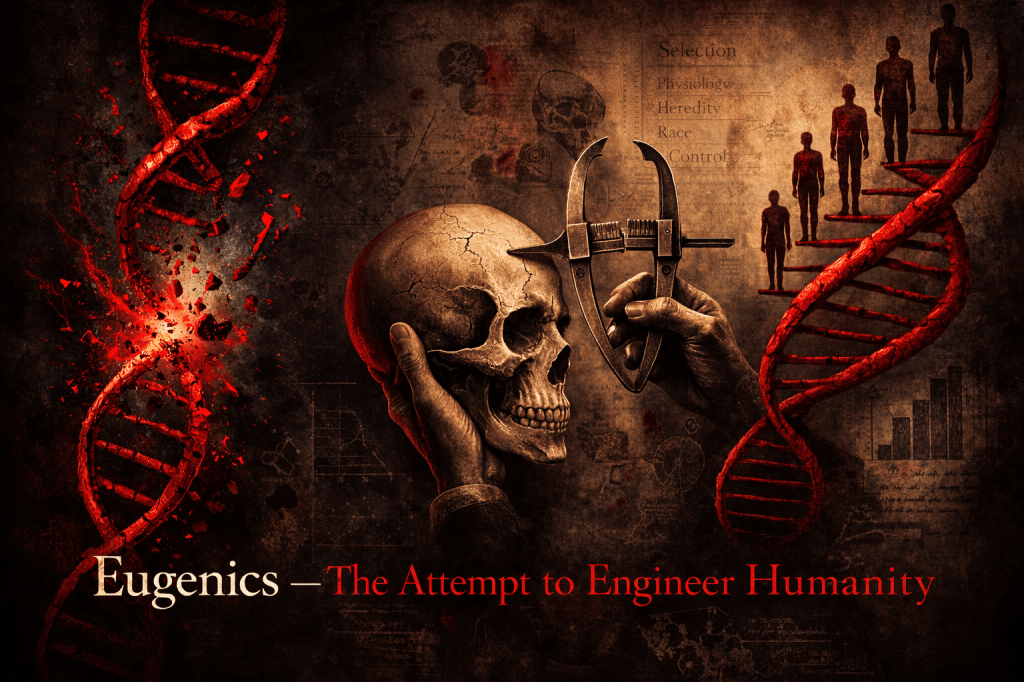
Eugenics
IPA Pronunciation: /juːˈdʒɛn.ɪks/
Part of Speech: Noun
Origin
Eugenics belongs to the vocabularies of social theory, genetics, and the history of science. It refers to a set of ideas and policies aimed at influencing human reproduction in order to increase the prevalence of traits considered desirable and reduce those deemed undesirable.
The term was introduced in the late 19th century by Francis Galton, a cousin of Charles Darwin, who believed principles of heredity could be applied to improve human populations.
Eugenics is heredity turned into social policy.
Etymology
From Greek:
eu- — good, well
genos — birth, race, stock
Literally: “good birth.”
The term reflects the idea that human traits could be shaped through controlled reproduction.
Core Definitions
Social Movement
An effort to influence reproduction to shape population traits.
“The early 20th century saw strong support for eugenics.”
Pseudoscientific Doctrine
A set of theories claiming genetic improvement of humanity through selective breeding.
“Modern science rejects classical eugenics.”
Historical Policy Framework
Programs promoting or enforcing reproductive control.
“Some governments enacted eugenic laws.”
Explanation & Nuance
Eugenics generally divided into two conceptual approaches:
Positive eugenics — encouraging reproduction among those considered genetically “fit.”
Negative eugenics — discouraging or preventing reproduction among those labeled “unfit.”
Policies associated with these ideas included:
Marriage restrictions
Institutionalization
Forced sterilization
Immigration controls
Although framed as scientific improvement, these policies were often rooted in social prejudice and flawed biological assumptions.
Historical Context
Eugenic ideas gained influence in the early 20th century across Europe and North America. Some governments adopted policies based on them, including sterilization programs.
The ideology reached its most extreme and catastrophic implementation under Adolf Hitler, whose regime used racialized eugenic doctrines to justify persecution and mass murder during World War II.
The horrors of these policies discredited eugenics as a scientific and ethical framework.
Scientific Reassessment
Modern genetics has shown that:
Human traits are influenced by complex gene–environment interactions
Many characteristics once labeled hereditary are multifactorial
Genetic diversity benefits populations
As a result, classical eugenic theories are widely rejected within contemporary science and ethics.
Ethical Dimension
Debates about eugenics highlight tensions between:
Scientific knowledge and social values
Individual rights and collective goals
Medical technology and moral limits
These discussions remain relevant in modern conversations about genetic screening, reproductive technologies, and bioethics.
Symbolic Dimensions
Blueprint — attempt to design humanity
Filter — selection imposed on life
Mirror — reflection of social prejudice
Boundary — limits of scientific authority
Warning Sign — reminder of ethical responsibility
Eugenics symbolizes the dangers of applying simplified biological theories to human society.
Synonyms & Near-Relations
Selective Breeding — controlled reproduction
Genetic Determinism — belief genes rigidly determine traits
Biopolitics — governance of life processes
Population Engineering — shaping demographic characteristics
Scientific Racism — misuse of science to justify inequality
(Only eugenics specifically denotes the historical ideology advocating genetic “improvement” of human populations.)
Conceptual Relations
Genetics — study of heredity
Bioethics — ethical questions in biology and medicine
Human Rights — protection of individual autonomy
Social Engineering — deliberate shaping of society
Scientific Responsibility — limits of applied science
Cultural & Intellectual Resonance
History of Science
Eugenics demonstrates how scientific ideas can be distorted by ideology.
Ethics
It serves as a central case study in discussions of scientific responsibility.
Public Policy
Historical eugenic laws influence modern debates about reproductive rights.
Philosophy
Raises questions about human perfection, equality, and moral limits of intervention.
Takeaway
Eugenics names a powerful but deeply flawed attempt to shape humanity through heredity.
It reminds us that science does not exist outside society,
that theories about improvement can conceal prejudice,
and that the pursuit of perfection
can become dangerous when imposed on human lives.
Eugenics stands as a cautionary chapter in the history of science —
a reminder that knowledge must be guided not only by curiosity,
but by humility and ethics.
A theory that tried to engineer humanity—and became a lesson in the limits of science without ethics.
 Word of the Day - The English Nook
Leave a comment