
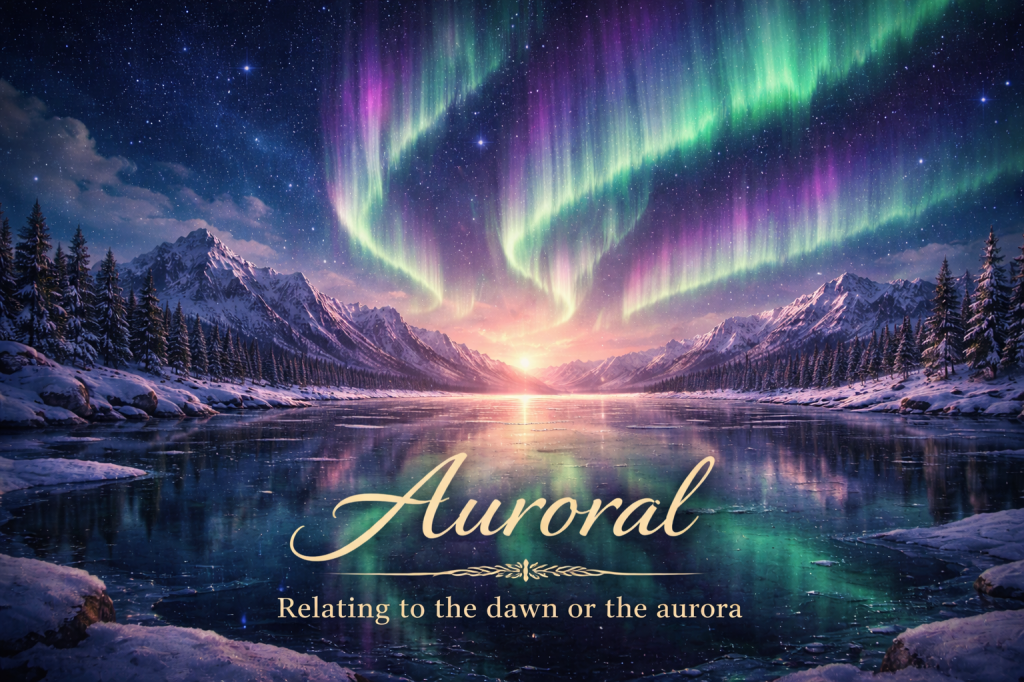
Auroral
IPA Pronunciation: /ɔːˈrɔːr.əl/
Part of Speech: Adjective
Origin
Auroral belongs to the vocabularies of astronomy, atmospheric science, and poetic description. It describes phenomena relating to an aurora — the luminous displays that appear in the upper atmosphere near polar regions.
These lights, shimmering across the night sky, arise when charged solar particles interact with Earth’s magnetic field and atmosphere.
Auroral means illuminated by the physics of the sun and the magnetism of Earth.
Etymology
From Latin: aurora — dawn
- -al — relating to
Originally referring to the goddess of dawn in Roman mythology, the word later came to describe the atmospheric light displays whose colors resemble luminous skies.
The term links cosmic physics with the imagery of sunrise.
Core Definitions
Relating to an Aurora
Pertaining to atmospheric light displays.
“Auroral activity increased last night.”
Characteristic of Polar Lights
Describing colors or patterns resembling an aurora.
“The clouds took on an auroral glow.”
Dawnlike or Radiant
Poetic sense: resembling the light of early morning.
Explanation & Nuance
Auroral phenomena occur when energetic particles from the sun collide with gases in the upper atmosphere.
This interaction produces:
Green light from oxygen
Red emissions at higher altitudes
Blue and violet light from nitrogen
These glowing curtains and arcs are visible in high-latitude regions as the Aurora Borealis in the north and the Aurora Australis in the south.
Auroral describes anything associated with these displays or their physical processes.
Scientific Significance
Auroral activity helps scientists study:
Solar wind behavior
Earth’s magnetosphere
Atmospheric chemistry
Space weather
Auroras reveal the invisible interaction between the sun and Earth’s magnetic shield.
Visual Characteristics
Auroral displays often appear as:
Curtains
Arcs
Bands
Rippling waves
Radiant crowns
Their colors shift and flow, giving the sky the appearance of moving light.
Auroral imagery often evokes:
Movement
Ethereal glow
Celestial energy
Transient beauty
Symbolic Dimensions
Dawn — renewal and beginning
Veil — thin boundary between worlds
River of Light — cosmic motion
Crown — luminous arc above the earth
Breath of the Sun — solar energy touching the planet
Auroral imagery symbolizes the meeting of cosmic forces and earthly atmosphere.
Synonyms & Near-Relations
Polar — relating to high latitudes
Luminous — emitting light
Radiant — glowing brightly
Atmospheric — relating to upper air phenomena
Celestial — connected with the heavens
(Only auroral specifically refers to phenomena associated with auroras.)
Conceptual Relations
Magnetosphere — Earth’s magnetic shield
Solar Wind — charged particles from the sun
Atmospheric Physics — interaction of particles and gases
Space Weather — solar-driven atmospheric effects
Cosmic Interaction — sun–earth energy exchange
Cultural & Intellectual Resonance
Astronomy
Auroral studies help monitor solar activity and magnetic storms.
Mythology
Many cultures interpreted auroras as spirits, omens, or celestial fires.
Exploration
Polar travelers often record auroral skies as defining experiences of the Arctic and Antarctic.
Poetry & Art
Auroral imagery symbolizes beauty, ephemerality, and cosmic wonder.
Takeaway
Auroral describes light born from the meeting of sky and sun —
a glow created where invisible particles strike the thin edge of Earth’s air.
It reminds us that the planet lives within a wider cosmic environment,
that energy travels across space to paint the night,
and that some of the most beautiful lights on Earth
are written by forces beyond it.
Auroral is the language of the sky’s magnetism —
the dawn that appears at midnight,
when the universe brushes against the atmosphere.
Auroral is when the sun writes light across the night sky.
 Word of the Day - The English Nook
Leave a comment