
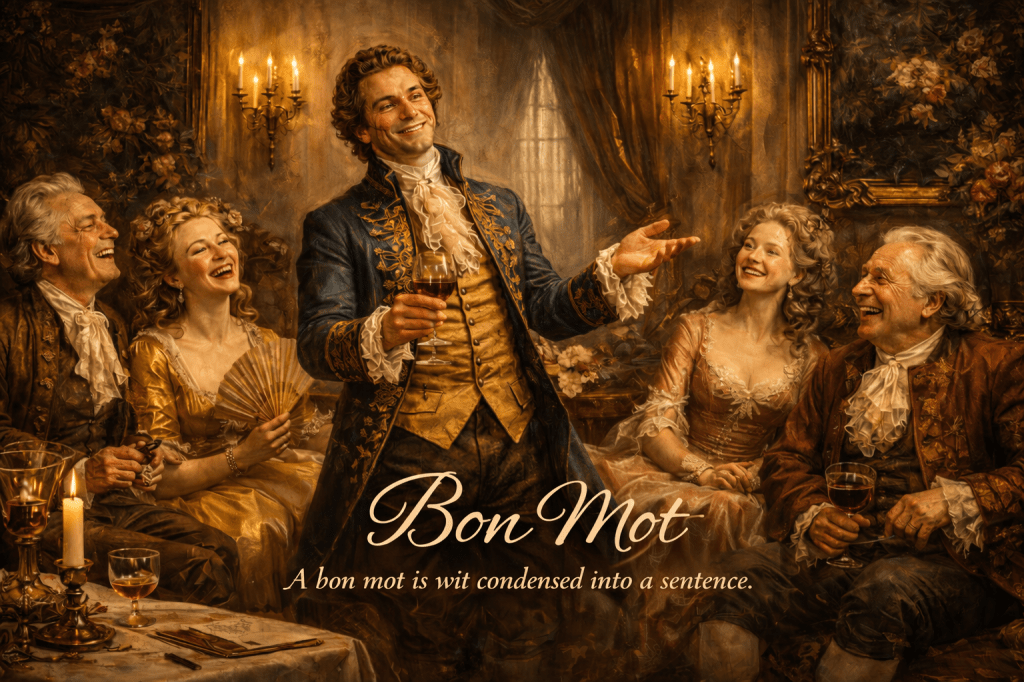
Bon mot
IPA Pronunciation: /ˌbɒn ˈmoʊ/ (English) • /bɔ̃ mo/ (French)
Plural: Bon mots /ˌbɒn ˈmoʊz/
Part of Speech: Noun
Origin
Bon mot belongs to the vocabularies of wit, rhetoric, and literary culture. It refers to a clever, striking, or witty remark — often brief but memorable, capturing an idea with elegance and precision.
Such remarks appear in salons, literature, political debate, and everyday conversation, where quick intelligence and verbal artistry are prized.
A bon mot is wit condensed into a sentence.
Etymology
From French:
bon — good
mot — word
Literally: “good word.”
The phrase suggests a remark that lands perfectly — both apt and clever.
Core Definitions
Witty Remark
A clever or humorous statement delivered with precision.
“She offered a sharp bon mot.”
Memorable Saying
A brief statement noted for its elegance or insight.
“The speech ended with a bon mot.”
Display of Verbal Wit
A remark valued as an example of intellectual quickness.
Explanation & Nuance
A bon mot differs from ordinary humor by combining:
Brevity
Sharpness
Intelligence
Elegance
Timing
It often functions as a conversational highlight — a moment where language crystallizes thought into a striking phrase.
Many bon mots rely on:
Wordplay
Irony
Paradox
Unexpected reversals
Concise insight
Their effectiveness depends as much on delivery as on wording.
Historical Context
The culture of bon mots flourished particularly in:
French aristocratic salons of the 17th and 18th centuries
Enlightenment intellectual circles
Political oratory
Literary society
Figures renowned for such wit include Oscar Wilde and Voltaire, whose remarks often circulate independently of their original contexts.
These statements often survive because they capture truths in memorable form.
Rhetorical Function
A well-placed bon mot can:
Summarize an argument
Deflate an opponent
Lighten tension
Expose hypocrisy
Create lasting quotation
Its power lies in the union of intellect and language.
Symbolic Dimensions
Spark — sudden brilliance of thought
Arrow — precise verbal strike
Mirror — reflection of truth through wit
Flash — momentary illumination
Seed — small phrase with lasting influence
A bon mot symbolizes the elegance of quick intelligence.
Synonyms & Near-Relations
Witticism — clever remark
Epigram — concise, pointed statement
Quip — brief witty retort
Aphorism — compact statement of principle
Repartee — quick conversational wit
(Only bon mot specifically denotes a memorable witty remark in the tradition of refined conversational culture.)
Conceptual Relations
Wit — intellectual playfulness
Rhetoric — art of persuasive speech
Irony — saying one thing while implying another
Brevity — economy of language
Conversation — social exchange of ideas
Cultural & Intellectual Resonance
Literary Culture
Bon mots circulate as quotable fragments of literary brilliance.
Social Interaction
They demonstrate conversational agility and cultural sophistication.
Political Speech
Leaders often deploy them to distill complex arguments.
Humor Studies
They illustrate the mechanics of cleverness and timing.
Takeaway
Bon mot names the moment when language strikes perfectly —
when thought becomes both sharp and elegant.
It reminds us that intelligence often speaks briefly,
that wit can illuminate as much as argument,
and that a single sentence
can outlive an entire speech.
A bon mot is a spark of mind in words —
small,
bright,
and difficult to forget.
When one sentence outshines an entire conversation.
 Word of the Day - The English Nook
Leave a comment