
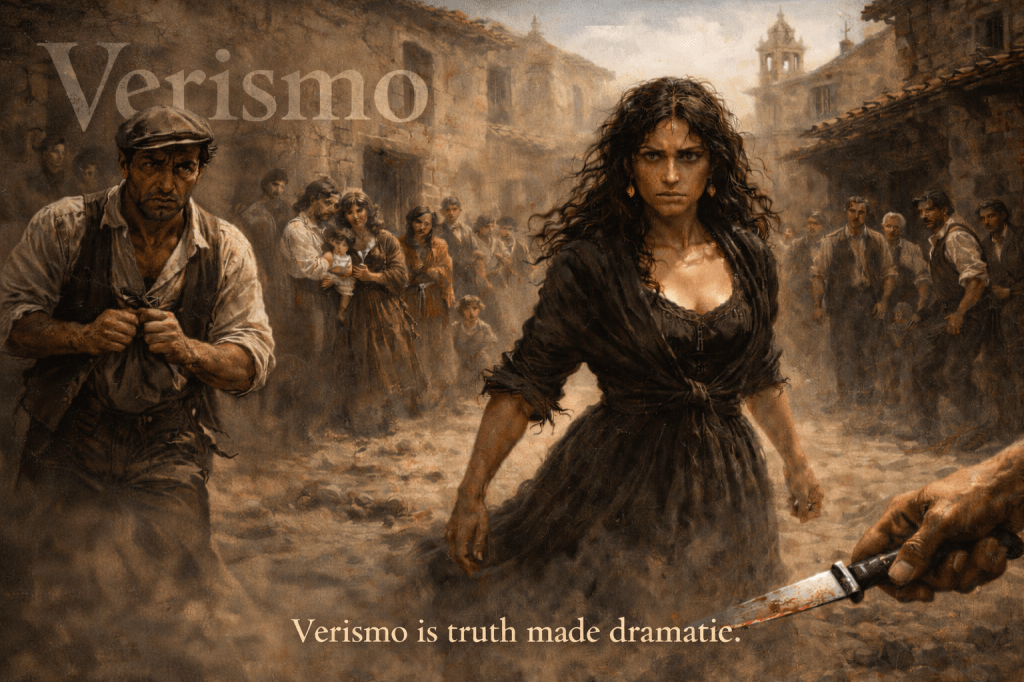
Verismo
IPA Pronunciation: /vɛˈriːz.moʊ/ (English) • /veˈriːzmo/ (Italian)
Part of Speech: Noun
Origin
Verismo belongs to the vocabularies of literary realism, opera, and late 19th-century Italian cultural movements. It refers to an artistic style committed to depicting everyday life — often harsh, passionate, and unidealized — with emotional immediacy and social authenticity.
The movement arose in Italy in the late 1800s, influenced by naturalism and realism, and found powerful expression in both fiction and opera.
Verismo is truth made dramatic.
Etymology
From Italian: vero — true
- -ismo — movement or doctrine
Literally: “truth-ism” or “the practice of truth.”
The term signals a deliberate rejection of romantic idealization in favor of lived reality.
Core Definitions
Literary Movement
A realist style focusing on ordinary people and social conditions.
“The novel reflects Italian verismo.”
Operatic Style
A late 19th-century operatic tradition emphasizing raw emotion and everyday tragedy.
“Cavalleria rusticana is a landmark of verismo.”
Aesthetic Principle
Commitment to authenticity over idealization.
“The director pursued verismo in staging.”
Explanation & Nuance
Verismo differs from broader realism by intensifying emotional and social immediacy.
Its hallmarks include:
Working-class protagonists
Violent or tragic plots
Passionate emotional expression
Moral ambiguity
Compressed, urgent storytelling
It replaces mythic heroes with villagers, laborers, and lovers caught in social constraint.
Verismo is realism heightened to emotional edge.
Literary Verismo
In fiction, the movement is closely associated with Giovanni Verga, whose stories portrayed Sicilian rural life without sentimentality.
Characteristics include:
Detached narration
Focus on poverty and struggle
Minimal authorial judgment
Regional detail
The goal was not embellishment, but exposure.
Operatic Verismo
In music, verismo opera foregrounded intense, immediate drama.
Landmark works include:
Cavalleria rusticana by Pietro Mascagni
Pagliacci by Ruggero Leoncavallo
These operas feature:
Short duration
Explosive emotional climaxes
Jealousy and betrayal
Lower-class settings
Music becomes visceral rather than ornamental.
Psychological Dimension
Verismo portrays:
Impulsive emotion
Social constraint
Jealous rage
Desperation
Fatal consequence
It assumes that ordinary lives contain operatic intensity.
Symbolic Dimensions
Dusty Road — grounded reality
Village Square — communal scrutiny
Knife — sudden violence
Curtain Lifted — exposure of truth
Cry — raw emotional release
Verismo symbolizes the drama within the everyday.
Synonyms & Near-Relations
Realism — broad commitment to reality
Naturalism — deterministic realism
Social Drama — class-centered storytelling
Grit — raw authenticity
Documentary Style — unembellished depiction
(Only verismo specifically denotes the Italian late 19th-century movement combining realism with heightened emotional immediacy.)
Conceptual Relations
Authenticity — fidelity to lived experience
Class — focus on marginalized lives
Determinism — environment shaping fate
Emotion — unfiltered intensity
Modernity — break from romantic tradition
Cultural & Intellectual Resonance
Literature
Represents Italy’s realist turn in narrative art.
Opera
Shifted focus from aristocratic spectacle to village tragedy.
Theater & Film
Influenced later movements emphasizing social realism.
Aesthetics
Challenges the boundary between artifice and truth.
Takeaway
Verismo names the art of stripping illusion —
of placing ordinary lives at the center of drama.
It reminds us that tragedy does not require palaces,
that passion thrives in villages,
and that truth,
when unadorned,
can be explosive.
Verismo is reality set aflame —
not myth elevated,
but life revealed,
in all its roughness,
its urgency,
and its human heat.
No kings. No legends. Just truth — burning at street level.
 Word of the Day - The English Nook
Leave a comment