
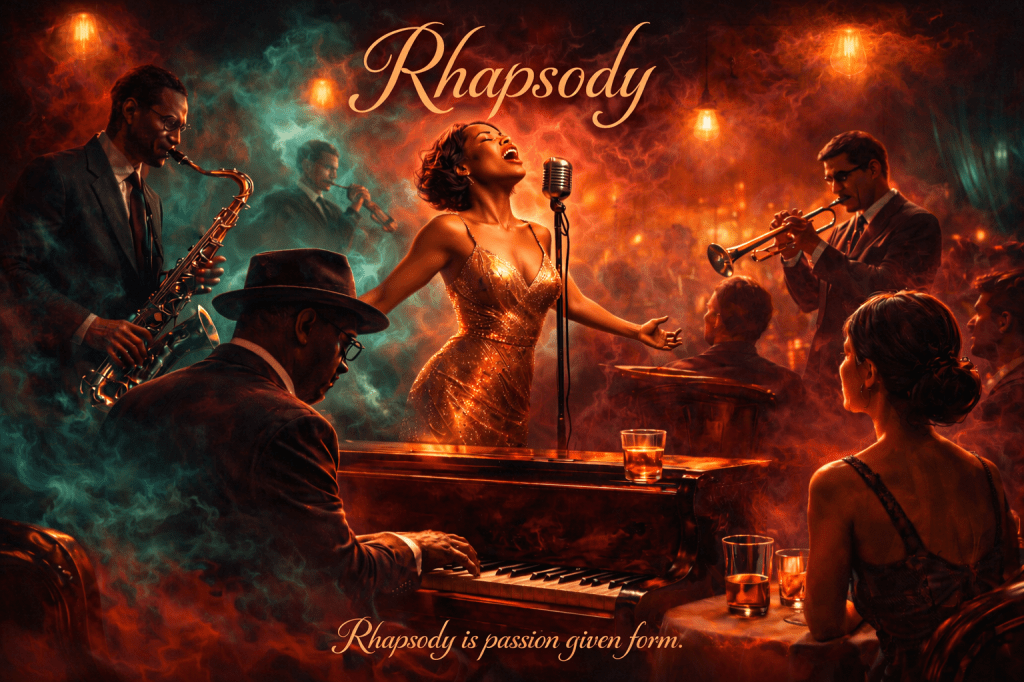
Rhapsody
IPA Pronunciation: /ˈræp.sə.di/
Part of Speech: Noun
Origin
Rhapsody belongs to the vocabularies of music, poetry, literary history, and emotional expression. It refers to an exalted, highly emotional utterance — or a musical composition marked by freedom, passion, and episodic structure.
In antiquity, the term described the performances of wandering reciters who stitched together epic poetry. In later centuries, it came to signify artistic forms that feel spontaneous, expansive, and emotionally surging.
Rhapsody is passion given form.
Etymology
From Greek: rhaptein — to stitch
- ōdē — song
Literally: “stitched song.”
Originally describing epic recitations (notably of works attributed to Homer), the term later evolved to denote heightened emotional or musical expression.
Core Definitions
Musical Composition
A free-form instrumental piece characterized by contrasting moods and themes.
“He composed a rhapsody for piano.”
Exalted Expression
An outburst of enthusiastic or ecstatic speech.
“She spoke in a rhapsody of praise.”
Epic Recitation (Historical)
A section of an epic poem performed aloud.
“The rhapsody recounts a heroic episode.”
Explanation & Nuance
Rhapsody suggests intensity without strict structure.
In music, it often includes:
Sweeping melodies
Sudden contrasts
Improvisatory feel
National or folk themes
Emotional climax
In speech or writing, it implies:
Overflowing enthusiasm
Ecstatic praise
Unrestrained feeling
Lyrical abandon
A rhapsody moves in waves rather than lines.
Musical Significance
In the Romantic era, composers embraced the rhapsody as a form that privileged expression over symmetry.
Notable examples include:
Rhapsody in Blue by George Gershwin
Hungarian Rhapsodies by Franz Liszt
These works blend formal technique with sweeping emotional breadth.
The rhapsody resists confinement while remaining intentional.
Literary & Emotional Dimension
As a rhetorical term, rhapsody describes speech that exceeds moderation.
It may be:
Joyful
Ecstatic
Romantic
Patriotic
Mystical
The word implies emotional overflow — language lifted beyond restraint.
Symbolic Dimensions
Wave — emotional surge
Thread — stitched fragments
Fire — intensity of feeling
Skyline — peaks and valleys
Songbird — spontaneous melody
Rhapsody symbolizes the art of exuberance.
Synonyms & Near-Relations
Ode — formal praise poem
Eulogy — celebratory speech
Ecstasy — overwhelming joy
Aria — expressive solo piece
Improvisation — spontaneous creation
(Only rhapsody specifically suggests stitched-together intensity and episodic emotional movement.)
Conceptual Relations
Expression — outward emotion
Romanticism — emphasis on feeling
Improvisation — freedom within art
Exaltation — heightened state
Narrative Flow — episodic structure
Cultural & Intellectual Resonance
Music
Represents freedom within compositional tradition.
Literature
Describes lyrical or ecstatic language.
Psychology
Captures moments of emotional overflow.
Aesthetics
Explores balance between structure and spontaneity.
Takeaway
Rhapsody names the surge —
the stitched song rising in waves.
It reminds us that art can move without strict design,
that emotion can organize itself into beauty,
and that intensity,
when shaped,
becomes music.
A rhapsody is not chaos.
It is passion arranged —
threaded through sound,
lifted into voice,
and carried
beyond restraint.
When emotion overflows, it sings in rhapsody.
 Word of the Day - The English Nook
Leave a comment