
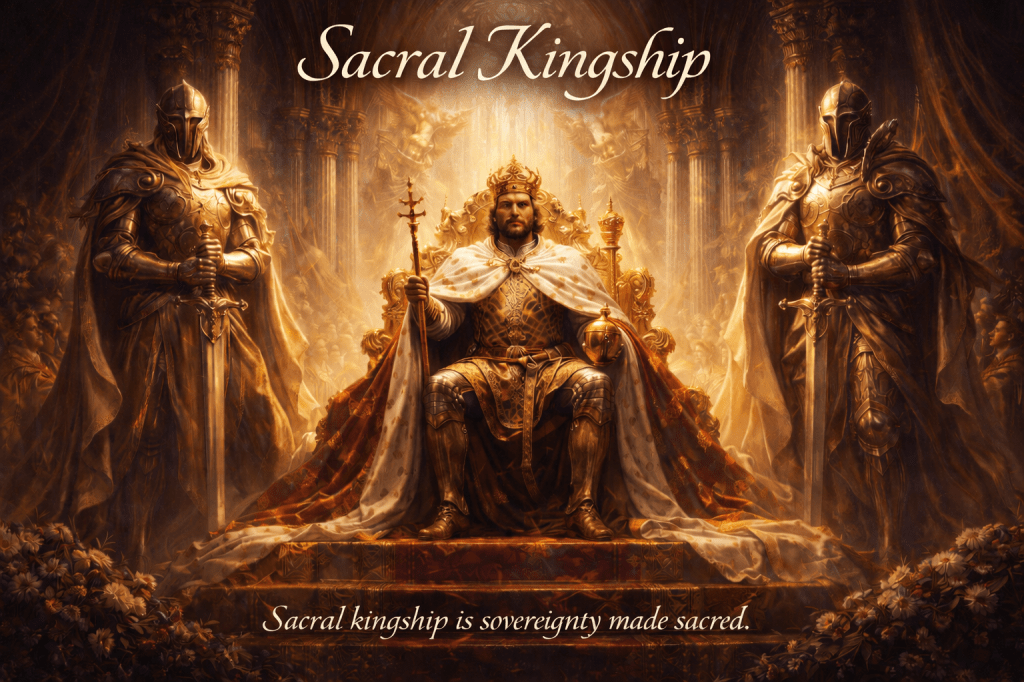
Sacral Kingship
IPA Pronunciation: /ˈseɪ.krəl ˈkɪŋ.ʃɪp/
Part of Speech: Noun phrase • Anthropological / Political Term
Origin
Sacral Kingship belongs to the vocabularies of anthropology, comparative religion, political theology, and early state formation. It refers to a system in which a ruler’s authority is understood as sacred, divine, or cosmically ordained — not merely political but spiritual in foundation.
In such systems, the king is not only governor but mediator between human society and the divine order.
Sacral kingship is sovereignty made sacred.
Etymology
From Latin: sacer — holy, consecrated
- Old English: cyning — king
- -ship — state or condition
Literally: the condition of sacred rulership.
The term preserves the idea that power may derive legitimacy from the sacred realm.
Core Definitions
Divinely Sanctioned Rule
A form of monarchy justified by religious authority.
“The dynasty claimed sacral kingship.”
Ritual Sovereignty
Kingship involving priestly or mediating functions.
“The ruler performed rites central to sacral kingship.”
Cosmic Representation
A system where the king embodies or reflects divine order.
“The king symbolized cosmic balance.”
Explanation & Nuance
Sacral kingship differs from secular monarchy in that political authority is inseparable from religious meaning.
The ruler may be:
Considered divine
Descended from gods
Chosen by deity
Anointed through sacred ritual
Guardian of cosmic harmony
The king’s health, fertility, or moral state is often believed to affect the land itself.
In some traditions, the king is a god.
In others, he is the god’s deputy.
In all cases, rule is cosmologically grounded.
Structural Characteristics
Common elements include:
Coronation rituals
Anointing or consecration
Priestly functions
Sacred regalia
Myths of divine ancestry
Taboos surrounding the ruler’s body
Kingship becomes liturgy enacted in governance.
Historical Examples
Forms of sacral kingship appeared across cultures:
Ancient Egyptian pharaohs
Mesopotamian god-kings
Medieval European “divine right” monarchies
Shinto-linked imperial authority in Japan
Various African and Southeast Asian sacred monarchies
In some cases, rulers were believed to maintain cosmic balance through ritual performance.
Anthropological Dimension
Scholars such as James George Frazer examined sacral kingship in comparative mythology, particularly in The Golden Bough, exploring themes of:
Ritual kingship
Fertility symbolism
Sacrificial succession
Seasonal renewal
Later theorists reinterpreted these ideas with greater nuance, but the framework remains foundational in studying early political religion.
Political-Theological Significance
Sacral kingship blurs boundaries between:
Religion and governance
Ritual and law
Cosmos and state
Myth and administration
Authority is not merely enforced — it is believed.
The king becomes:
Axis mundi — symbolic world center
Embodied law
Living covenant
Guardian of order
Symbolic Dimensions
Crown — visible sign of divine mandate
Throne — seat of cosmic stability
Anointing Oil — sanctified legitimacy
Sun — radiating authority
Body of the King — microcosm of the realm
Sacral kingship symbolizes power as sacred trust rather than contractual office.
Synonyms & Near-Relations
Divine Kingship — god-identified ruler
Theocratic Monarchy — rule grounded in religion
God-King — deified sovereign
Anointed Rule — sanctified authority
Divine Right — theological justification
(Only sacral kingship emphasizes the anthropological structure of sacred authority embodied in the ruler.)
Conceptual Relations
Legitimacy — foundation of authority
Myth — narrative grounding power
Ritual — performative renewal of sovereignty
Cosmic Order — harmony between heaven and earth
Political Theology — intersection of faith and governance
Cultural & Intellectual Resonance
Comparative Religion
Central to understanding ancient state formation.
Political Theory
Illustrates pre-modern foundations of legitimacy.
Myth Studies
Explores the symbolic body of the ruler.
Modern Reflection
Echoes in constitutional symbolism and ceremonial monarchy.
Takeaway
Sacral kingship names the fusion of throne and altar —
where governance is not merely administrative,
but cosmological.
It reminds us that power has often drawn its strength
from myth,
from ritual,
from belief.
In sacral kingship,
the ruler does not only command.
He represents.
He mediates.
He embodies the fragile bridge
between heaven and earth.
When the throne becomes an altar, power turns sacred.
 Word of the Day - The English Nook
Leave a comment