
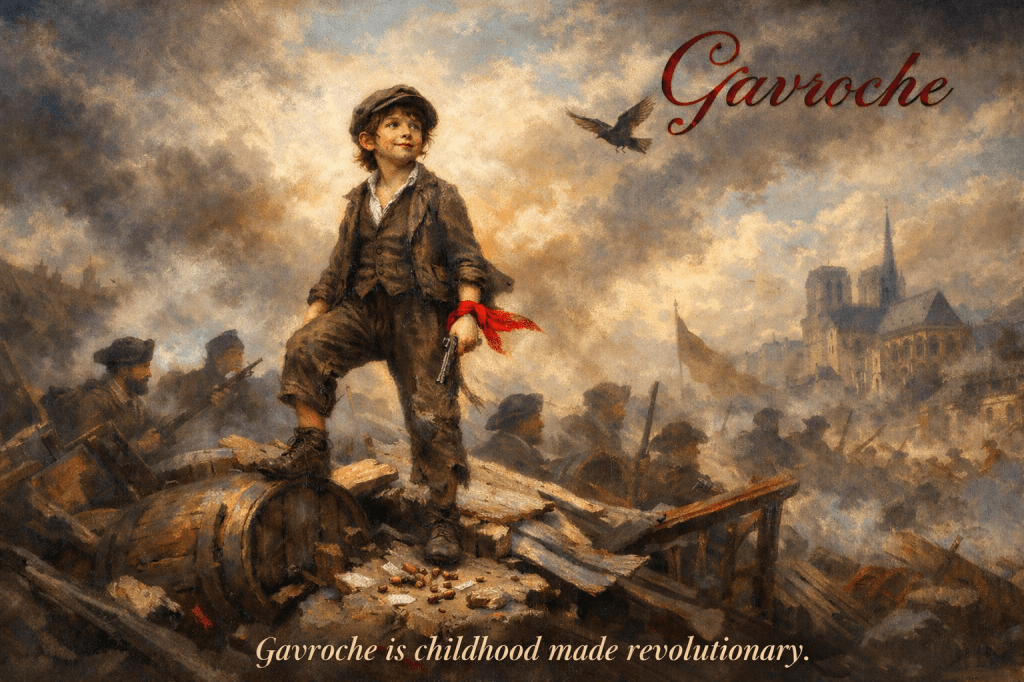
Gavroche
IPA Pronunciation: /ɡævˈrɒʃ/ (English) • /ɡav.ʁɔʃ/ (French)
Part of Speech: Proper Noun • Literary Character
Origin
Gavroche belongs to the vocabularies of literary history, revolutionary symbolism, and French cultural memory. He is a street urchin character in Les Misérables by Victor Hugo.
Though young, impoverished, and socially invisible, Gavroche embodies defiance, wit, and moral courage. He represents the resilient spirit of the Parisian underclass during the June Rebellion of 1832.
Gavroche is childhood made revolutionary.
Etymology
The name “Gavroche” likely derives from French slang associated with cheekiness or roguishness. It suggests:
Impudence
Street cleverness
Playful insolence
The name itself carries the rhythm of mischief.
Core Definitions
Literary Character
A bold, witty Parisian boy who participates in the uprising.
“Gavroche sings on the barricade.”
Symbol of Revolutionary Youth
Embodiment of courage among the oppressed.
“Gavroche stands for fearless innocence.”
Archetype
The cheerful yet tragic street child.
“He’s a modern Gavroche.”
Explanation & Nuance
Gavroche is not merely comic relief. He is:
Resourceful
Independent
Defiant
Compassionate
Unsentimental
Despite neglect and poverty, he retains humor and generosity. He mocks authority, sings in danger, and treats revolution as both game and destiny.
His bravery is instinctive rather than ideological.
Gavroche does not theorize justice — he lives it.
Narrative Role
Within Les Misérables, Gavroche functions as:
Witness to inequality
Voice of Parisian streets
Bridge between innocence and revolt
Moral counterpoint to adult corruption
His most famous scene — gathering ammunition under gunfire — transforms him into a symbol of youthful sacrifice.
Symbolic Dimensions
Barricade — threshold between childhood and history
Song — courage expressed through joy
Street — society’s neglected ground
Bullet — cost of defiance
Laughter — resistance through spirit
Gavroche symbolizes the uncrushable dignity of the poor.
Psychological Dimension
Gavroche embodies paradox:
Childhood without protection
Humor without safety
Freedom without security
Defiance without fear
He reveals how resilience can emerge from abandonment — and how innocence can coexist with political violence.
Cultural Significance
Gavroche became an enduring emblem in French cultural imagination:
Street-smart independence
Urban revolutionary spirit
Youthful defiance of injustice
The character gained further international recognition through stage and screen adaptations, particularly the musical Les Misérables.
Examples in Context
Literary:
“Gavroche darts between the barricades.”
Descriptive:
“The boy had a Gavroche grin.”
Political:
“He spoke with Gavroche boldness.”
Metaphorical:
“Every revolution has its Gavroche.”
Reflective:
“Gavroche dies singing.”
Synonyms & Near-Relations
Urchin — street child
Revolutionary Youth — political adolescent
Ragamuffin — mischievous child
Waif — abandoned child
Trickster — playful defier of authority
(Only Gavroche specifically denotes Hugo’s iconic street child turned symbol of resistance.)
Conceptual Relations
Innocence — moral clarity amid chaos
Revolution — upheaval born from injustice
Class — poverty and exclusion
Courage — action despite vulnerability
Sacrifice — youth confronting power
Cultural & Intellectual Resonance
Literature
One of the most memorable child figures in 19th-century fiction.
Political Symbolism
Represents the overlooked participants of historical change.
Urban Mythos
Personifies the spirit of Paris’s working-class neighborhoods.
Humanism
Illustrates Hugo’s belief in dignity within the marginalized.
Takeaway
Gavroche names the boy who laughs at gunfire —
who stands small against history
yet refuses to bow.
He reminds us that courage is not measured by age,
that poverty does not erase pride,
and that revolutions are carried
not only by leaders,
but by children
who refuse to be silent.
Gavroche is not merely a character.
He is the street’s heartbeat —
singing against the sound of rifles.
Small in stature, immense in spirit—Gavroche sings where history fires.
 Word of the Day - The English Nook
Leave a comment