
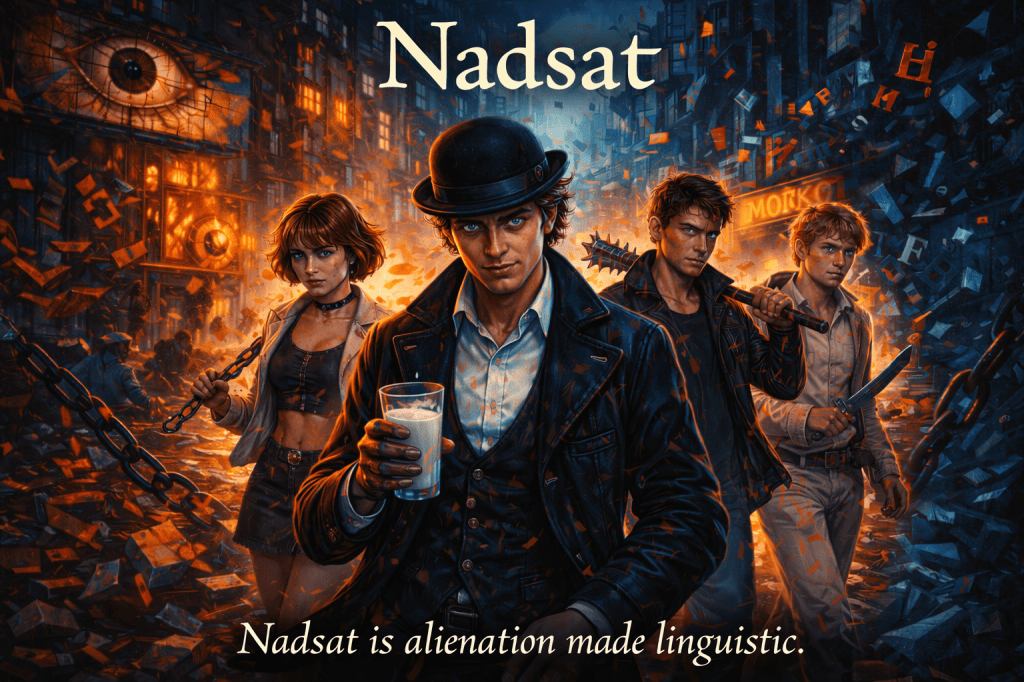
Nadsat
IPA Pronunciation: /ˈnæd.sæt/
Part of Speech: Noun (Proper Noun • Linguistic Term)
Origin
Nadsat belongs to the vocabularies of literary linguistics, dystopian fiction, and constructed slang. It refers to the fictional argot spoken by teenage characters in the novel A Clockwork Orange by Anthony Burgess.
In the novel, Nadsat functions as both stylistic device and psychological filter, shaping how readers experience violence, youth culture, and moral ambiguity.
Nadsat is alienation made linguistic.
Etymology
From Russian suffix: -надцать (-nadtsat’) — meaning “-teen” (as in thirteen, fourteen, etc.)
The name implies teenage speech — language belonging to adolescence.
The term suggests both youth identity and numerical boundary.
Core Definitions
Fictional Slang Dialect
A constructed sociolect blending English with Russian-derived vocabulary.
“The narrator speaks in Nadsat.”
Narrative Device
A linguistic filter distancing readers from explicit violence.
“Nadsat softens and stylizes brutality.”
Cultural Marker
A language signaling in-group identity and generational rebellion.
“Nadsat defines the youth subculture.”
Explanation & Nuance
Nadsat is not a full language but a hybrid slang system. It incorporates:
Russian loanwords
Anglicized spellings
Cockney rhyming slang
Invented compounds
Archaic or stylized expressions
Examples include:
Droog — friend (from Russian drug)
Moloko — milk
Devotchka — girl
Gulliver — head
Horrorshow — good (from Russian khorosho)
The language feels foreign yet gradually becomes intelligible through context.
Nadsat trains the reader to translate.
Literary Function
Nadsat serves multiple purposes:
Defamiliarization — making the familiar strange
Moral Buffer — distancing readers from violence
Immersion — placing readers inside youth perspective
Satire — exaggerating generational separation
Identity Coding — marking insider versus outsider
By forcing readers to decode meaning, Burgess implicates them in the narrative world.
Psychological Effect
Nadsat alters perception:
Violence sounds stylized rather than raw.
Cruelty feels rhythmic rather than blunt.
Brutality becomes linguistically mediated.
This creates tension between:
Aesthetic pleasure in language
Moral discomfort in action
The reader’s gradual fluency mirrors complicity.
Cultural Significance
Nadsat became one of the most recognizable fictional slangs in modern literature.
It influenced:
Dystopian fiction
Youth subculture aesthetics
Linguistic experimentation in novels
Discussions of language and power
It remains a prominent example of how invented language shapes narrative ethics.
Examples in Context
Literary:
“Nadsat immerses the reader in adolescent consciousness.”
Analytical:
“The use of Nadsat complicates moral judgment.”
Descriptive:
“The dialogue unfolds entirely in Nadsat.”
Critical:
“Nadsat distances and seduces simultaneously.”
Reflective:
“Fluency in Nadsat changes the reading experience.”
Symbolic Dimensions
Code — language as boundary
Mask — speech concealing intention
Mirror — youth culture reflected in slang
Barrier — separation from authority
Rhythm — violence stylized into cadence
Nadsat symbolizes how language can both reveal and obscure reality.
Synonyms & Near-Relations
Argot — specialized group language
Sociolect — speech of a social group
Cant — coded vocabulary
Constructed Slang — invented vernacular
Idiolect — individual speech pattern
(Only Nadsat specifically denotes the fictional teenage argot of A Clockwork Orange.)
Conceptual Relations
Defamiliarization — estranging technique
Youth Identity — generational distinction
Violence — mediated through language
Narrative Voice — shaping reader perception
Linguistic Relativity — language shaping thought
Cultural & Intellectual Resonance
Literary Modernism & Postmodernism
Demonstrates experimentation with voice and reader immersion.
Sociolinguistics
Illustrates how slang creates in-groups and exclusion.
Philosophy of Language
Explores how vocabulary reframes moral perception.
Film Adaptation
Further popularized through A Clockwork Orange, directed by Stanley Kubrick.
Takeaway
Nadsat names the language of adolescence imagined as code —
a dialect that distances, seduces, and unsettles.
It reminds us that words shape moral experience,
that fluency can breed familiarity,
and that language is never neutral.
Nadsat is not merely slang.
It is a filter,
a mask,
a mirror —
a vocabulary that makes violence rhythmic
and forces the reader
to learn the sound of another world.
Nadsat is not just slang—it is a lens that makes language beautiful and brutality disturbingly fluent.
 Word of the Day - The English Nook
Leave a comment