
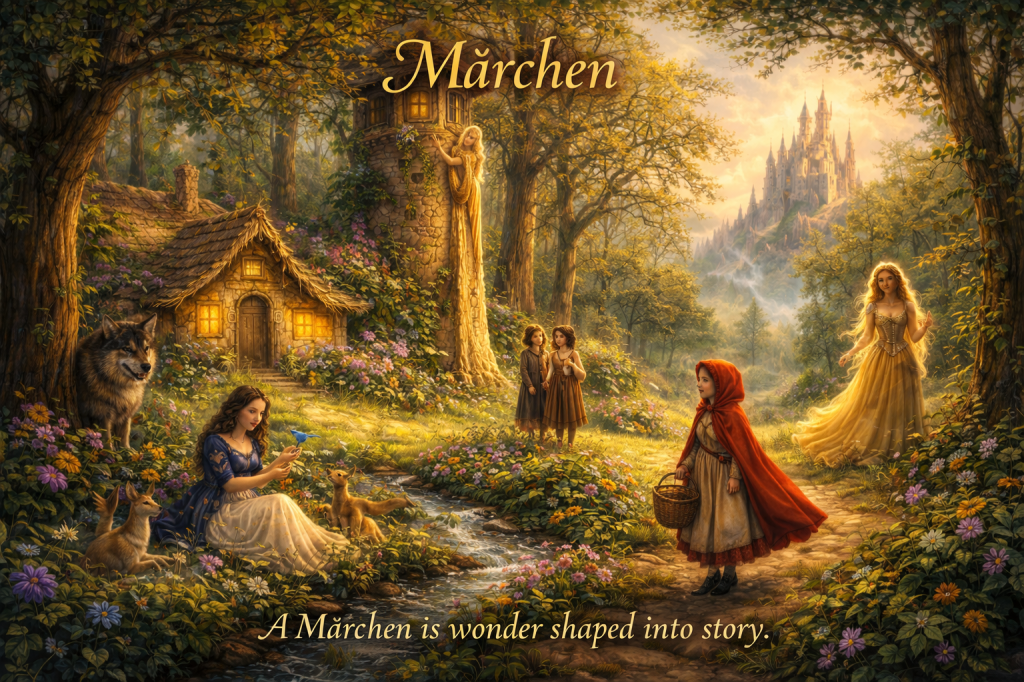
Märchen
IPA Pronunciation: /ˈmɛːɐ̯.çən/ (German) • /ˈmɛr.kən/ or /ˈmɛər.kən/ (English approximation)
Plural: Märchen (unchanged)
Part of Speech: Noun (neuter in German: das Märchen)
Origin
Märchen belongs to the vocabularies of folklore, literary studies, and German Romanticism. It refers to a traditional fairy tale — a short narrative involving magical elements, archetypal characters, and moral or symbolic structure.
The term is most closely associated with the collections of Brothers Grimm, whose 19th-century compilations shaped the modern understanding of the European fairy tale tradition.
A Märchen is wonder shaped into story.
Etymology
From Middle High German: mære — tale, report, news
Diminutive suffix: -chen — little
Literally: “little tale”
The word preserves the sense of something small in form yet expansive in imagination.
Core Definitions
Fairy Tale
A traditional folk narrative involving magic or the supernatural.
“She grew up reading Märchen.”
Folkloric Narrative Form
A story transmitted orally before literary collection.
“The Märchen follows a classic quest pattern.”
Symbolic Tale
A simple narrative carrying archetypal meaning.
“The novel echoes the structure of a Märchen.”
Explanation & Nuance
A Märchen differs from a legend or myth.
It is typically:
Timeless — “Once upon a time”
Placeless — undefined kingdoms or forests
Archetypal — kings, witches, youngest sons
Magical — enchantments, transformations
Moral — justice ultimately restored
Unlike myth, it does not claim sacred truth.
Unlike legend, it does not claim historical grounding.
A Märchen exists in narrative suspension — outside ordinary reality, yet emotionally recognizable.
Structural Characteristics
Common elements include:
The rule of three (three trials, three siblings)
Transformation (beast to prince, rags to royalty)
Magical helpers (animals, spirits, objects)
Clear moral polarity (good versus evil)
Reward and restoration
Its language is often simple, its structure precise, its symbolism deep.
Psychological Dimension
In depth psychology — particularly in the work of Carl Jung — Märchen are understood as expressions of collective archetypes.
They externalize inner conflicts:
Fear of abandonment
Desire for recognition
Rite of passage
Struggle with shadow
Integration of identity
A Märchen dramatizes psychological growth through symbolic narrative.
Cultural Significance
Märchen influenced:
European Romanticism
Children’s literature
Modern fantasy fiction
Operatic and theatrical traditions
National folklore identity
Though often associated with children, many original Märchen are dark, complex, and psychologically layered.
Examples in Context
Literary:
“The story reads like a Märchen.”
Academic:
“Märchen follow identifiable structural motifs.”
Descriptive:
“The castle looked lifted from a Märchen.”
Critical:
“The novel deconstructs the traditional Märchen.”
Metaphorical:
“Their romance felt like a Märchen.”
Symbolic Dimensions
Forest — the unknown self
Mirror — identity and recognition
Spell — binding force of fate
Journey — maturation through ordeal
Crown — earned transformation
Märchen symbolize inner change told through outer magic.
Synonyms & Near-Relations
Fairy Tale — general English term
Folktale — broader category
Fable — moral animal tale
Myth — sacred origin narrative
Legend — quasi-historical tale
(Only Märchen specifically denotes the Germanic fairy-tale tradition characterized by archetypal magic and narrative simplicity.)
Conceptual Relations
Archetype — recurring symbolic pattern
Oral Tradition — transmission through speech
Transformation — central motif
Initiation — passage into maturity
Imagination — creative symbolic space
Cultural & Intellectual Resonance
Folklore Studies
A foundational category in narrative classification systems.
Literary Theory
Analyzed for structure, symbolism, and universality.
Psychology
Interpreted as narrative expressions of unconscious processes.
Fantasy Literature
Serves as the root template for modern magical storytelling.
Takeaway
Märchen names the small tale that carries immense weight —
a story simple in surface,
vast in meaning.
It reminds us that magic can express truth,
that forests conceal growth,
and that transformation often begins
with a single step into the unknown.
A Märchen is not merely a fairy tale.
It is a symbolic map,
drawn in wonder,
guiding the listener
from innocence
through darkness
toward return.
A Märchen is a small tale that carries the architecture of wonder.
 Word of the Day - The English Nook
Leave a comment