
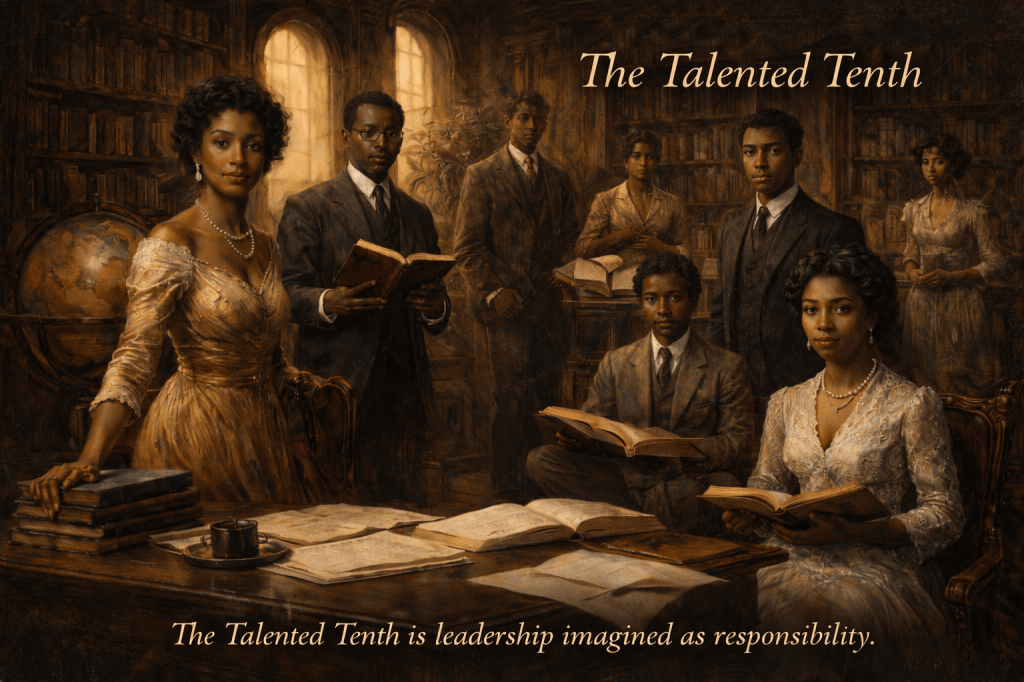
Talented Tenth
IPA Pronunciation: /ˈtæl.ən.tɪd tɛnθ/
Part of Speech: Noun phrase • Historical / Sociological Term
Origin
Talented Tenth belongs to the vocabularies of African American intellectual history, education theory, and social philosophy. It refers to the idea that roughly ten percent of a population — specifically the most educated and capable — can uplift the whole community through leadership, scholarship, and civic influence.
The concept was most prominently articulated in 1903 by W. E. B. Du Bois, who argued that cultivating an educated Black elite would accelerate social progress and racial equality in the United States.
The Talented Tenth is leadership imagined as responsibility.
Etymology
From English:
Talented — possessing exceptional ability
Tenth — one part out of ten
The phrase expresses both a proportion and a philosophy: that a minority of trained minds can shape collective destiny.
Core Definitions
Educational Philosophy
The belief that educating a select intellectual minority benefits the entire community.
“Du Bois advocated developing the Talented Tenth.”
Social Leadership Class
An elite group expected to guide social progress.
“The Talented Tenth were seen as cultural leaders.”
Historical Concept
An early 20th-century strategy for racial advancement.
“The policy drew from the Talented Tenth idea.”
Explanation & Nuance
The Talented Tenth was not meant simply to privilege elites. In its original formulation, it implied obligation rather than superiority.
Members were expected to:
Serve their communities
Promote justice
Educate others
Advocate reform
Model excellence
The idea assumes that influence radiates outward: education in a few generates opportunity for many.
The Talented Tenth is excellence linked to duty.
Intellectual Context
The concept emerged during debates among Black thinkers about the most effective path to equality after Reconstruction.
One major contrast was between:
Classical higher education advocates — emphasizing intellectual leadership
Industrial education advocates — emphasizing vocational skills
Du Bois’s formulation responded partly to the ideas of Booker T. Washington, who prioritized practical training and gradual economic advancement.
Thus, the Talented Tenth represents one side of a foundational philosophical debate about education and social change.
Social Theory Dimension
The concept rests on several assumptions:
Leadership shapes culture
Education multiplies influence
Ideas precede reform
Role models transform expectations
It reflects a broader sociological principle: small groups often drive large historical shifts.
Historical Significance
The Talented Tenth influenced:
Black educational institutions
Civil rights leadership models
Professional class formation
Intellectual movements
Political organizing
Many prominent figures of the early civil rights era were educated under institutions shaped by this philosophy.
Examples in Context
Historical:
“Du Bois described the Talented Tenth as race leaders.”
Educational:
“The program aimed to cultivate a modern Talented Tenth.”
Analytical:
“The theory assumes social change flows from elites.”
Critical:
“Some scholars question the Talented Tenth model.”
Reflective:
“She saw education as a path into the Talented Tenth.”
Symbolic Dimensions
Torchbearers — guiding others forward
Keystone — small piece holding structure
Seed Group — growth beginning in few
Lighthouse — illumination for many
Vanguard — advance guard of change
The Talented Tenth symbolizes concentrated potential directed toward collective uplift.
Synonyms & Near-Relations
Intellectual Elite — educated minority
Vanguard — leading group
Leadership Class — guiding stratum
Meritocracy — ability-based hierarchy
Avant-garde — forward thinkers
(Only Talented Tenth specifically denotes the historical philosophy linking elite education to racial progress.)
Conceptual Relations
Education — engine of advancement
Responsibility — privilege paired with duty
Representation — leadership visibility
Equity — goal of social uplift
Agency — capacity to enact change
Cultural & Intellectual Resonance
Civil Rights Thought
One of the foundational theories of Black leadership and advancement.
Educational Philosophy
Influential in debates about access versus excellence.
Sociology
Illustrates how elite formation shapes group trajectories.
Political Theory
Raises questions about democracy, merit, and representation.
Takeaway
Talented Tenth names the idea that progress can begin with a few —
that cultivated minds can become catalysts for collective transformation.
It reminds us that education is not only personal elevation,
that talent can be responsibility,
and that leadership, at its best,
is a form of service.
The Talented Tenth is not merely a percentage.
It is a proposition:
that when knowledge rises in some,
possibility rises for all.
Not an elite of privilege, but an elite of responsibility.
 Word of the Day - The English Nook
Leave a comment