
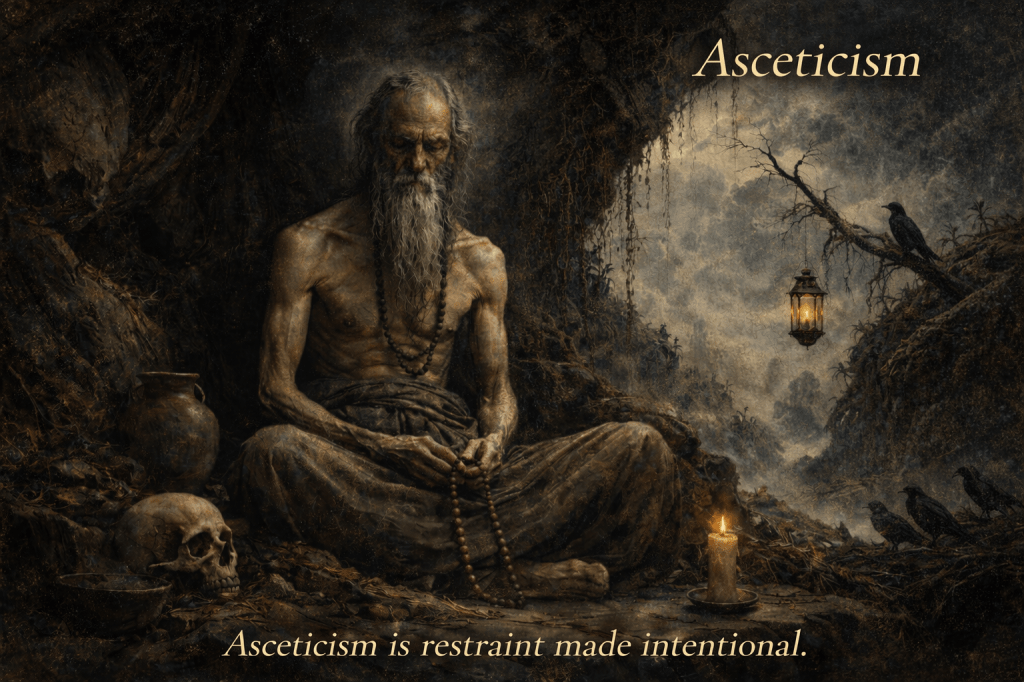
Asceticism
IPA Pronunciation: /əˈsɛt.ɪ.sɪ.zəm/
Part of Speech: Noun
Origin
Asceticism belongs to the vocabularies of philosophy, religion, ethics, and psychology. It refers to a disciplined way of life characterized by self-denial, restraint, and voluntary simplicity undertaken for spiritual, moral, or intellectual development.
Historically associated with monastics, sages, and seekers, asceticism is less about rejecting the world than refining one’s relationship to it. It treats desire not as an enemy, but as a force to be trained.
Asceticism is restraint made intentional.
Etymology
From Greek: askēsis — exercise, training, disciplined practice
From askein — to train or practice
Originally used for athletic training, the term later came to describe spiritual discipline — preserving the idea that the self can be shaped through effort.
Core Definitions
Spiritual Discipline
A lifestyle of self-denial practiced for moral or religious goals.
“He embraced asceticism in the monastery.”
Philosophical Practice
Voluntary simplicity aimed at clarity or freedom.
“Her asceticism sharpened her focus.”
Renunciatory Lifestyle
Intentional rejection of comfort or luxury.
“The sage lived in asceticism.”
Explanation & Nuance
Asceticism is not mere deprivation; it is structured restraint directed toward transformation.
An ascetic practice may involve:
Fasting
Silence
Celibacy
Solitude
Minimal possessions
Meditation
The intention is not punishment but purification — of attention, desire, or perception.
Asceticism seeks mastery over impulse rather than indulgence in it.
Motivations for Ascetic Practice
People adopt ascetic disciplines for different aims:
Spiritual — union with the divine
Philosophical — freedom from attachment
Psychological — clarity and focus
Ethical — rejection of excess
Political — protest against materialism
Thus, asceticism is not a single doctrine but a family of practices united by restraint.
Historical Significance
Ascetic traditions appear across cultures and religions:
Christian monastics
Buddhist monks
Hindu sannyasis
Stoic philosophers
Desert hermits
Though doctrines differ, they share a belief that limitation can produce liberation.
Psychological Dimension
Asceticism explores a paradox:
Reducing external stimuli can expand internal awareness.
It often leads practitioners to experience:
Heightened perception
Emotional steadiness
Reduced anxiety about loss
Greater intentionality
The practice suggests that abundance may distract while simplicity reveals.
Examples in Context
Religious:
“Asceticism shaped his daily rituals.”
Philosophical:
“The school advocated intellectual asceticism.”
Descriptive:
“The room’s asceticism reflected her values.”
Historical:
“Asceticism defined the order’s discipline.”
Metaphorical:
“His prose shows stylistic asceticism.”
Symbolic Dimensions
Empty Bowl — openness to receive
Bare Room — clarity without clutter
Straight Path — discipline of direction
Flame — purified energy
Stone — endurance through restraint
Asceticism symbolizes strength expressed through limitation.
Synonyms & Near-Relations
Austerity — strict simplicity
Self-denial — renunciation of pleasure
Abstinence — refraining from indulgence
Minimalism — reduction of excess
Discipline — controlled practice
(Only asceticism specifically implies voluntary restraint pursued as a transformative path.)
Conceptual Relations
Desire — force to be regulated
Freedom — independence from craving
Focus — attention sharpened by simplicity
Willpower — strength of intention
Transcendence — rising beyond impulse
Cultural & Intellectual Resonance
Religion
Central to monastic and contemplative traditions worldwide.
Philosophy
Explored as a method of ethical self-formation.
Psychology
Studied for its effects on habit, impulse, and cognition.
Art & Literature
Used metaphorically for stylistic restraint or purity of form.
Takeaway
Asceticism names the discipline of choosing less —
not from lack,
but from intention.
It reminds us that freedom can come from limits,
that desire can be trained,
and that silence can be fuller than noise.
Asceticism is the art of subtraction,
the practice of deliberate simplicity,
and the quiet conviction
that mastery begins
where excess ends.
Less as a loss, but as a language of inner mastery.
 Word of the Day - The English Nook
Leave a comment